Iconic Vintage Part 4, the last half of the alphabet. We love vintage from everywhere. Part 3 celebrated Iconic Vintage starting with letters A – M. This part takes on N-Z. Finding things for each letter of the alphabet isn’t as easy as we thought it would be when we hatched this scheme. But so far we’ve managed. What things would you choose? We’d love to hear. But in the meantime, here is the second half of our iconic vintage celebration.
N is for Noritake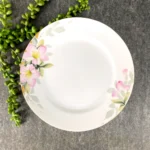
Noritake is a Japanese company that produces fine china and decor. Following the 1889 Paris Exhibition, the company owners decided to create china similar to the fine French white porcelain china they had seen, but at more affordable prices for the American market. It took a while to establish factories and refine the product, but by 1914, they started exporting dinnerware. The price point and quality made Noritake a popular choice as wedding china. How old a piece is can be determined by checking the backstamp. Read a more complete company history and explore backstamps here. Featured: Northern Azelea salad plates (4)
O is for Original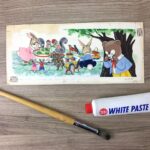
How can you know if you have an original illustration or a print? Get out your magnifying glass and look at it up close. Is the image solid or a series of tiny dots? Can you see brush marks? If you can see brush marks and the image is solid, you have an original. Featured: Original Illustration from “Around the Corner” Early Reader
P is for Photograph
Your family photographs and what you might collect are amazing slices of life, people and places captured on film and then paper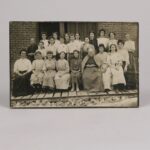 over 130 years. Please write in pencil on the backs of family photos, the year, the people and perhaps even the event. This way you will leave a valuable archive to the next generation. When these photos are shared, I can almost hear “You are the spit and image of your great aunt!” or “That’s the exact way my grandfather would sit!” When you collect photographs taken by strangers, deciding on a theme will focus your attention on that collection. If only these New England factory girls were identified and the company name and location was penciled on the back of this wonderful piece of history, we would have been able to research each of their lives.
Q is for Quartz 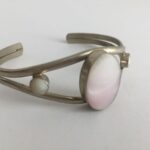
Citrine, Amethyst, Chalcedony, and Prasiolite are all types of quartz. Quartz has been used for centuries and was once thought to be ice frozen in rock form. Used in jewelry, it comes in many varieties and is considered a semi-precious gemstone. Used in the electronics industry as well as construction such as countertops. Almost all quartz used in industry is now synthetic. Leaving the natural crystal rock to the artists and jewelers. Featured: Mexican Silver and Pink Quartz Bracelet
R is for Rhinestone 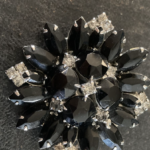
The story goes that the word “rhinestone” comes from rock crystals originally found in the Rhine river. Whether that is true or not is unknown. What we do know is that rhinestones were created so that those who could not afford precious gemstones could afford similar looks. The use of this colored glass dates to the 13th century. Sometimes called paste or diamante, rhinestones come in all shapes and sizes and are found on costumes, clothing, accessories, jewelry, and even cosmetic supplies. Made of glass and colored and using various metal coatings changes the look such as aurora borealis, or foiled backs. Synthetic plastics are also used to create faux stones to lighten the weight on large items like costumes and clothing. Featured: Black Rhinestone Starburst Brooch
S is for Snuff Box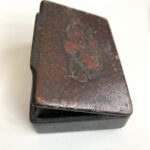
Before the days of cigarettes, tobacco was used in powder form and placed in little decorative boxes. The powder was known as snuff, hence the name of the boxes. This snuff box was most likely owned by someone who was of the working class. It’s made of wood and features a lovely design on the top of the box. Featured: Victorian Era Wooden Snuff Box
T is for Tape Measure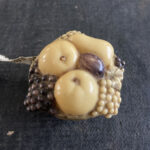
In the days before ready-to-wear clothing, a sewing tape measure was part of every sewing kit. Because these tools of the trade were so ubiquitous they were made to resemble everyday items making them easier to identify as one’s own as well as adding a bit of fun to an often tedious task. Celluloid was a new and popular plastic invented in the mid-1800s and was used for many of these tape measures as it was inexpensive and easy to mold. Featured: Antique Celluloid Basket of Fruit Sewing Tape Measure
U is for University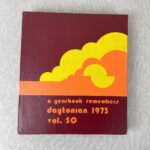
University and college yearbooks are time capsules. The way we dressed, the clubs we joined, the events we attended all deliver a slice of life as it was. For artists, they can be a treasure trove of images. For graduates of the school, they can be a historical insight. For children, they can help flesh out who their parent was in their early adulthood.
V is for Value
How do we value things? Is it what we paid for it? Is it whether it is made from precious metals or jewels? Is it the age or the story of it worthy of a movie? I am particularly interested in how the heart and memory value vintage items. Many things of very little cost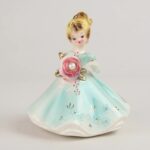 in the 1930s to 1950s at Woolworth’s or JJ Newbury’s were gifted by small loving hands add an incredible value of the gift to the recipient. I am always willing to try to find something precious that was broken or lost or only available to one sibling after a death. This little bell celebrated the birth month of someone near and dear. Perhaps it cost a quarter at the time but its value might not be calculable by today’s standards.
W is for Wood Burned 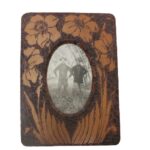
Formally known as “pyrography”, the art of producing designs on wood or leather by burning or scorching the medium with a hot instrument has been around since ancient times. Until the late 19th century, pyrography was an art form dominated by men. The invention of pyrography machines and kits for use in the home popularized the craft and made it accessible to women who were expected to beautify their homes with handiwork. Featured: Antique wood burned frame dated 1911
X is for Xerography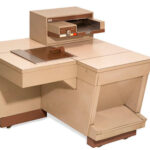
Xerography is a copying method that uses dry powder, that was invented in 1942 but was not viable commercially until 1960 when Xerox debuted the Xerox 914. It was a game-changer for offices, to understate the obvious. Xerography is still used in laser printers.
Y is for Yellowware
Yellowware (also written as yellow ware) is a type of earthenware named after the clay that gives it the yellow hue that originated in the UK in the late 1700s. It wasn’t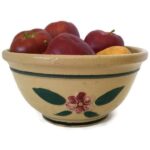 produced in volume in the US until the mid-1800s when large amounts of yellow firing clay were discovered in Ohio. Cherished for their durability, yellowware bowls, pitchers, pie plates and rolling pins were produced by companies like Brush-McCoy, Roseville, Watt and Weller and remain highly collectible today. Featured: Yellowware Watt #9 Bowl
Z is for Zell Majolica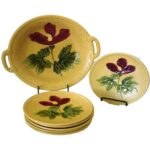
Majolica is a tin-glazed ceramic pottery that is typically decorated with colorful themes featuring flora and fauna. It was produced at factories located in the Zell region in Germany beginning in the late 1700s. The Hibiscus pattern was manufactured by the Zell Baden Pottery Co. between 1907 – 1928. Featured: Antique Zell Hibiscus Majolica Salad Set