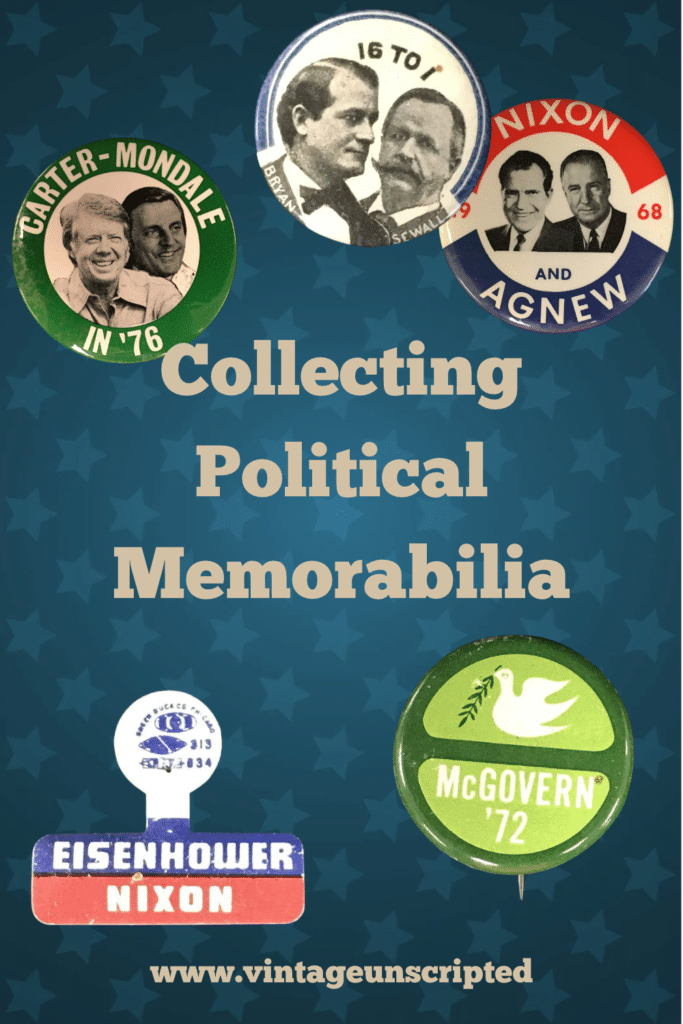
Election year campaigns bring a plethora of political merchandise. To be honest, most of it gets discarded shortly after the election happens. However, there is a group of folks who savor and collect the random bits and pieces produced to entice us to vote one way or another. These are the political memorabilia collectors. They range from those who may have a connection to a candidate to someone who collects items from a specific year, a particular candidate or cause, or any possible variety of reasons. Perhaps they may have worked on a particular campaign that started them down the collector path.
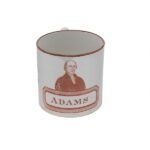
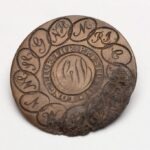
Collecting political memorabilia in the United States began with our very first President. Supporters of George Washington wore copper buttons with the initials GW stamped in the center surrounded by the words “Long live the President,” a play on words taken from the British “Long live the King.” Surrounding that was a chain of thirteen ovals, each representing one of the original colonies engraved with the colony’s initials. Thus began American political advertising. The Smithsonian has this mug with a portrait of John Adams, our 2nd President, in their collection.
Not all political memorabilia is presidential of course. Local elections produced all sorts of items as well. While we tend to think of items such as ephemera and pin back buttons, there is much more to be found and collected. From sewing boxes printed with both John Quincy Adams and his rival Andrew Jackson who won the race, to booklets, flyers, spoons, and even pipes.
The first photographic campaign button was a tintype of Abraham Lincoln with the reverse side showing his running mate Hannibal Hamlin from 1860.
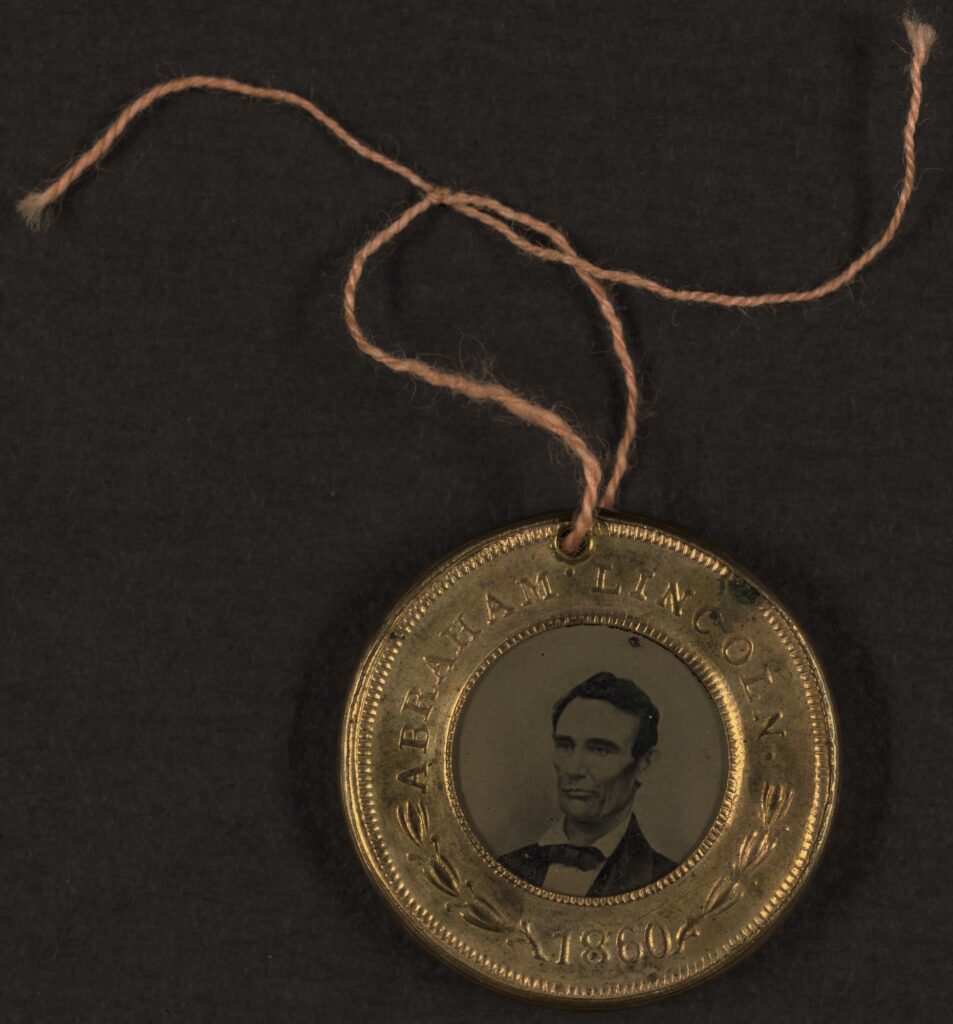
The first patent for a campaign button was granted in 1889 to Leon Witendorf and August Reymond. Their design was a hollow button with a slide that you could pull out that would display a picture. Another innovation came from Amanda Lougee in 1896, who patented a flat cloth-covered clothing button with a protective layer of celluloid that didn’t require a shank. Lougee’s button needed to be sewn on. Whitehead & Hoag, a Newark, NJ, manufacturer that was a pioneer in the area of political memorabilia, purchased Lougee’s patent because they wanted to incorporate a celluloid cover over printed paper on a metal back and could not do it without violating her patent. One of their designers, George B. Adams, added a pin mechanism on the back. They held this and other patents so tightly that for two decades, no one else could make buttons without paying them.
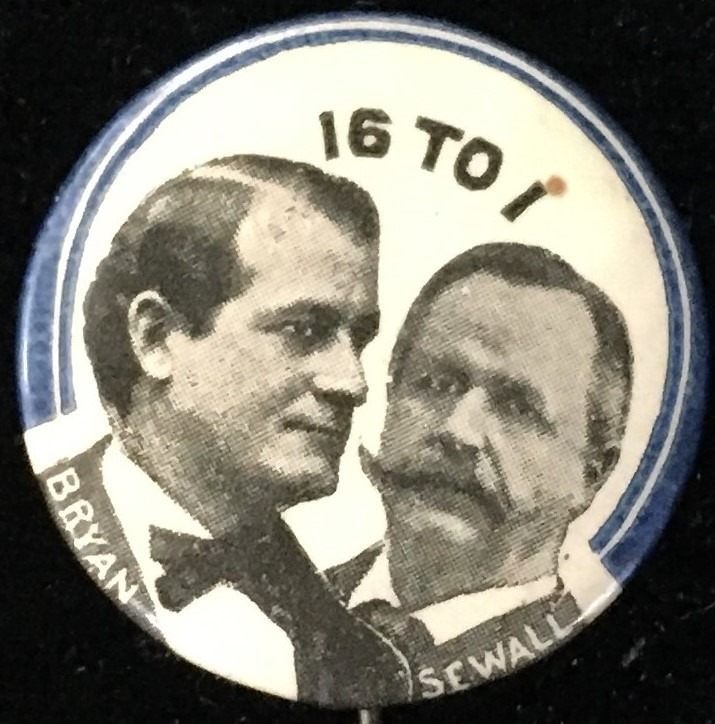
In 1916, litho printed entered the button market with printing directly on metal that was punched out with a folded tab to attach it to clothing. The style of campaign button that we are more familiar with, made of metal with rounded edges and lithographed with a spring pin back, was used in 1920.
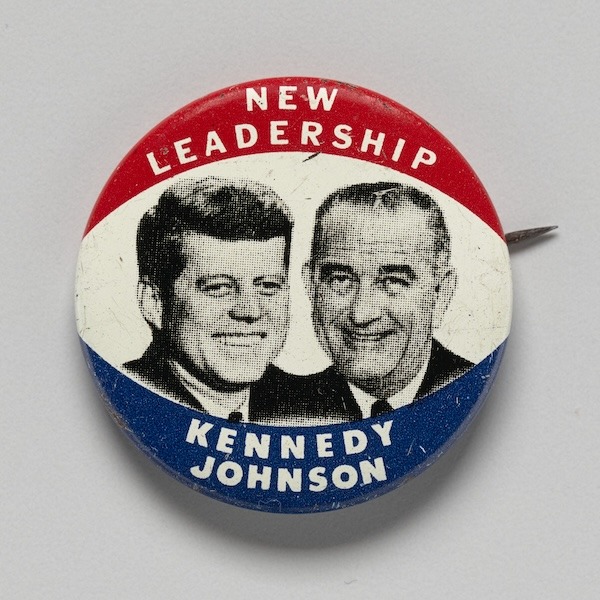
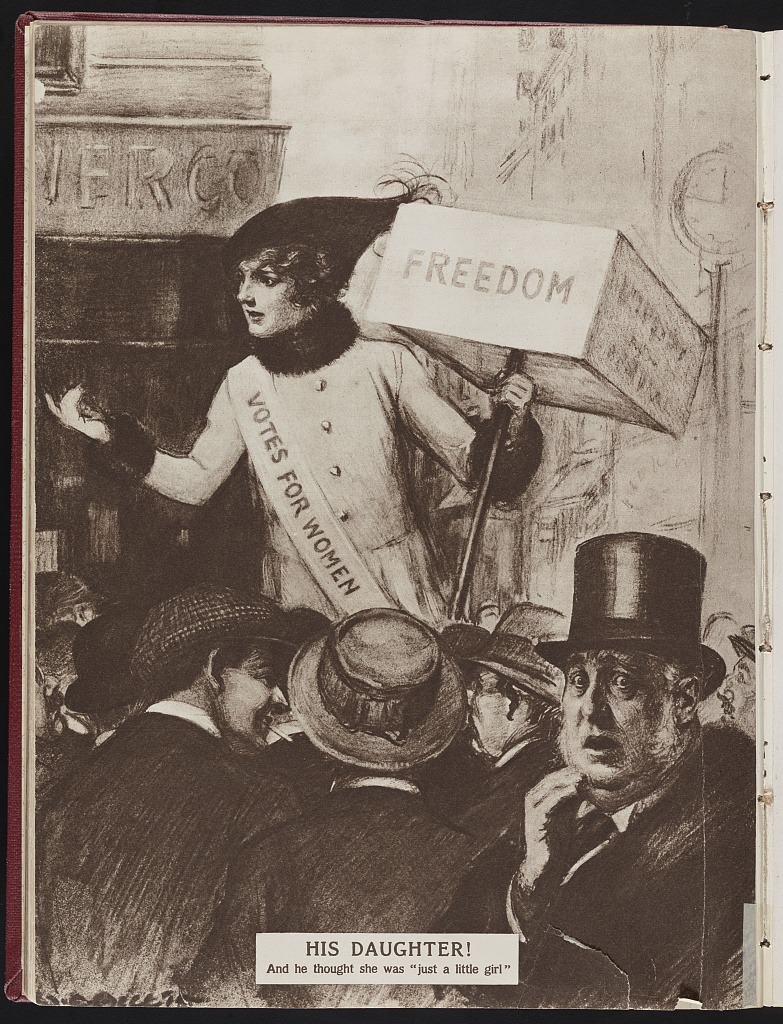
Anything that could be emblazoned with the face of a politician or slogan was fair game. Everything from paperweights, snuff boxes to coin operated banks was fair game. In fact, the first Women’s Suffrage march in 1913 included each woman wearing a white dress to display solidarity. Over their white dresses, they added a white sash with the words “Vote for Women” emblazoned on each.
Campaign ribbons were produced in large quantities to be pinned to a lapel, worn on a dress, or perhaps even used as bookmarks. They were often collected and framed in groupings, usually with a theme. Perhaps by year, candidate, party or other subject matter such as location.
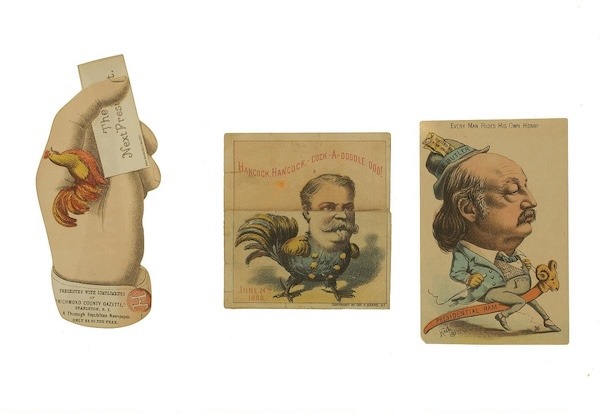
You can find loads of ephemera from political campaigns including post cards, matchbooks, posters, leaflets, flyers, even paper collars. Everything from newspaper inserts to calling cards printed with propaganda were handed out to the public.
By the time we got to the 20th century, there were foam boater or skimmer hats worn at political conventions, paper dresses, and of course T-Shirts, bumper stickers and more. Due to rising costs, campaign lapel stickers have largely replaced the campaign button. According to Wikipedia, the most valuable campaign button is from the 1920 presidential election. It depicts the likeness of James M. Cox along with his running mate, Franklin D. Roosevelt.
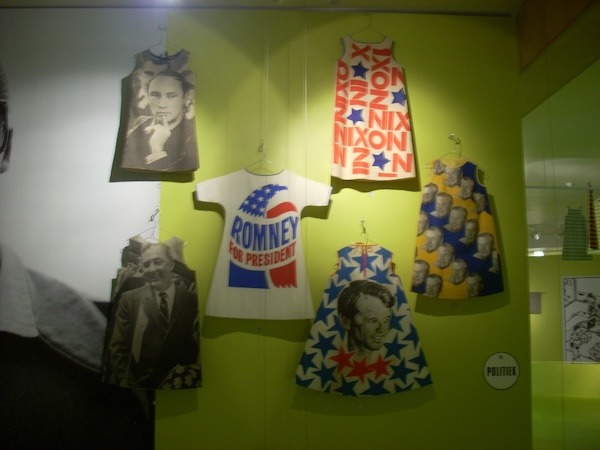
- 1968 Political Paper Dresses
Along with everything else, things changed over the years, where we once passed out buttons, stickers, and flyers, we now have designers including Tory Burch, Jason Wu and Vera Wang designing high end clothing made specifically for the Joe Biden 2020 election.
If you are interested in collecting political memorabilia the American Political Items Collectors website is a great place to begin. You can visit their website here.
Read more about the history of political buttons at:
The Life and Times of a Campaign Button, from History, Art and Archives, The US House of Representatives
Inventor Amanda M. Lougee, from the Busy Beaver Button Museum (the bio includes her fruitcake recipe)
Whitehead & Hoag, a brief history, from the Busy Beaver Button Museum
Buttons to Ballots: Icons of the Campaign Trail, The Robert J. Dole Institute of Politics