There are two interesting words in this week’s fresh to market vintage.
In the description of the antique basket, the word “nosegay” is used to describe something that might be put in the basket. A nosegay is a small dense handheld bunch of flowers and herbs, which would be the perfect size for the basket’s small opening. The term originated in the 15th century from nose, meaning scent, and gay, meaning ornament. They were carried in medieval and Tudor times to sniff when you wanted to block out the unfathomably rancid street smells and protect yourself from disease (in theory). Victorians renamed them tussie-mussies and made them to send messages through the language of flowers.
The Arm & Hammer cleaning chart is a “vovelle” or a wheel chart. Vovelles have rotating wheels of paper or wood, layered together and fastened in the center. In the Middle Ages and Renaissance, vovelles were used in books about astronomy, navigation, medicine and astrology. And, of course, they were used for ciphers.
We are going to spend the week looking for opportunities to drop those two words casually in conversation. In the meantime…
Sheffield Stainless Enamel Bracelet
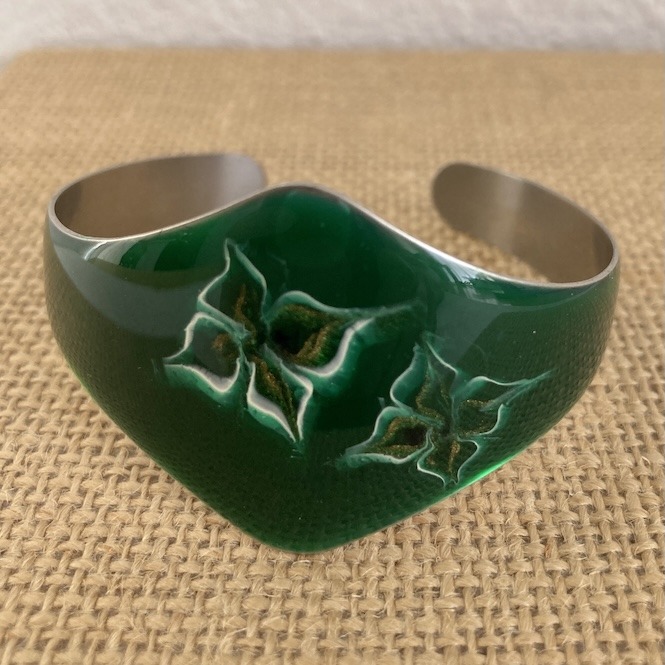
Stamped “Made in England” on the back, this stainless steel bracelet has a bright green enamel front with two gold and white diamond-shaped drawn stars on its face. The cuff style gives it the ability to fit most-sized wrists, as it’s adjustable. A rather unusual piece as there is little information that I could find outside of a few references to the 1970s, which I cannot verify. Either way, its a fun bit of unusual jewelry and would definitely get attention.
Green Enamel Cuff Bracelet, $ 28.95
Pam, Vintage Renude
American Woven Wicker Basket (c 1920s)
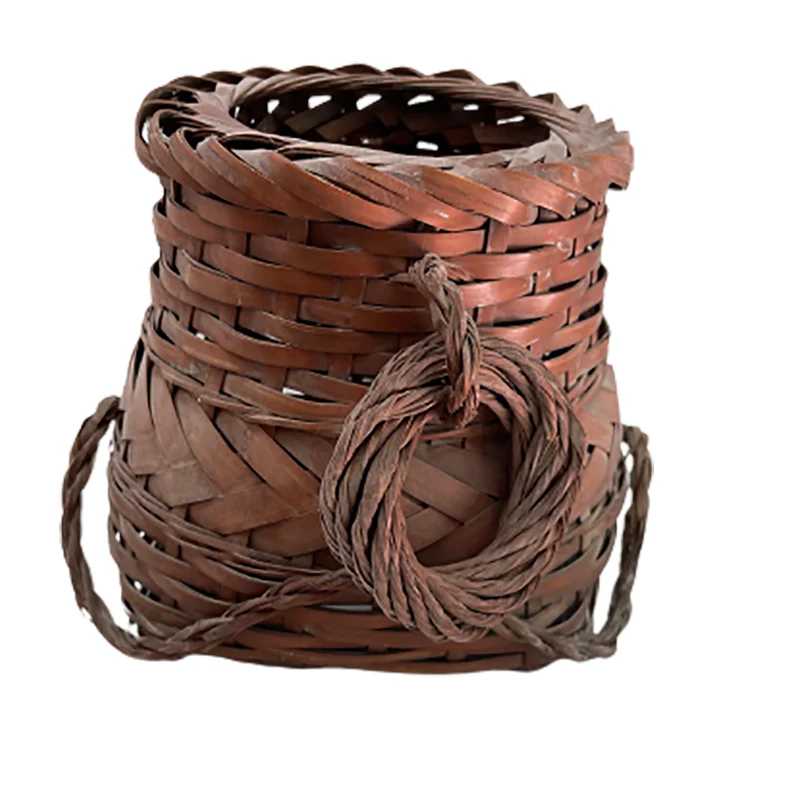
I love this sweet little woven basket, likely designed to hold a nosegay back in the 1920s. Made of wicker woven with interesting looped handles, it would also make a fun pen holder, adding a vintage touch to your home office.
Woven Wicker Basket, $75
Linda, Selective Salvage
Arm & Hammer Dial to Easier Living Vovelle
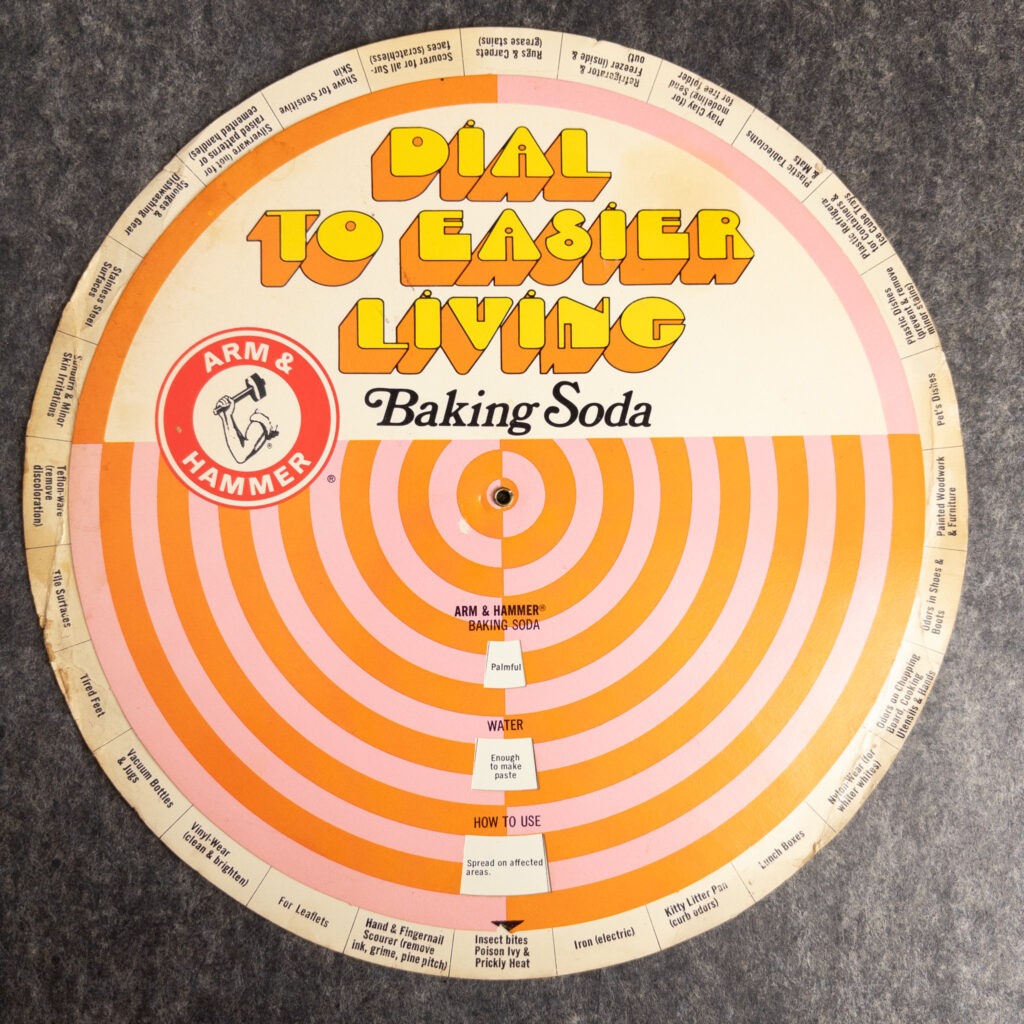
Baking soda has a reputation for being a superstar at cleaning things. This double sided 1950s advertising wheel from Arm & Hammer provides specifics for all kinds of cleaning situations. Imagine how useful this wheel would have been/would be as a household reference. It’s the best kind of advertising because it has value and you keep it handy. It would be no match for handed down generational knowledge, but it is definitely a good back up.
Arm & Hammer MCM Ephemera, $24
Laurie, NextStage Vintage
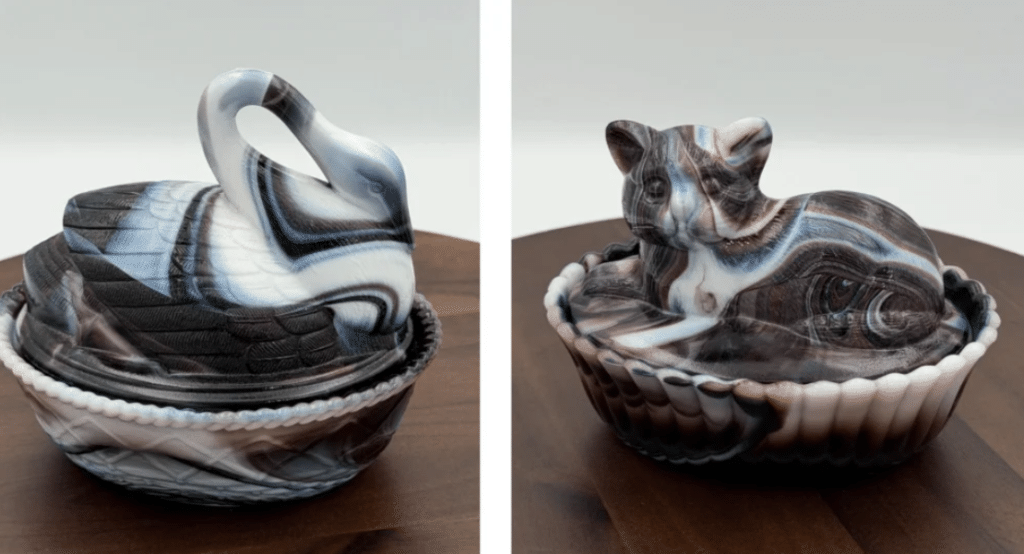
Westmoreland Slag Glass “On-Nests”
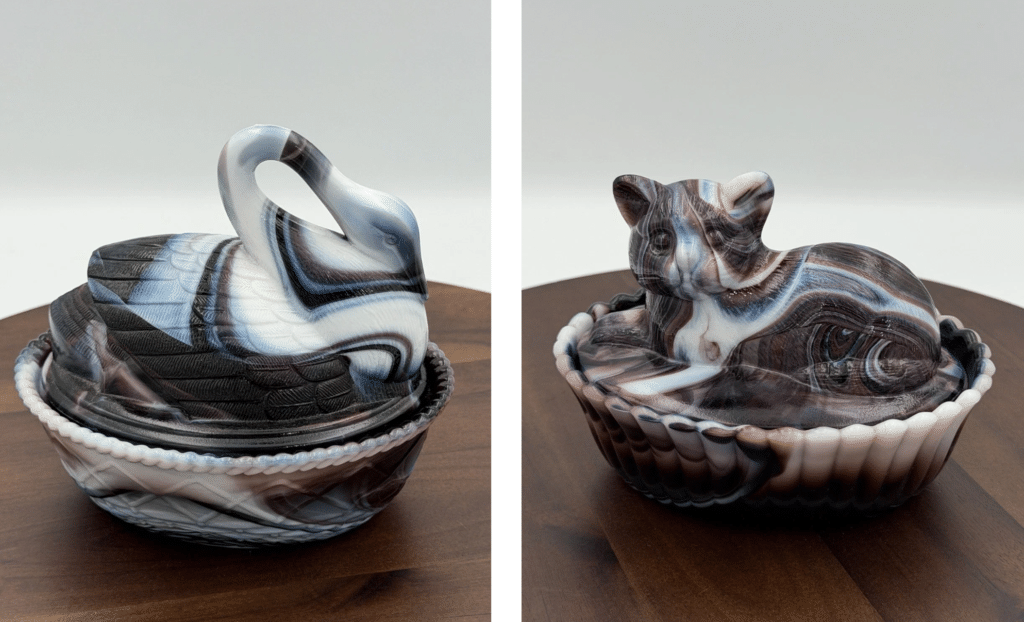
This Westmoreland swan-on-nest and cat-on-nest are made with slag glass, which is made by swirling different colors of glass into white or beige glass. No two pieces made with slag glass are alike because of the randomness of the swirl.
There is no actual slag in 20th century slag glass. Slag is waste from iron smelting and steel production. In the mid 1800s, glassmakers discovered that if they added cold, pulverized slag to molten glass, it would make an opaque glass with a marbleized texture. The finished pieces looked like carved stone, so it was called malachite or mosaic glass.
It was not a flawless process, in fact, it was quite unpredictable because of the randomness of the minerals and impurities in the slag. The finished product was brittle and had a proclivity towards shattering. With the rise of automated glass molding in the early 1900s, a reliable, consistent glass mixture was necessary.
The H. Northwood Glass Co. was the first to make what we know as slag glass by mixing glass colors, introducing their caramel and purple slag glassware starting in 1903. In the 1930s-40s, Akro Agate Co. mixed bright colors into white glass. You’ve probably seen their flower pots and kids tea sets. Imperial Glass Co. and Fenton started mixing colors in the 1950s, although Fenton made it for other companies for a while before they made it under their own name.
Westmoreland’s signature mid century product was their white milk glass. Production of Westmoreland slag glass started in 1972 in an attempt to revive lagging sales, and continued until the company closed in 1984.
Westmoreland Swan-On-Nest, $279, Cat-On-Nest, $279.99.
Both pieces are available from this week’s guest, 701 Old Soul Antiques
How is it November already? Have you started your holiday shopping? This is your reminder that if you have vintage gifts on your list, shop early because vintage can be one of a kind. You don’t want to get shut out by dillydallying.
Another thing you don’t want to miss out on is whatever is new on Vintage Unscripted. Sign up for our email newsletter and you’ll get an email once a week with links to all our posts. And never any spam. We would sooner surrender our entire stash of canned jellied cranberry sauce than share your info.