Seasons changing mean wardrobe changing. Time to tuck away your current season faves and get your next season faves out. How you choose and take care of those faves determines how long they hold up looking good. Even fast fashion pieces, made for a quick cheap endorphin hit, can get an extended life if they are treated properly. So let’s go back to 1951, when it was standard operating procedure to put extra effort into care to get as much wear as you could from what you wore, and look at some vintage clothing care tips.
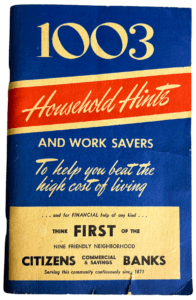 Our guide is 1003 Household Hints and Work Savers to Help You Beat the High Cost of Living, edited by Michael Gore and published by Bankers Community Service Company. The company produced and published booklets banks could co-brand and hand out to their customers from the early 1940s through the 1950s. Local advertisements were added on the inside of the covers to help offset the cost. 1003 Household Hints was their most famous and most widely distributed booklet. This particular booklet came from Flint, MI.
1951 was a few years after the end of World War II, and things were rosy with the economy, but being thrifty and pro-active were practical skills honed by homemakers who followed the art and science of home economics. Tips for how to do that better, particularly in a booklet that was gifted to them, were read and applied as the situation dictated.
While some of the tips for making your clothing last are well past the best used by date, a goodly number are still beneficial today. I’ve added some commentary, both for tips I support and tips that make me shriek in horror.
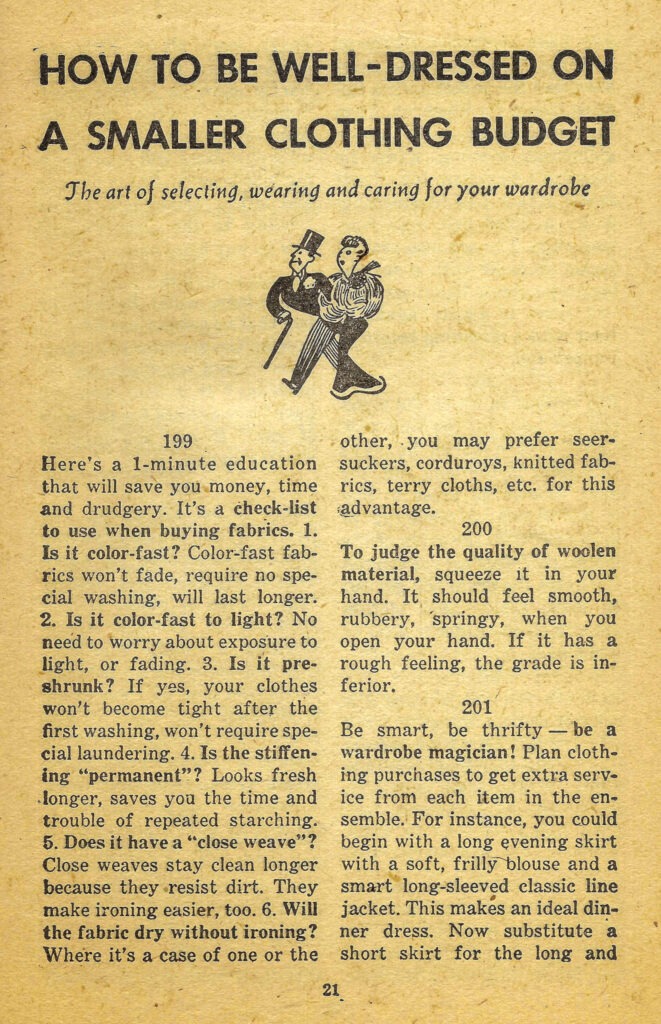
Tip 200: To judge the quality of woolen material, squeeze it in your hand. This is partially true. How fine or course wool feels is dependent on what kind of sheep it came for. Merino wool is baby soft. Lincoln or cheviot wool is not. For anything you want to wear touching your skin, a fine wool is perfect. For outerwear or home goods like rugs, where durability is paramount, a course wool is better. Of course, badly processed wool is going to feel itchy, no matter what sheep it came from.
Tip 201: Be smart, be thrifty — be a wardrobe magician! This is the 1951 way of saying invest in a capsule wardrobe of fewer pieces that are better quality and versatile so you can mix and match them easily. True then, true now.
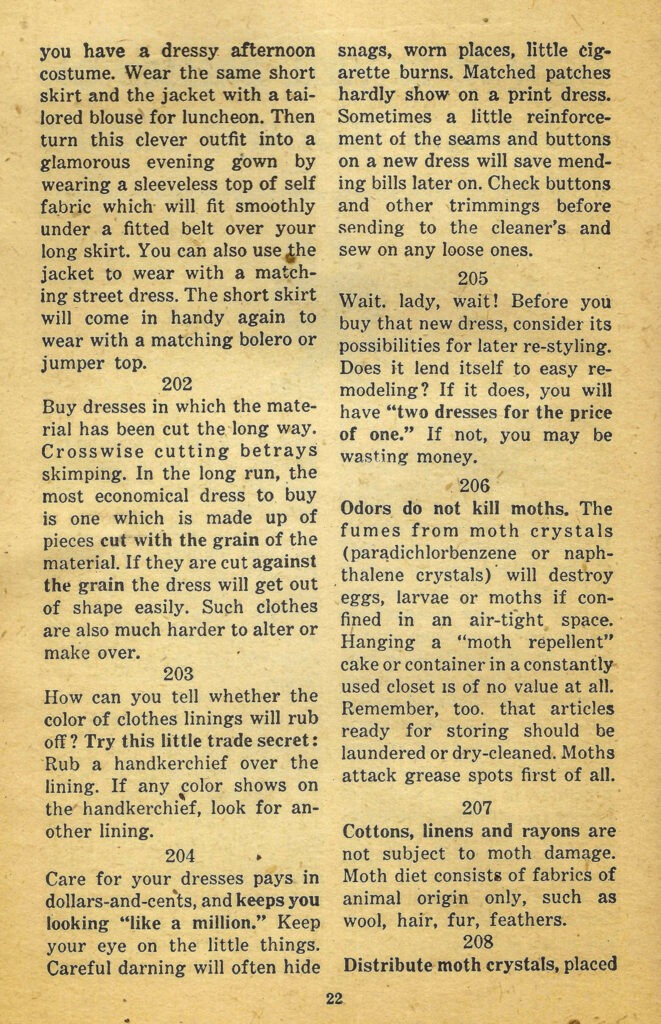
Tip 202: Buy dresses in which the material has been cut the long way. This is still true. A garment where the fabric is cut against the grain instead of with the grain is prone to awkward stretching. Against the grain is different than cut on the bias, which stretches somewhat predictably and gives maximum draping.
Tip 206: Odors do not kill moths. Hoo boy, moths are a subject that could be talked about for weeks. In fact, we have a post dedicated to facts and fiction about controlling moths. This tip is accurate. Hanging something in a closet is not going to kill moths. Moth balls have to be used in airtight spaces.
Tip 207: Cottons, linens and rayons are not subject to moth damage. Absolutely accurate. They will go after anything that comes from an animal, though.
Tip 208: Distribute moth crystals, placed between layers of tissue paper throughout box, chest or trunk. If you were going to use moth crystals, and I am not suggesting that you do, this is how you would do it. In the other blog post, we go into the best way to store things to prevent moths. (Clean anything wool before you bring it into the house, including carpets. Clean things before you put them away for the season. Store them in individual plastic bags so the moths can’t migrate from one garment to the other.) Also, to ascertain if you have a moth problem, hang a pheromone glue trap in your closet and see if it catches anything.
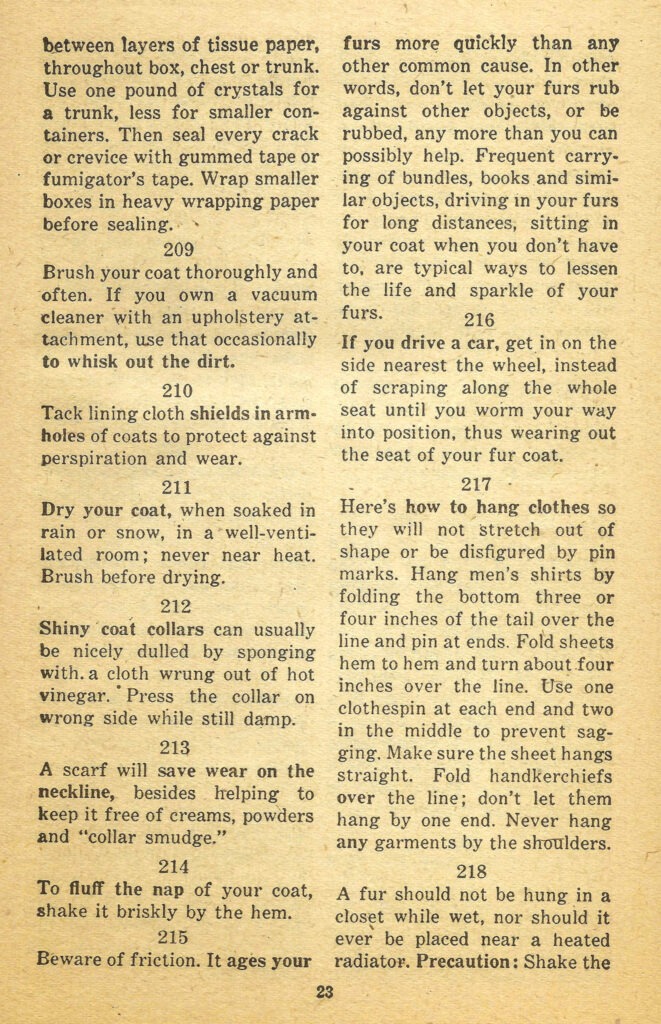
Tip 209: Brush your coat thoroughly and often. If you have a cloth overcoat, we support this. A good clothing brush will get any of the daily grime off, preventing a build up.
Tip 217: Here’s how to hang clothes so they will not stretch out of shape or be disfigured by pin marks. The suggestions here seem solid. And have been duly noted.
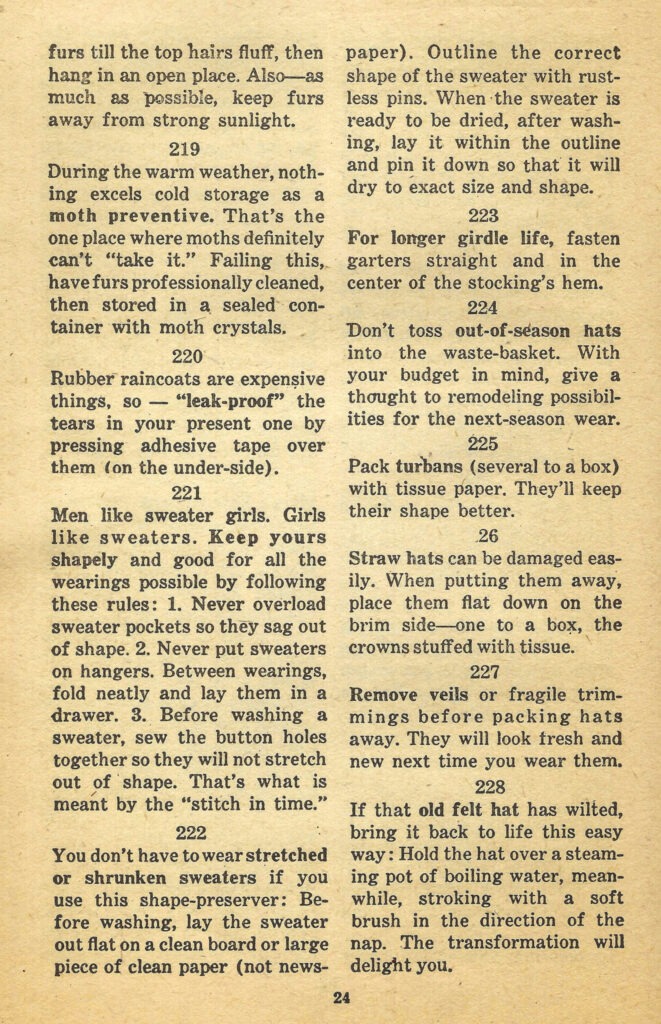
Tip 221: Men like sweater girls. Girls like sweaters. Keep yours shapely and good for all for all the wearings possible… The lede sentence got a snort and an eye roll, but it is true that girls like sweaters. Today’s sweaters are made of more resilient materials, so you won’t catch me sewing the button holes together on the regular, but to be honest, for a sweater with big statement buttons and matching big buttonholes, I would consider it.
Tip 223: For longer girdle life… stop there. No.
Tip 225: Pack turbans with tissue paper. Yes to this for turbans and soft hats in general. Packing them in tissue will help maintain their shape.
Tip 226: Straw hats can be damaged easily. Yes they can, and yes to stuffing the crown with tissue paper.
Tip 228: If that old felt hat has wilted, bring it back to life… Yes to using steam and a brush to reshape a wool felt hat. Not so sure about acrylic felt.
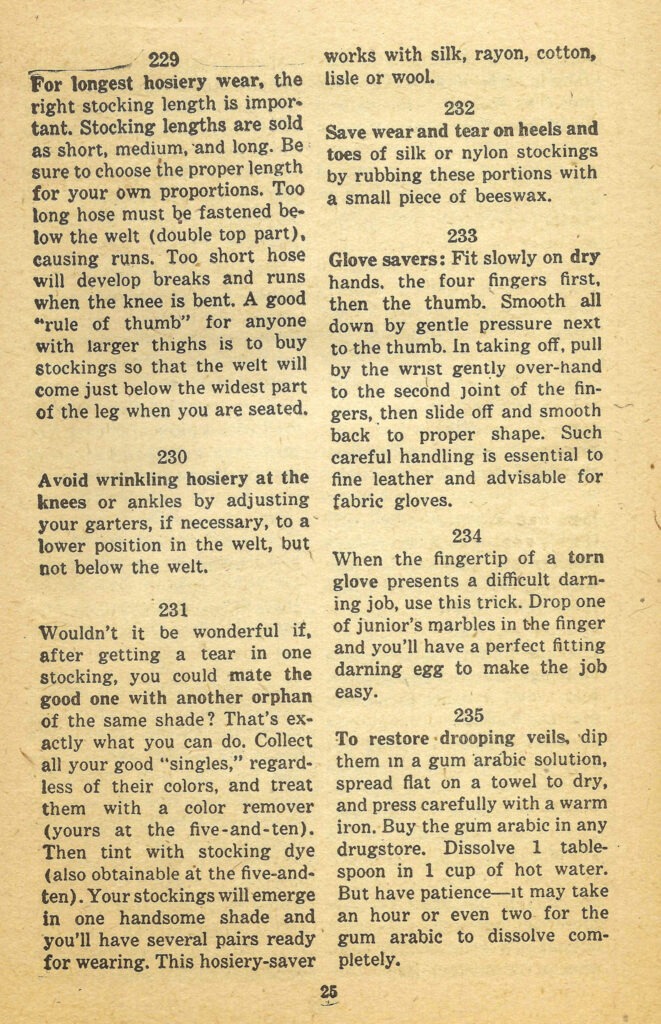
Most of these tips are devoted to the care of stockings. During WWII, there was a stocking shortage because the materials were diverted to making things for the war effort. In fact, when nylon stockings were introduced to the market, there were Nylon Riots as stocking-deprived women went to extremes to get their hands on a pair. So though the stocking tips are fascinating, thank heavens we don’t need to think about dying stray stockings to make pairs.
Tip 234: When the fingertip of a torn glove presents a difficult darning job, try this trick. Absolutely ingenious to drop a marble into the glove finger to use as a wee darning egg.
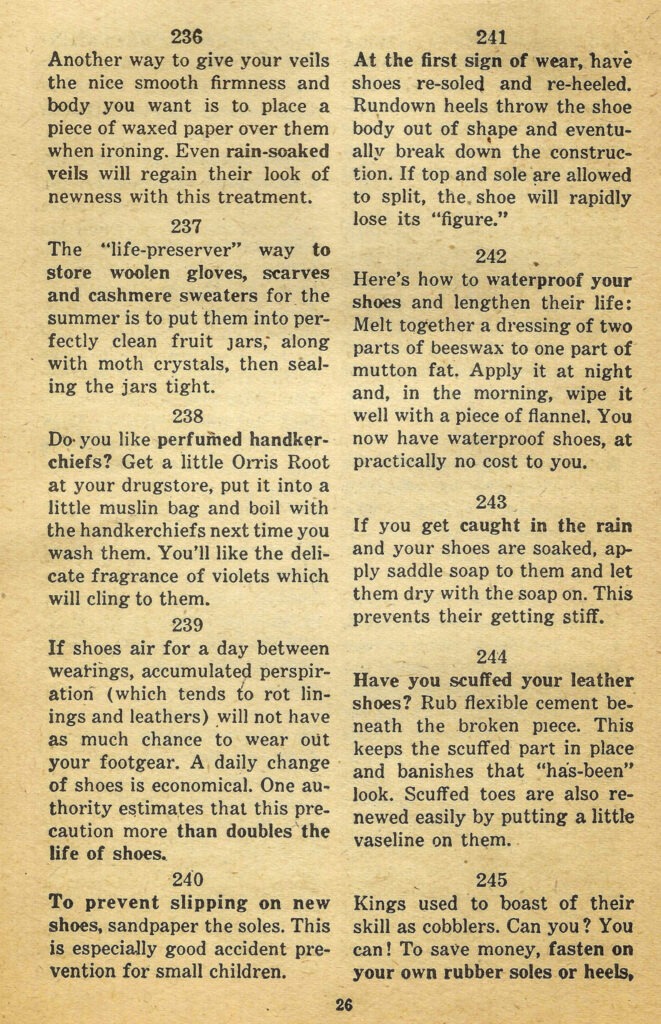
Tip 237: The “life-preserver” way to store woolen gloves, scarves and cashmere sweaters for the summer is to put them in perfectly clean fruit jars. This is genius. Moths cannot get in or out of a glass jar. The second part of this tip, add moth crystals, is a hard pass. If it’s clean and moth free when it goes in, it will be clean and moth free when it comes out.
Tips 239, 240 and 241 about shoe care are all an emphatic yes.
Tip 242: Here’s how to waterproof your shoes and lengthen their life… No. No, no, no. We will not be making a dressing of beeswax and mutton fat to rub on our shoes. No.
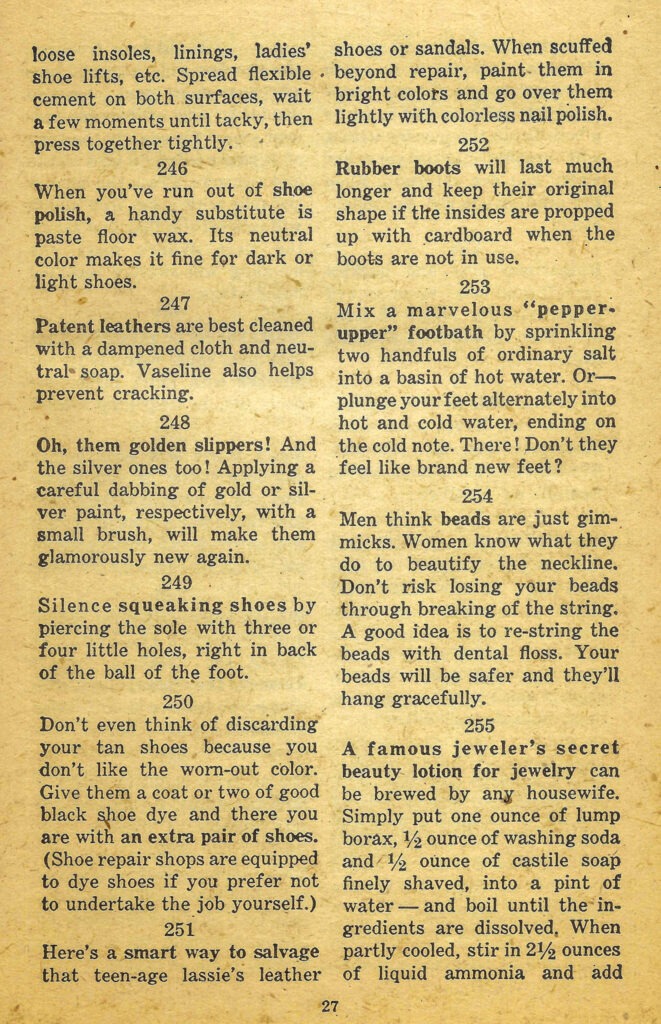
More on shoe care. We will admit that the idea of shoe dye as suggested in Tip 250 is intriguing. There are many products available for this experiment.
Tip 255: A famous jeweler’s secret beauty lotion for jewelry can be brewed by any housewife. You can’t get lump borax anymore, but you can get borax. You can also get washing soda and all the other ingredients. But it will be a very cold day in a very warm place before I mix this concoction up and boil my jewelry in it.
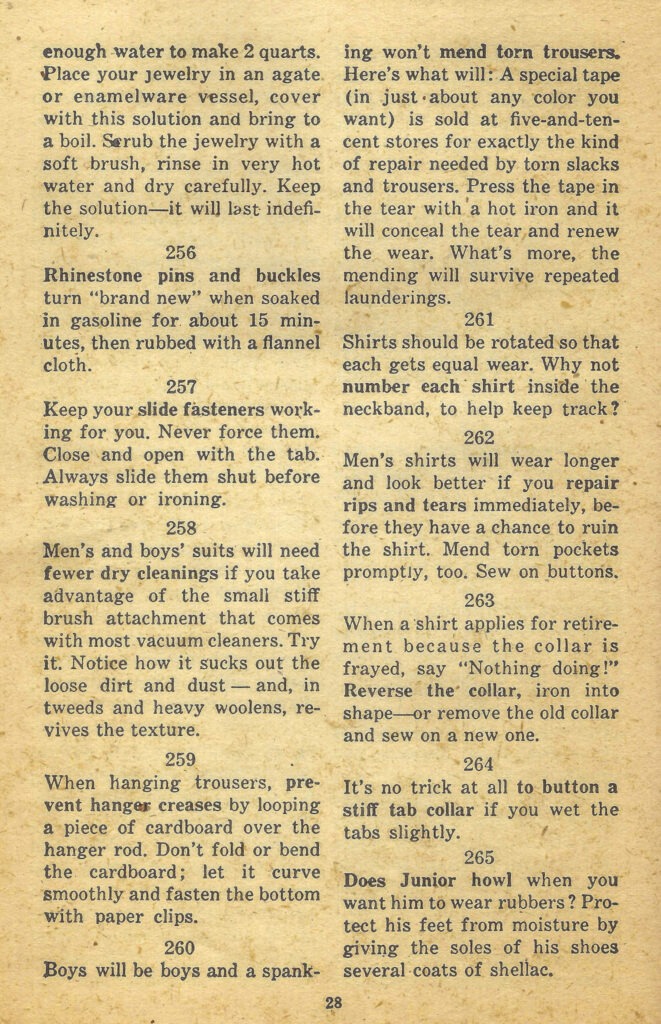
Tip 256: Rhinestone pins and buckles turn “brand new” when soaked in gasoline for about 15 minutes… No, nyet, non, nein, nee, nej, não. Not even for “what if” fun if I come across a very sad rhinestone brooch. (Okay, maybe then.)
Tip 261: Shirts should be rotated so that each gets equal wear. Yes. Even your favorite t-shirt will last longer if you put it in a rotation instead of wearing it every time it comes out of the dryer. (Dishes should be rotated too.)
Tip 263: When a shirt applies for retirement because the collar is frayed, say “Nothing doing!” I know actual real people who take on the task of reversing collars willingly for favorite shirts. It’s neither that time consuming and nor mission impossible.
Investing in better quality clothing and making it last is a good way to break the fast fashion cycle. A capsule wardrobe of fewer, better pieces that you take the time to care for well will make your closets and drawers less stuffed with flotsam and more gently filled with intent. And because you’ve chosen them specifically, you won’t have any of those garments you kind of like, but don’t really love, but don’t want to get rid of because you spent cash money on them.
Which of these vintage clothing care tips do you already do? Which are new to you? Which made you laugh? Which are things you might try? Let us know in the comments.




2 comments
Don’t know about you, Laurie, but I’m a firm believer in using waxed paper when ironing my veils! 🙂
Is there any other way?