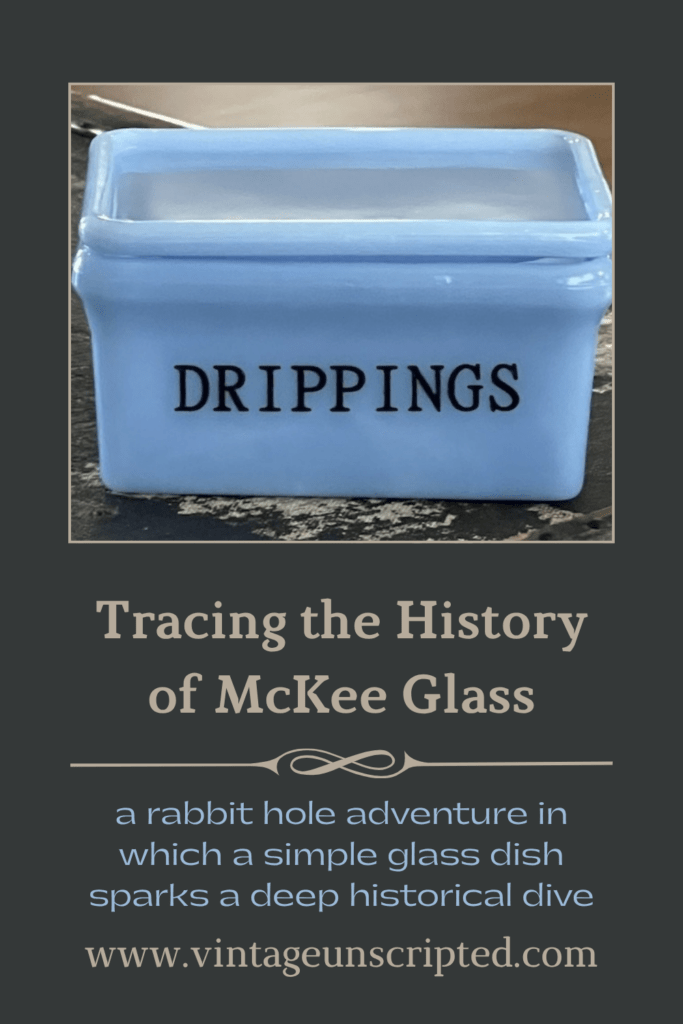
I was recently gifted a McKee Glass item, though since it unmarked I had no idea who the maker was. Nonetheless, I loved the item and was happy to have been given it by a wonderful friend. The piece has no markings beyond “Drippings” in black print on the front. It’s a smaller sized rectangular glass lidded box in delphite blue. Since I have a small collection of vintage glass refrigerator containers, I admired it. As fate would have it, my friend thought it would be a nice addition to my collection.
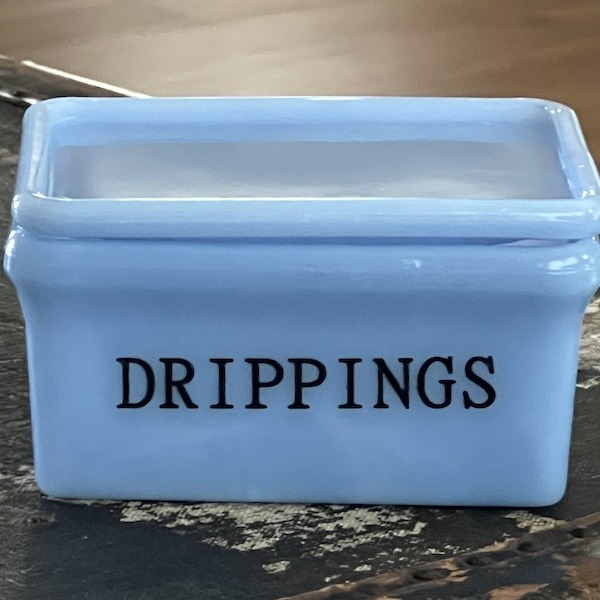
Once home, I began to research the piece to determine the maker. I found it easily in my collectors books on vintage glassware, although there was scant information on the company itself. So off I went tracing the history of McKee Glass.
There were actually many McKee Glass companies in the 1800s, but only two are important to this story.
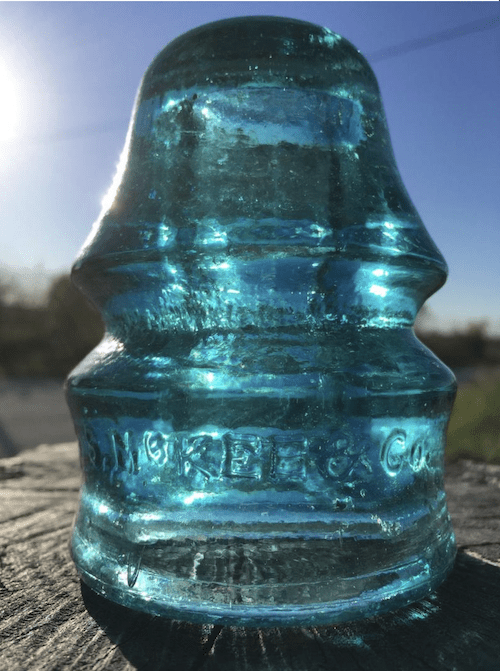
In the beginning, Samuel McKee started business as the S. McKee & Company in Pittsburgh, PA in 1834. The company quickly expanded when brothers James and Thomas joined up. As glass makers, they produced window glass, telegraph glass insulators, and hollowware items such as jars and bottles. Collectors of glass insulators may be familiar with their threadless insulators, which were in production for about 70 years until the business closed in 1908.
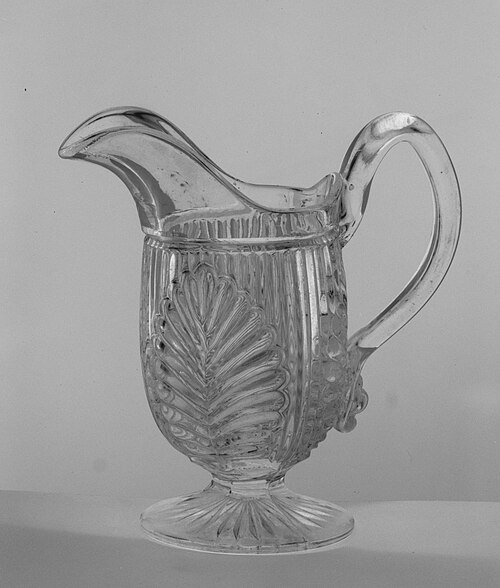
In 1854, Frederick and James McKee, sons of Thomas, one of the brothers in the original S. McKee & Co., opened F. & J. McKee, a second glass company. By 1867, this company had changed names several times and landed on McKee and Brothers. At this point they made window glass, bottles and vials, as well as flint glass and pressed glass tableware (EAPG), for which they are now better known by collectors. When Frederick passed away in 1874, and James stepped down from running operations shortly after, Thomas’s youngest son, H. Sellers McKee, took over.
In 1888, H. Sellers moved the company from their original location in the South Side area of Pittsburgh. The new location in Westmoreland County offered both plentiful natural gas to run the expanding plant as well as close proximity to the Pennsylvania Railroad. A company town was built around the factory to house workers and their families. The town was named after H. Sellers McKee’s wife, Jeannette.
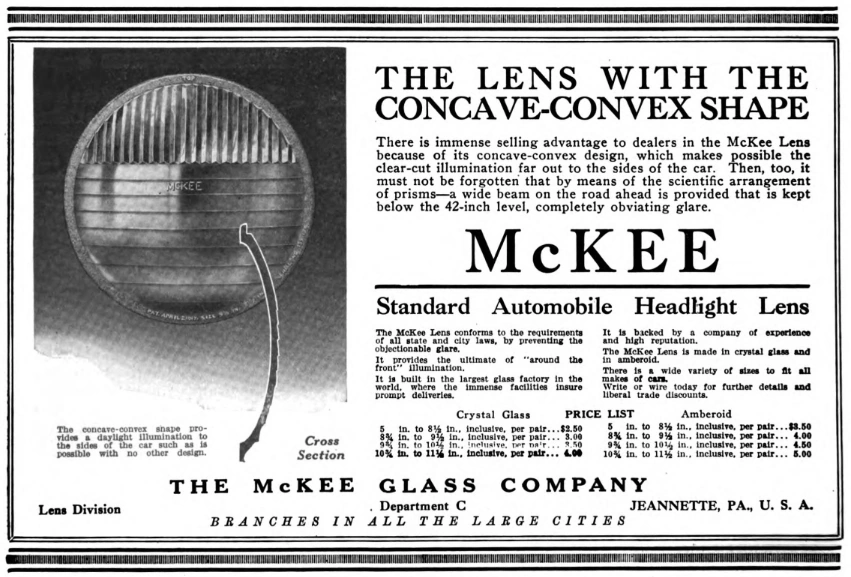
H. Sellers McKee was at this point running two companies. McKee and Brothers continued making tableware, eventually becoming the largest pressed glass factory in the world. And the Chambers-McKee Glass Company with its separate factory, became the largest window glass company in the world.
McKee also formed a real estate speculation company with two other men, hiring civil engineers to plot out a town around the factories with industrial zones, commercial districts and residential neighborhoods. He and his partners also formed the Jeannette Planing Mill Co. to provide the lumber for building the new areas.
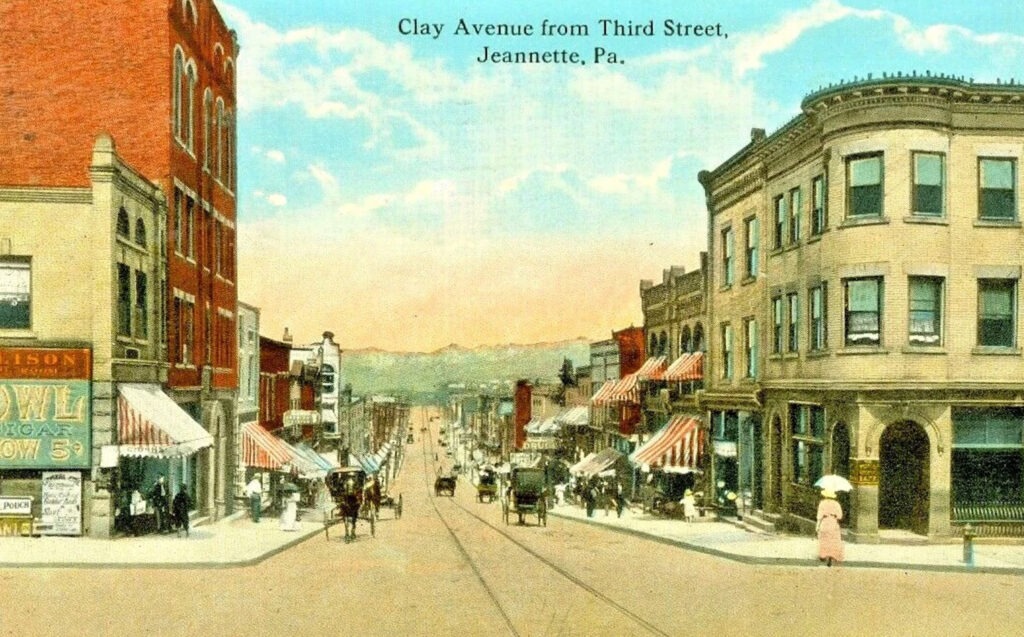
For a short time, from 1899-1903, McKee and Brothers joined a co-0p with other glass companies to pool resources and standardize prices. But that didn’t last long. They broke away in 1904 and became the McKee-Jeannette Glass Co., then became simply the McKee Glass Company in 1908. By then, they were producing all manner of glass, both commercial and decorative. The popular Pres Cut tableware glass, always crystal clear, was made starting in 1904. The company also made all kinds of colored glass for home use, which was widely popular and produced en masse. During this period of time Jeanette, PA was known as “The Glass City,” since between 70% to 85% of the world’s glass was produced there.
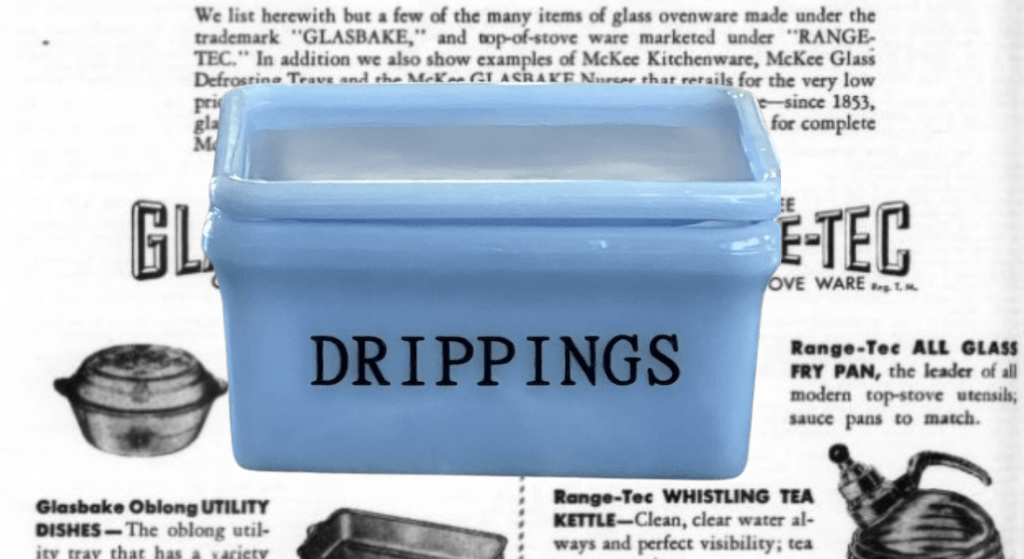
1917 came about, and McKee began producing “Glasbake” in response to Corning Glass’ “Pyrex.” Glasbake remained in production until 1983. McKee was also first to market with the still popular jadite green glass, launching Skokie Green in 1930 and Jade Green in 1931.
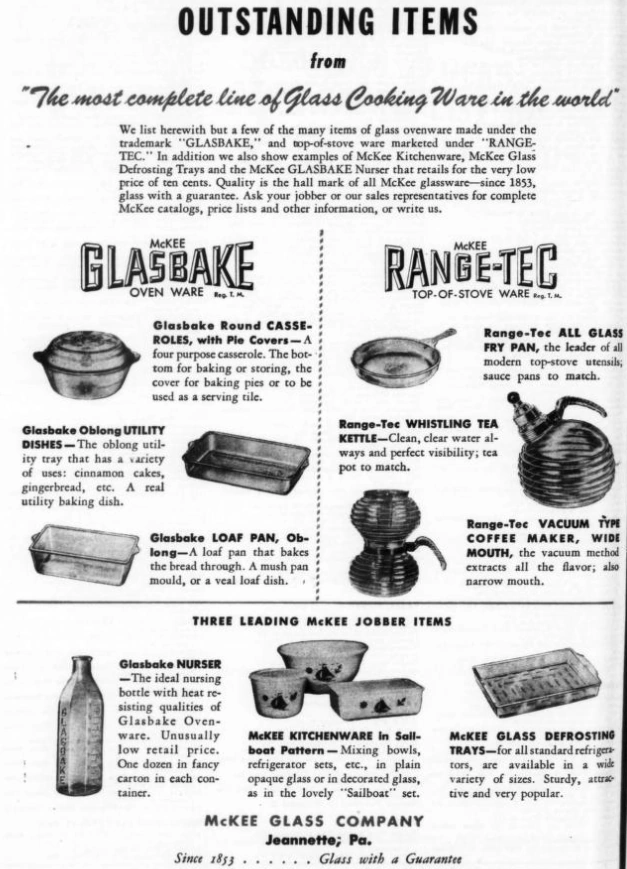
Between 1917 and 1951, I could not find any information on the company, although they continued to produce products throughout those years. 1951 brought about the purchase of the McKee Glass Co. by Thatcher Glass, ending the independent ownership of the McKee family. It became a division of Thatcher. In 1961, the company was bought again, this time by Jeannette Glass Company, a competitor that started in Jeanette, PA because of the resources H. Sellers McKee developed for his own company. In 1983, the company closed its doors.
While searching for information on my drippings container, I found varied information on the various companies and the many family members and multiple companies they owned over the years. What I did find out was that various companies produced loads of different kinds of glass over many, many years. Some items were marked, some not. My blue Delphite box is not marked, although McKee began making these powder blue glass items in the 1930s.
Did you know? True McKee Pres Cut glass is always clear. In the 1980s, L.E. Smith Glass and Fenton obtained the original molds and produced the pieces in color. These are often marked Pres Cut because the name was in the mold.
We as collectors and sellers clearly have a soft spot for vintage and antique glass. Over the years we’ve written several posts about vintage glass. You can peruse them here.
This site has detailed information regarding the McKee family and companies https://secure-sha.org/bottle/pdffiles/SamuelMcKee.pdf
The Jeannette Area Historical Society has many historic photos of Jeanette, PA.