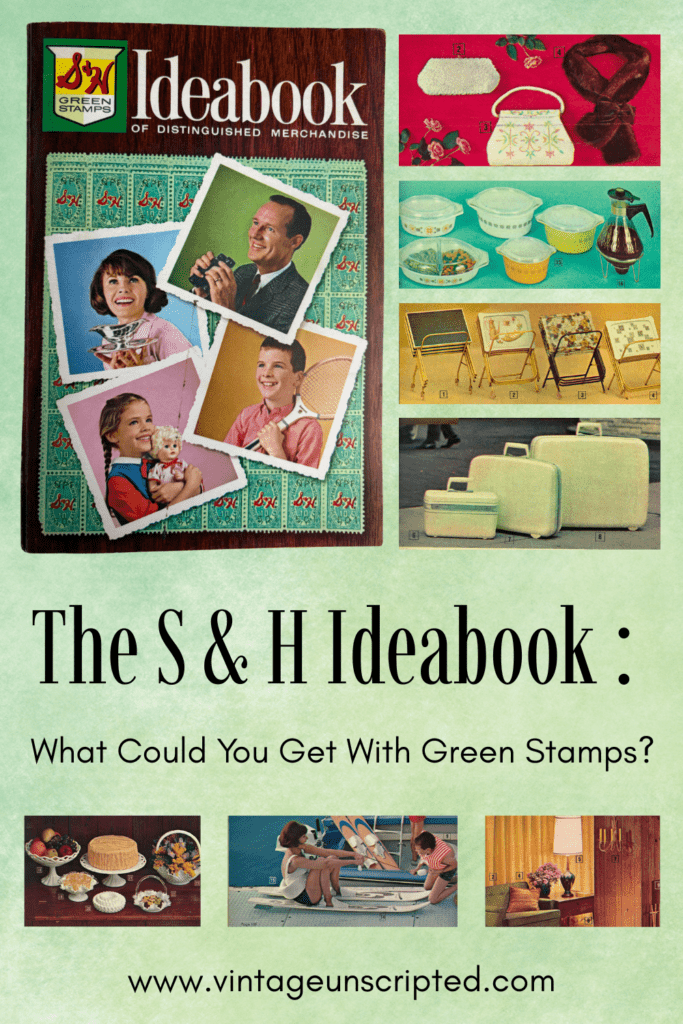
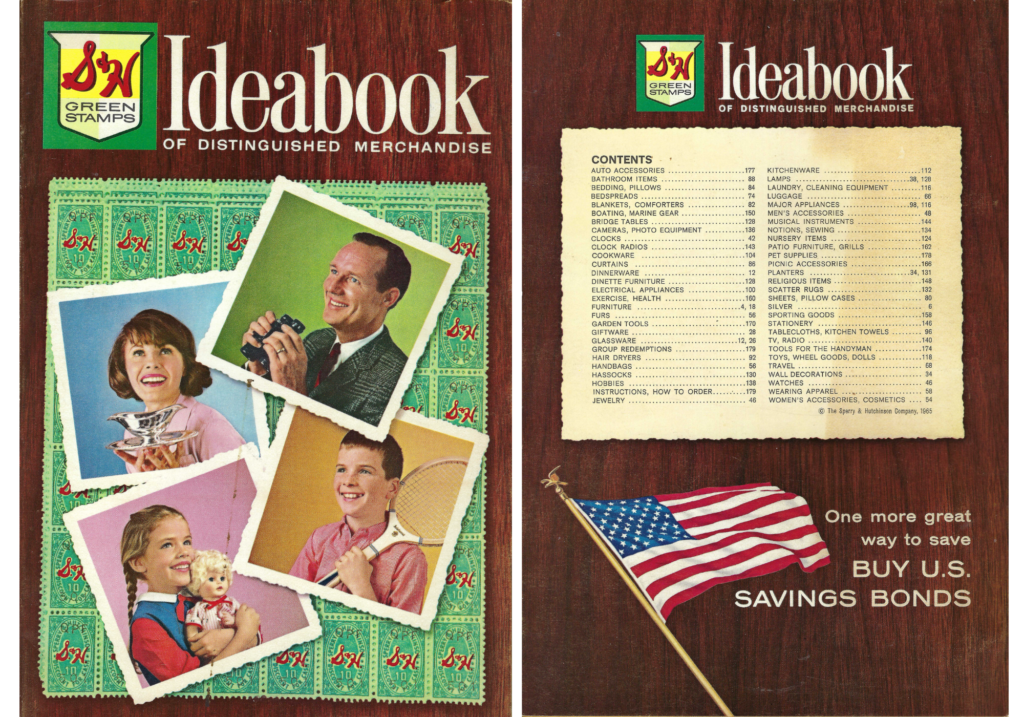
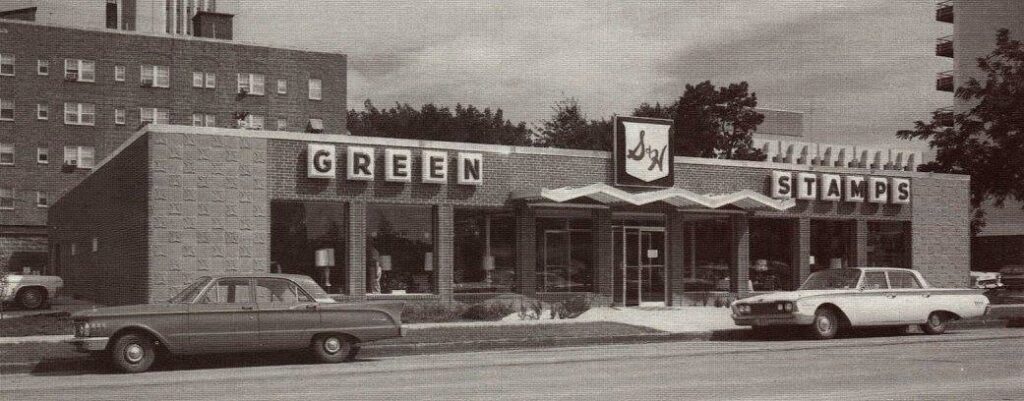
There were at least 200 trading stamp companies in the 1950s and 1960s, but one stood above all the others in terms of market share, S & H Green Stamps. An estimated 80% of American households collected Green Stamps. S & H maintained 600 branded store locations for redeeming those stamps for all sorts of things, both magical and mundane. And, most importantly, they produced the S & H Ideabook of Distinguished Merchandise, the catalog that showcased everything you could get with your Green Stamps. At its peak, 35 million households received the Ideabook. That’s more than the combined circulation of Reader’s Digest, Life, Look and the Saturday Evening Post, four of the biggest magazines of the era.
Where did S & H get their merchandise?
Merchandise in the Ideabook came from well known manufacturers like Corning, Pyrex, General Electric, Sunbeam, Fenton, Syroco, Coleman, Kodak, Ekco and scads more. S&H was so big it had Avengers-level wholesale purchasing power. They were able to buy goods at deep discounts. And of course, the number of stamp books a customer needed to get items was calculated at retail value.
In order to have the same merchandise available at all 600 of their redemption stores, most of the items purchased were from current active product lines. S&H purchased in such volume that manufacturers would do special production runs just for them. It was in every company’s best interest to have their newest merchandise featured in a publication that found it’s way into the hands of 35 million families.
What could you get with your Green Stamps?
The S & H Ideabook was an Aladdin’s cave of things you might want, from kitchen mold sets to lamps, furniture, clothing, linens, vacations and so much more. If it was part of the good life in post war America, you could get it with Green Stamps. The pricier things an everyday household might aim for were color TVs (150 books) or a Baldwin upright piano (380 books). The most expensive thing ever offered was a Chrysler motorboat that was valued at about 1250 books. To get that boat, someone would have to spend $150,000 in 1960s money, which would be $1.43 million in today money.
In the 1960s, an average family could fill about 10 books of stamps a year, making the stuff of everyday life like toys, magazine racks, toasters, clocks well within reach.
Groups were also able to take advantage of Green Stamps to get things they needed. If a non-profit like a scout troop, church or private school wanted to do a stamp collection drive to purchase something major like a school bus, they would contact the S & H National Group Savings Department. That department would, in turn, source the requested item and give the group an exact number of books to get that item. The most famous collection was in 1966, when Pennsylvania school children collected 5.4 million individual stamps to get one gorilla for the Pittsburgh Zoo and one for the Glenwood Park Zoo in Erie, PA.
A sampling of the 1965 Ideabook
We can’t show you all 178 pages, but we can offer some choice selections. Note: the print quality of the Ideabook was not top tier, so the scans aren’t either. We did our best, really we did.
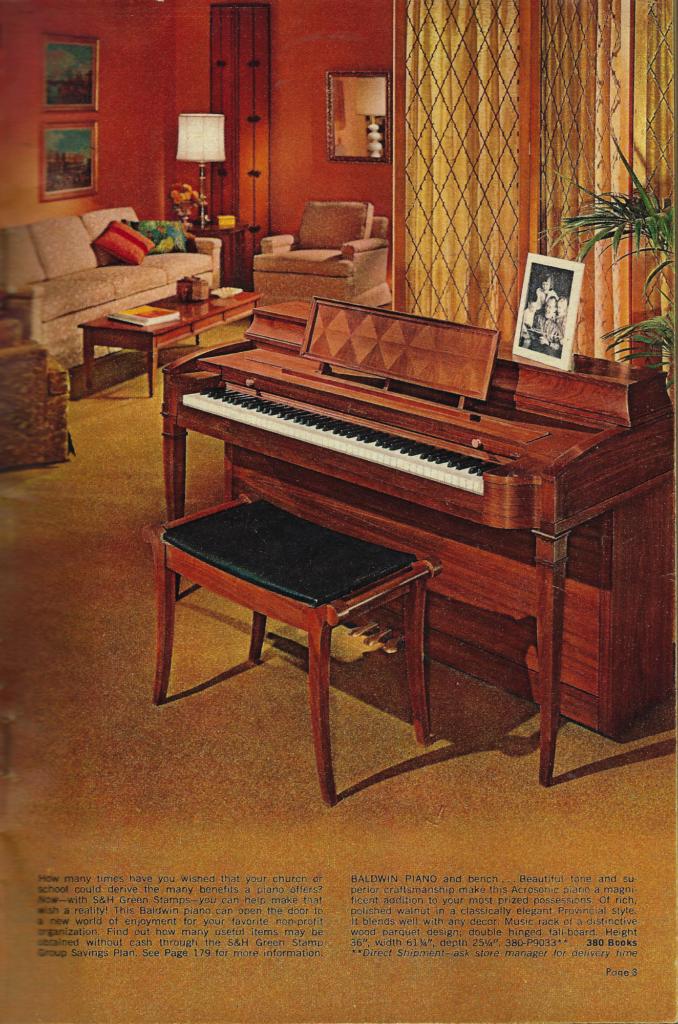
Having an upright piano in your living room was elegant. This Baldwin Piano and bench (380 bks) is right at the front of the catalog. 380 books was a stretch, even if all your friends, family, aunties and great uncles were funneling their stamps to you, but you have to know there were clever households that managed it.
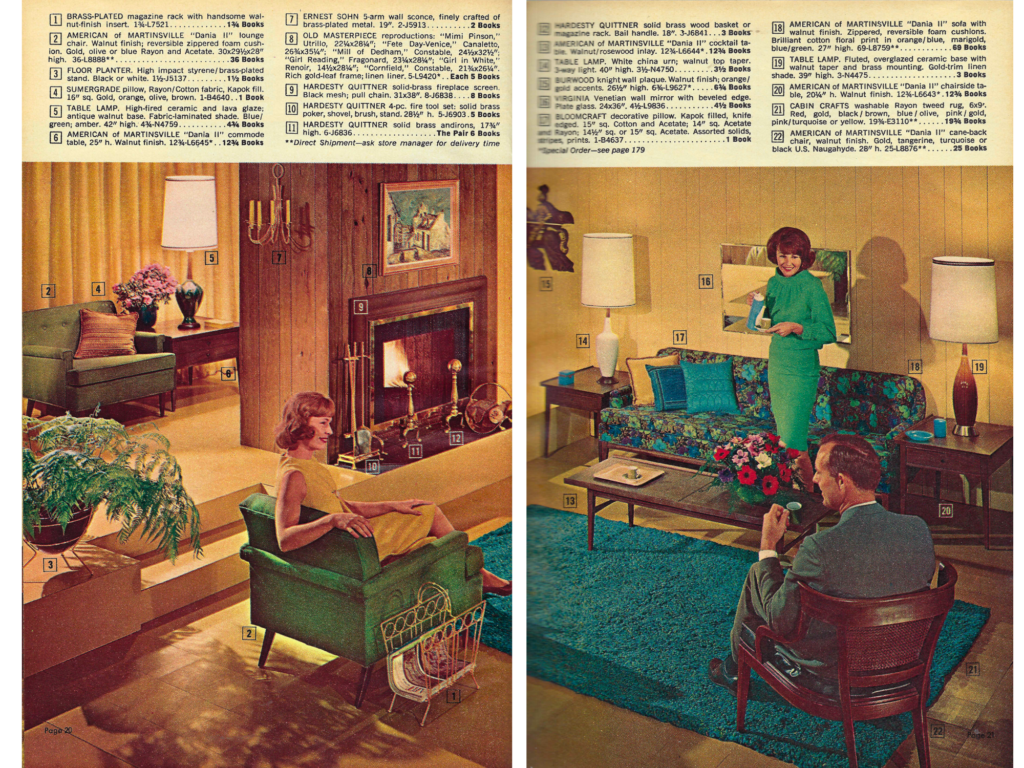
Decor? Don’t mind if I do. First off, that Cabin Crafts 6×9 rug (19 3/4 bks) and that American of Martinsville lounge chair (36 bks) to go on it. And the Old Master reproduction (5 bks) in the gold leaf frame over the fireplace would look good over any fireplace.
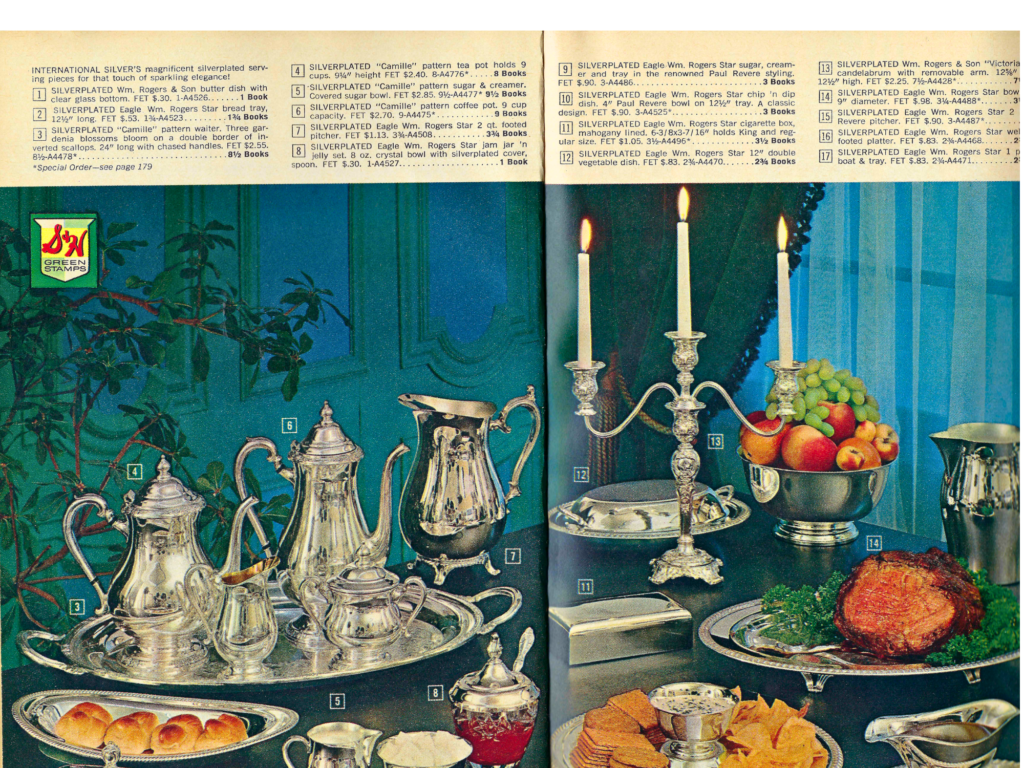
Everything you needed to set an elegant table, you could get from S&H. And people did. Proof of that is the silverplated Wm. Rogers covered vegetable dish (2 3/4 bks). Based on an unscientific survey of estate sales and thrift stores, it is the most common silver plate serving piece known to humanity. You could get the pieces of International Silver silverplated Camille tea set individually, so you could add to your set over time (35 bks total).
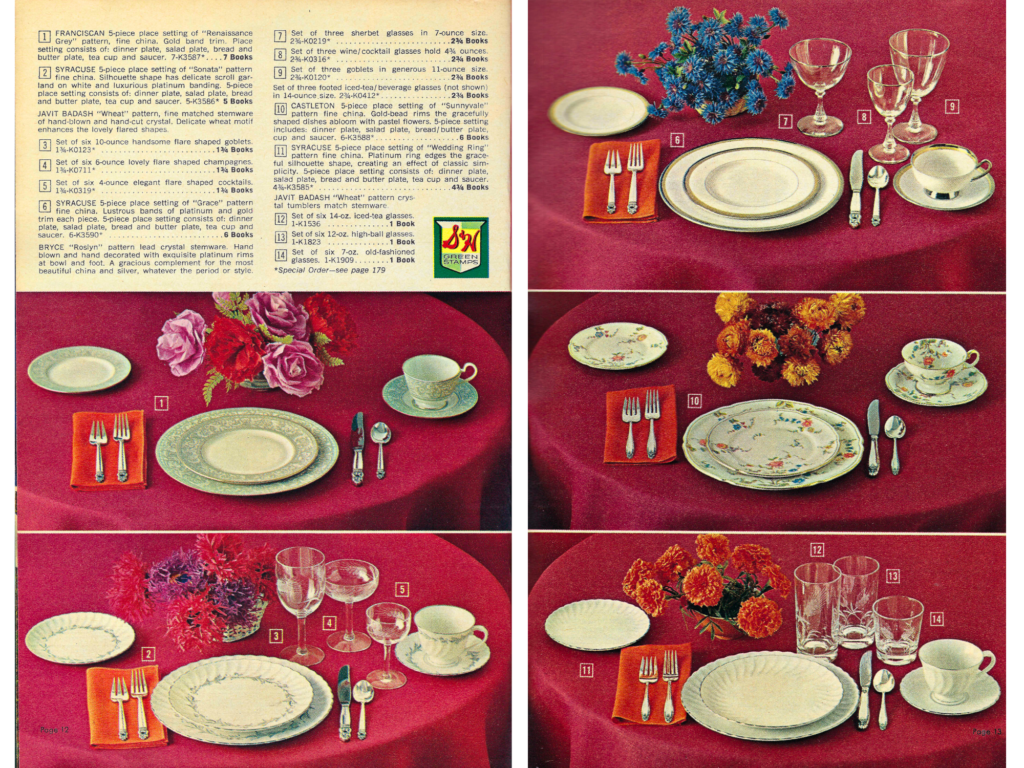
For flatware, you could choose from sterling silver by the placesetting (10-12 bks), or entire services of silverplated (13 bks) or stainless steel (2-5 3/4 bks) flatware. Franciscan, Syracuse and Castleton fancy china was available by the place setting (4 3/4-7 bks). Starter sets of everyday china from Johnson Bros, Myott, Homer Laughlin or Taylor, Smith & Taylor would run you 1 3/4-3 books.
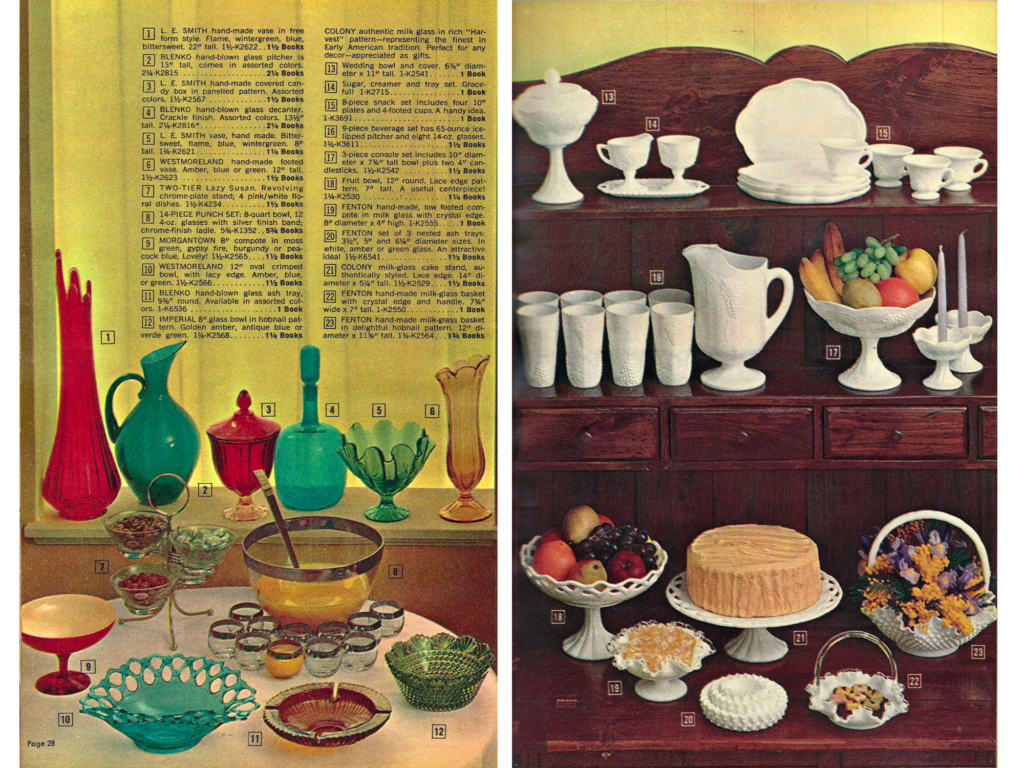
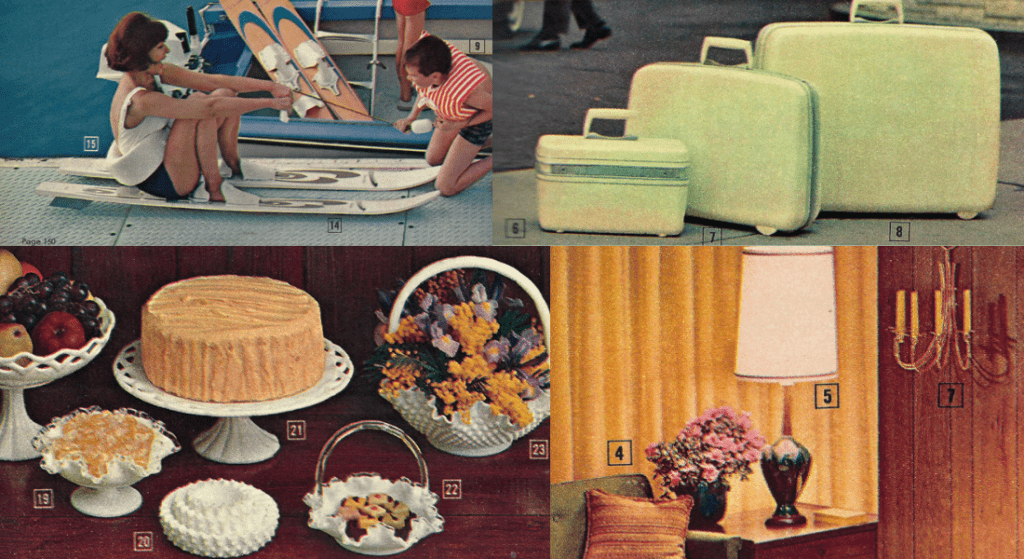
How fast would your heart beat if you found any of the glass pieces on the left page? If you’re a vintage seller or collector, how may of these pieces have you touched? The L.E. Smith vase at the top left (1 1/2 bks), the Blenko pitcher to the right of it (2 1/4 bks) or the Westmoreland lacy edged bowl down front (1 1/2 bks) would make me faint if I encountered them in the wild. And on the right, pieces of the Fenton and Colony milk glass down front would run you 1-1 3/4 books.
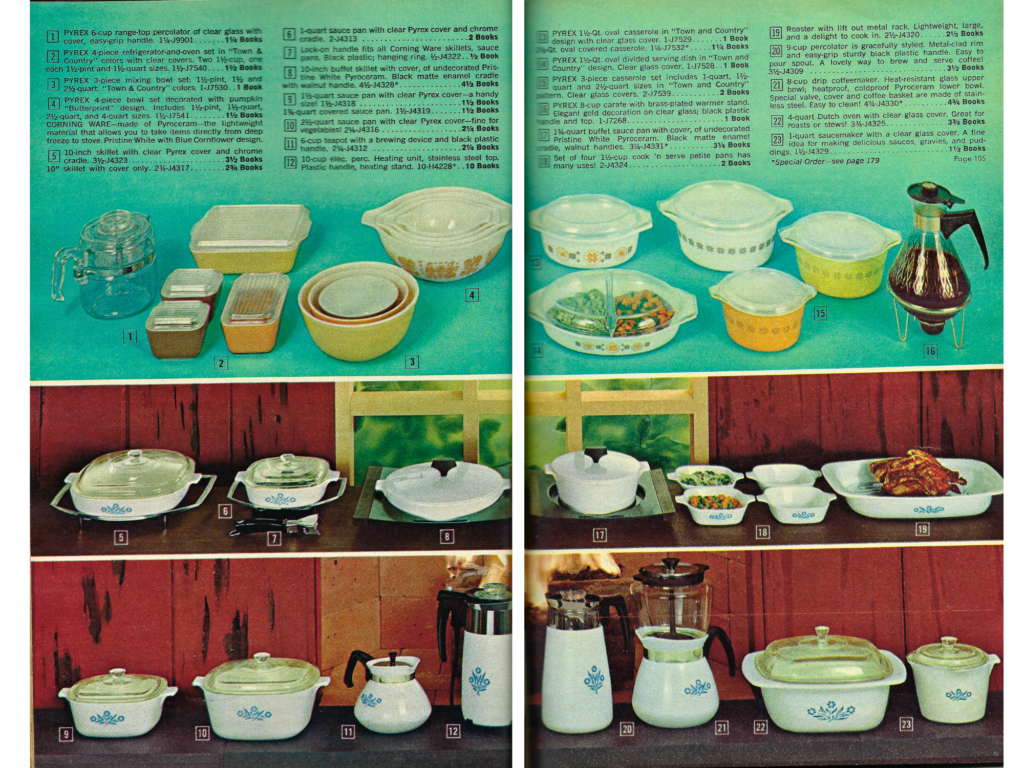
You could stock your kitchen with essentials and luxuries from the Ideabook. Where to start…how about the Pyrex percolator (1 1/4 bks), Pyrex Butterprint Cinderella nesting bowls (1 1/2 bks), or the Corning drip coffeemaker (no. 21 down front–4 3/4 bks).
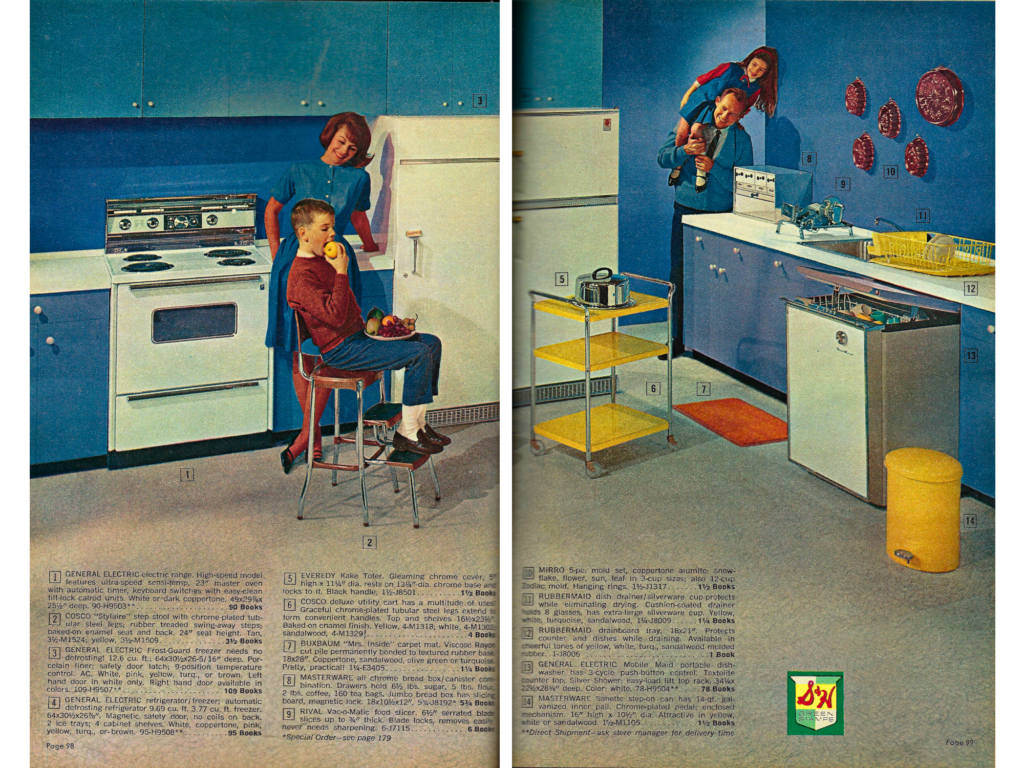
Or your could outfit your kitchen with a GE Electric Range (90 bks), GE Fridge/Freezer (95 bks), Cosco step stool (3 1/2 bks) or a Mirro 5 pc mold set (1 1/2 bks).
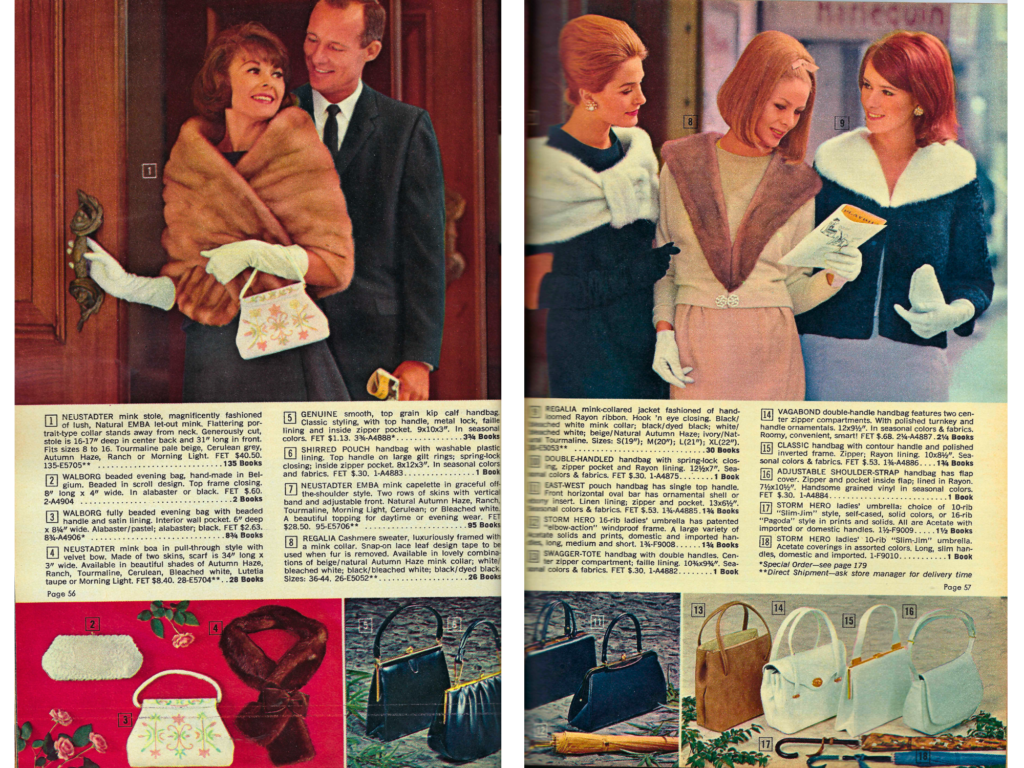
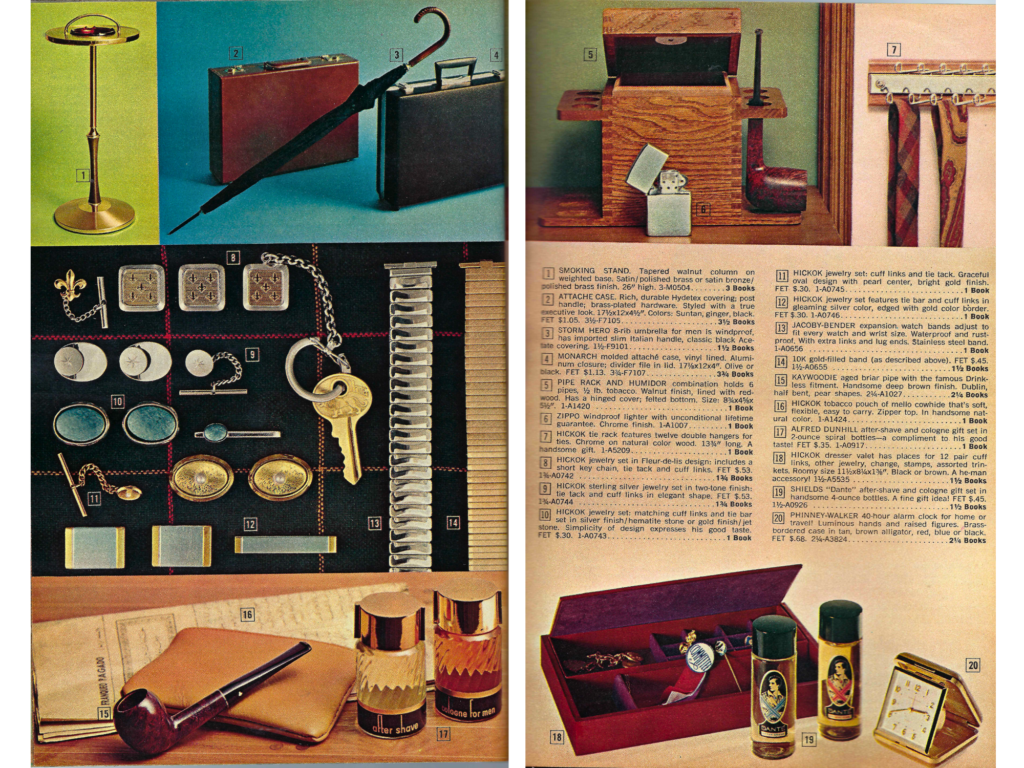
Looking for something special for him or her? How about some Alfred Dunhill aftershave and cologne (1 bk) or a Hickock tie rack(1 bk) or a Kaywoody briar pipe (2 1/4 bks) for monsieur? Or maybe a Neustadter mink stole (135 bks) or a Regalia cashmere sweater with mink collar (26 bks) or a handbag (1 to 2 1/4 bks) for madame?
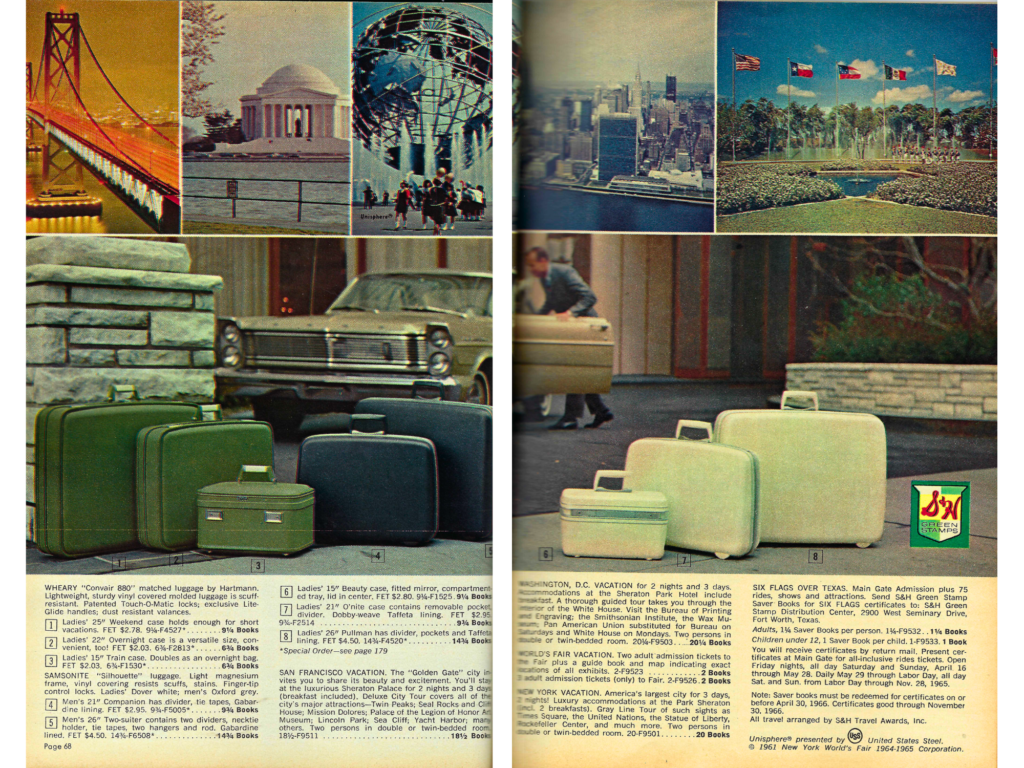
Want to take a trip? Maybe a San Francisco trip for two including hotel and deluxe tour (18 1/2 bks) or admission for two to the World’s Fair, a guidebook and a map (2 bks). Need some luggage? A Samsonite Silhouette 26″ two suiter (14 3/4 bks) or beauty case (9 1/4 bks) would be useful.
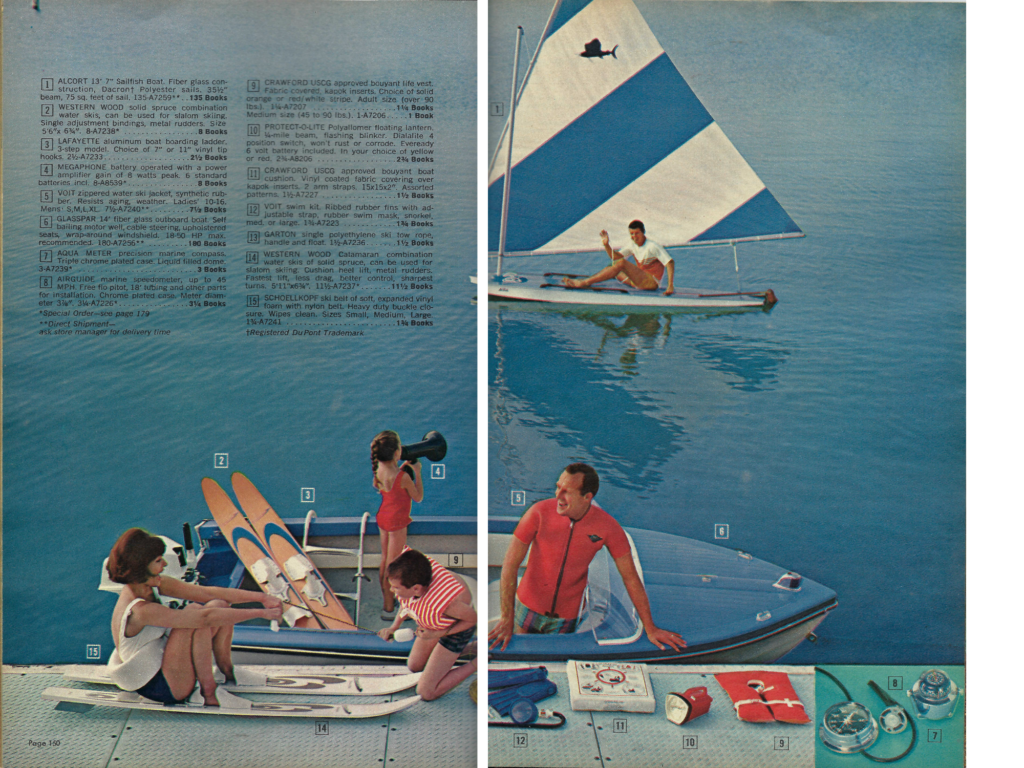
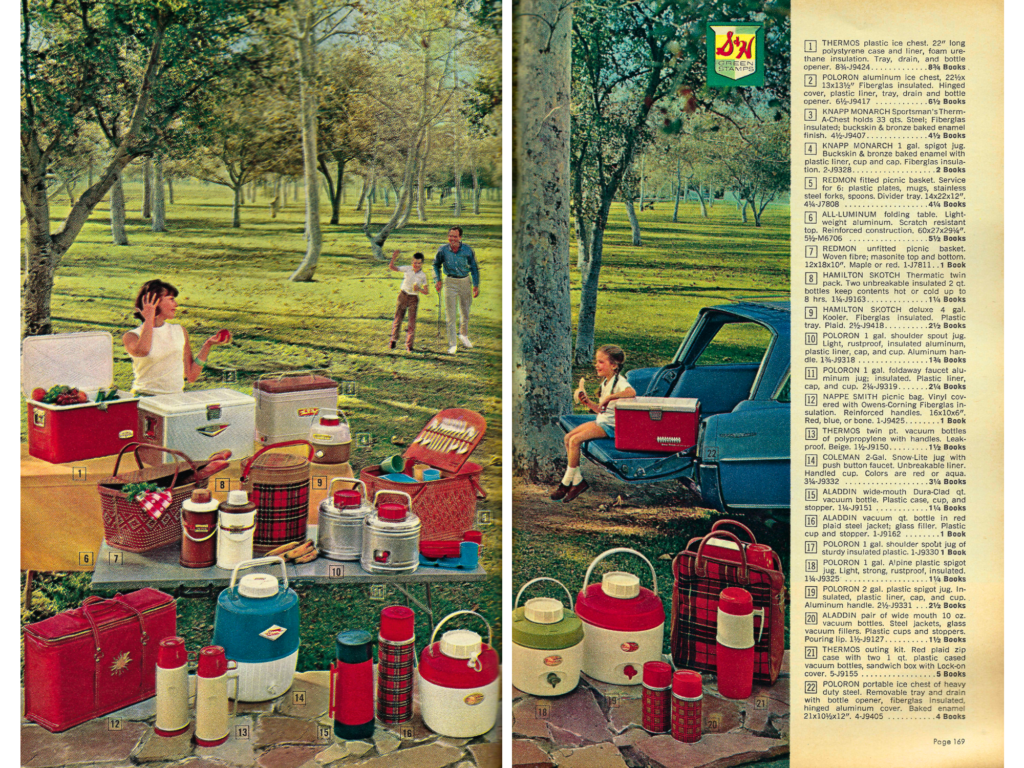
Maybe you wanted something to make your leisure time more enjoyable. A Glasspar 14′ outboard boat (180 bks), Western Wood waterskis (8 bks or 11 1/2 bks) and Schoellkopf ski belt (1 3/4 bks) would be just the thing. (I learned to waterskiing on that kind of ski wearing that kind of ski belt.) Or plan your picnic with a Poloron aluminum ice chest (6 1/2 bks), a Redmon picnic basket (1 bk or 4 1/4 bks) and a Coleman 2 gal. jug (3 1/4 bk).
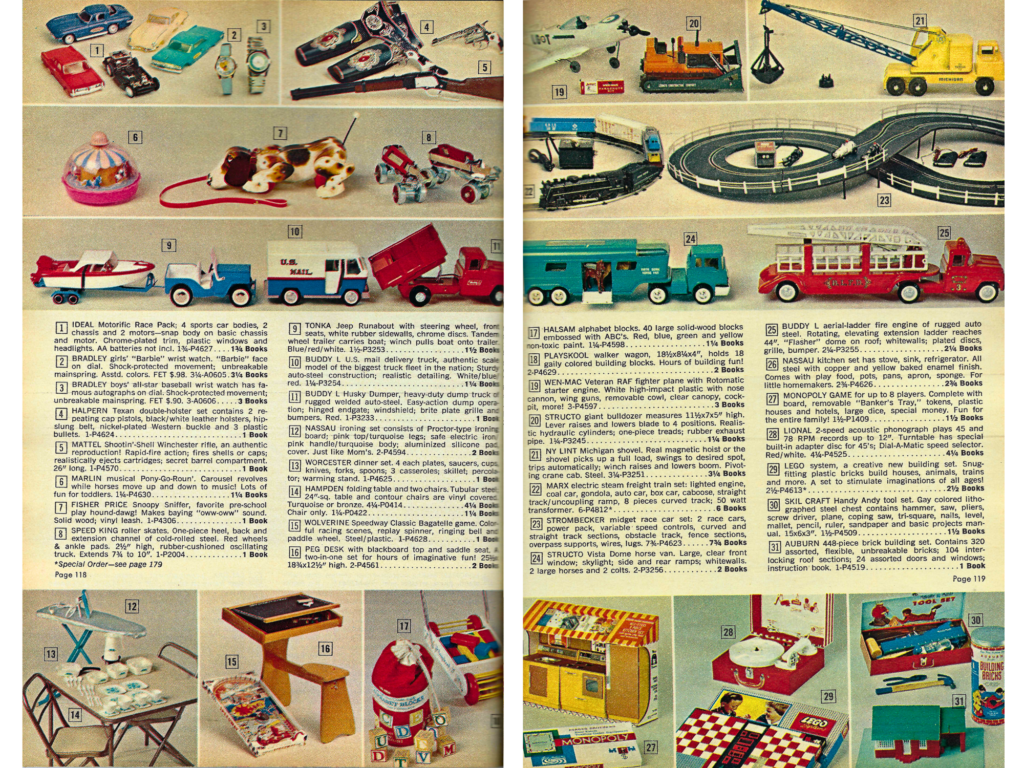
Fun and games could be had. Look at that Lego System, “a creative new building set” (2 1/4 bks)! A Monopoly game (1 1/2 bks), a Fisher-Price Snoopy Sniffer (1 bk) and a Buddy-L firetruck would set you back (2 1/4 bks).
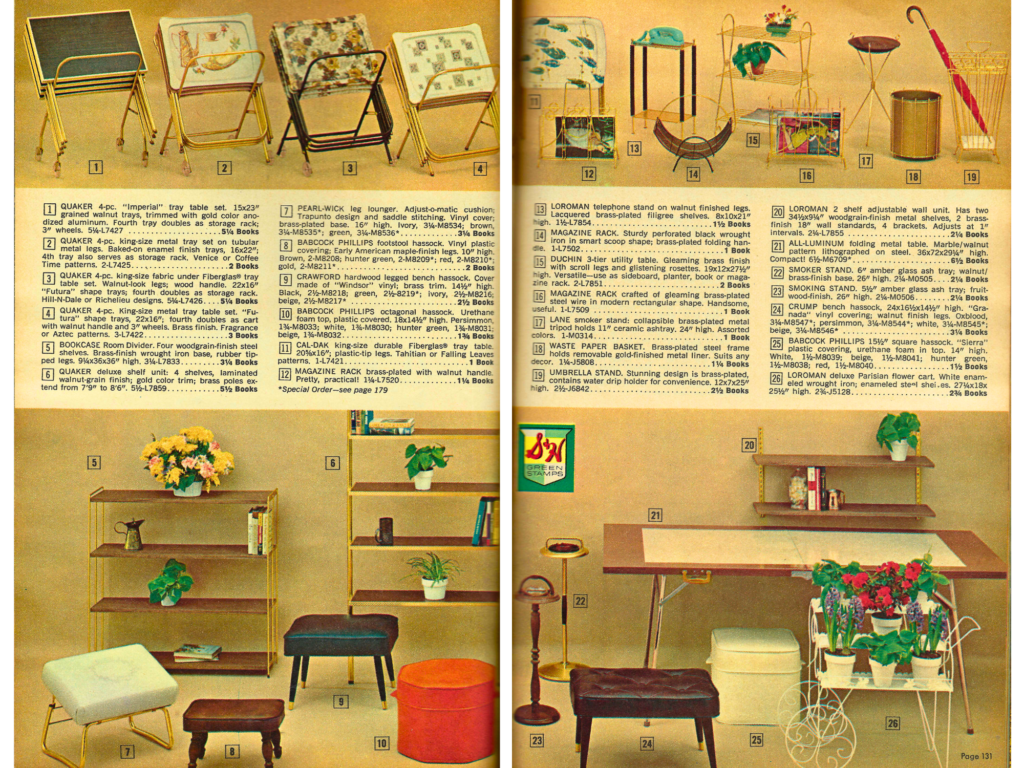
Without TV trays, life would be much more inconvenient. You could get a nice set of Quaker tray tables with a stand (2 – 5 1/4 bks). Or a Duchin three shelf utility table (2 bks), a Babcock-Phillips octagonal hassock (1 3/4 bks) or a All-luminum folding table (6 1/2 bks).
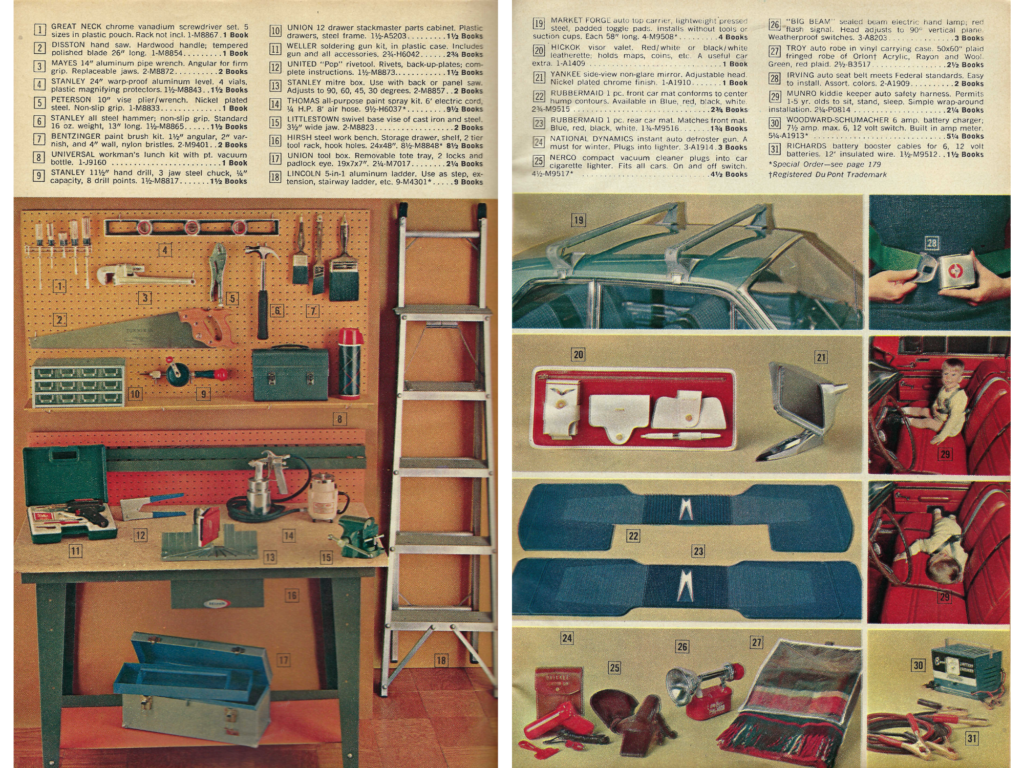
Finally, good things for your car and your workshop. A workshop needs a good saw–you could get a Disston hand saw (1 bk), and a Hirsch steel workbench (8 1/2 bks) or a Lincoln 5-in-1 aluminum ladder (9 bks). For your car, how about an Irving easy to install seatbelt (2 bks). And contemplate the Munro kiddie keeper auto safety harness, which let 1-5 year olds “sit, stand, sleep” (2 1/4 bks).
This was only the tiniest sample of the merchandise you could redeem your S&H Green Stamps books for. If you want to see a whole catalog, and I highly recommend it, Internet Archive has a full digitized S&H Ideabook from 1968. As a vintage seller and lover, it is a fun game to see what products I own or have sold that were originally offered in the catalog. The Mirro zodiac mold has come and gone from my hands 3 times and I’ve definitely had all the Fenton pieces. What can you find that you yourself own or have sold?