In 1880, William Morris, an iconic British textile designer, poet and craftsman, said “have nothing in your houses that you do not know to be useful, or believe to be beautiful.” That credo is a rallying cry for the minimalists of the world. The handmade wooden dust pan in this week’s fresh to market vintage embodies that thought. It was built to be useful, but it’s simple shape is aesthetically pleasing. The green paint made it beautiful in it’s prime, but the age and cracking make it even more beautiful now because of the honestly earned patina.
Simple objects, one of a kind things made for a specific purpose and used regularly, make the transition from utility to decor easily. It’s easy to imagine that dustpan on a shelf, showing off it’s history. Did the maker imagine it would still be around after a century? They certainly built it to last.
Handmade Wooden Dust Pan c 1920s
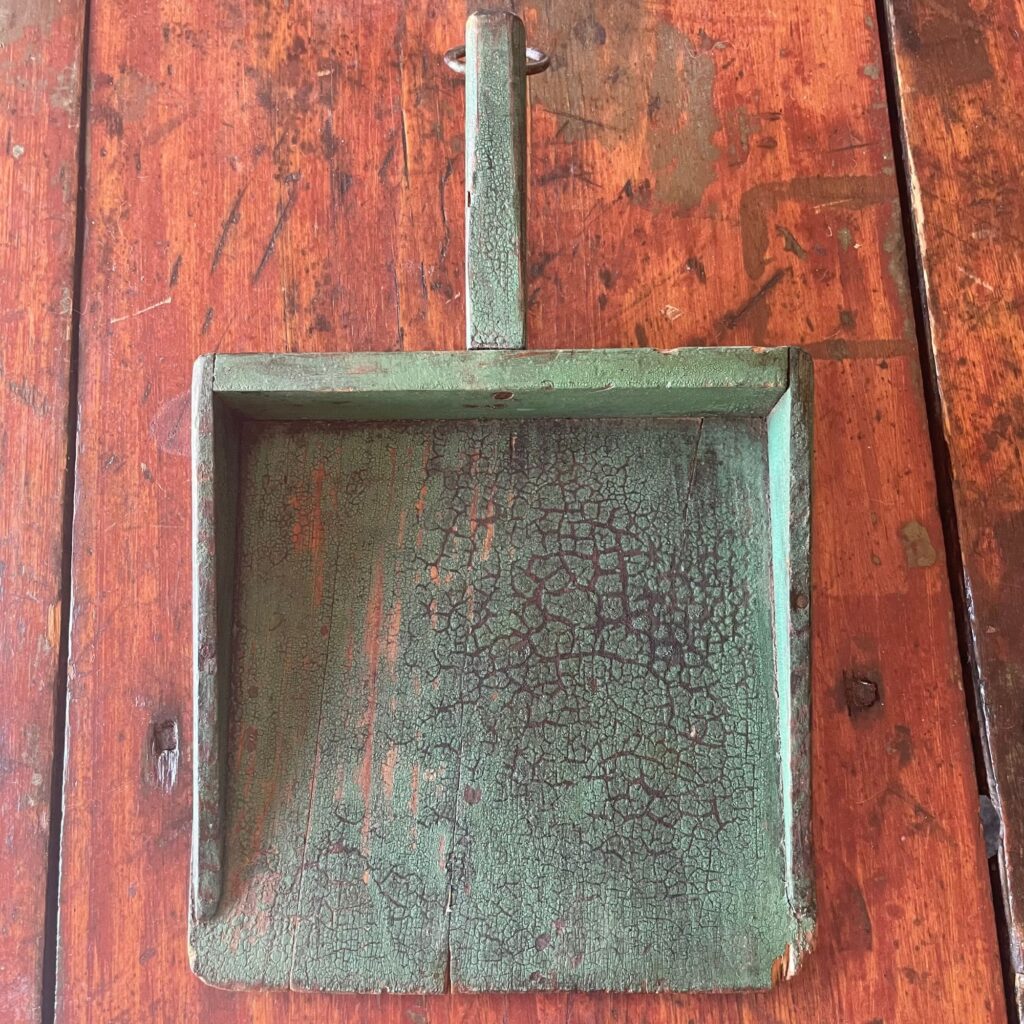
Another piece I’d love to know the backstory on. Suppose it was a housewarming gift or a gentle hint that the dust bunnies were out of control? We’ll never know, but the fact that something as mundane as a dust pan has survived for a century says something about the people who appreciate hand-made artifacts as works of art.
Folky Wooden Dust Pan, $65
Linda, Selective Salvage
Rhinestone Demi Parure
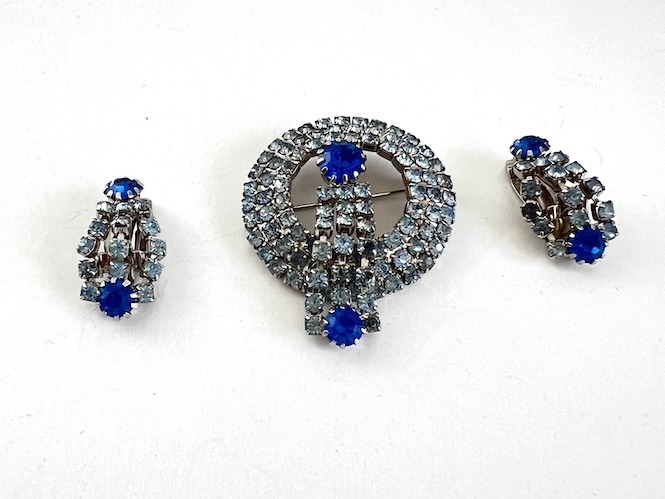
A parure is a full set of jewelry. In this case, the set contains only a brooch and earrings, less than a full set which is known as a demi parure or a smaller set. The brooch and earrings appear to have never been worn which is a shame as jewelry is meant to be worn. As June tends to be wedding season, these would make a nice addition to the something blue, following in the Victorian tradition of something old, something new, something borrowed, something blue.
Blue Rhinestone Demi Parure, $44.95
Pam, Vintage Renude
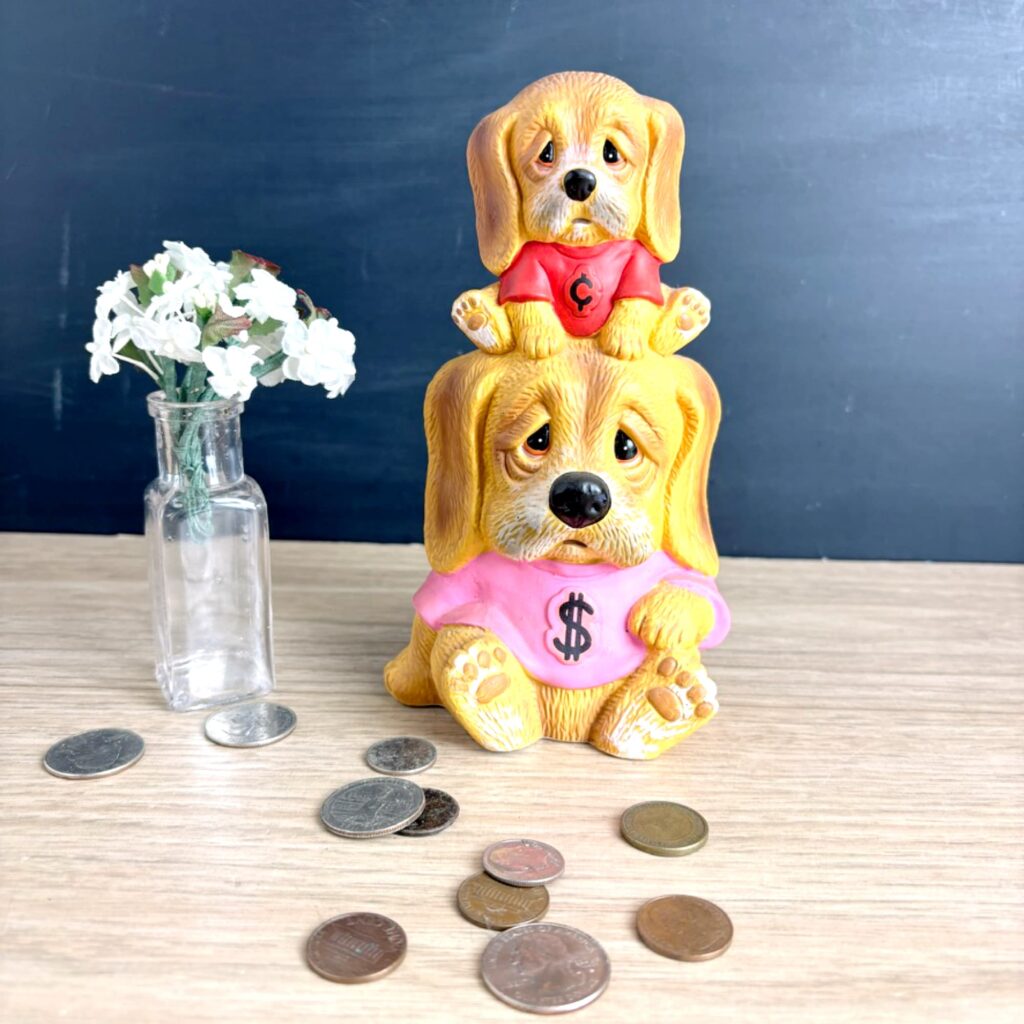
1980s Enesco Critter Sitters Bank
The early 1980s were excellent years for licensed characters. You may be familiar with Strawberry Shortcake, the Care Bears, the Smurfs and Rainbow Brite. It’s estimated there were between 300-500 licensed characters at the time, mainly because of a change in the rule for how much advertising could be shown in an hour of children’s television. Prior to 1983, advertising during children’s programming was capped at 12 minutes per hour on weekdays and 9.5 minutes on weekends. The Federal Communications Commission (FCC) tore up restrictions in 1983, which meant toy and greeting card companies, for example, could make and air 30 minute animated shows which were not-so-covert advertisements for their characters, passing as programming. (Restrictions were reinstated in 1991 because of public pushback over these advertorial shows.)
This sparked giftware companies that didn’t make TV shows, like Enesco, Russ Berrie and Sanrio, to develop collectibles. They couldn’t compete with TV shows, but they could drench their character collectibles in emotional messaging and tie them in to life events like birthdays and christenings.
One of those character lines was Morgan Inc’s Critter Sitters, an anthropomorphic animal collection that was licensed to Enesco for giftware and Mead for school supplies and stationery. This adorable stacking dog bank was part of that line. It’s not just an adorable piece of decor, it’s a remnant from that character licensing boom in the early 1980s.
1983 Enesco Critter Sitters Stacked Dogs Coin Bank, $18.
Laurie, NextStage Vintage
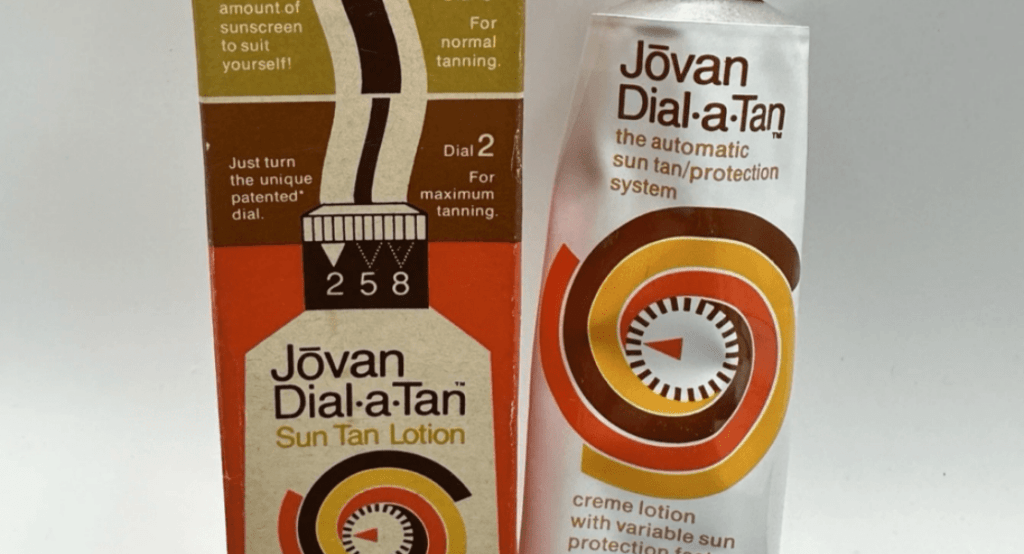
1980s Jōvan Dial-a-Tan Tanning Lotion
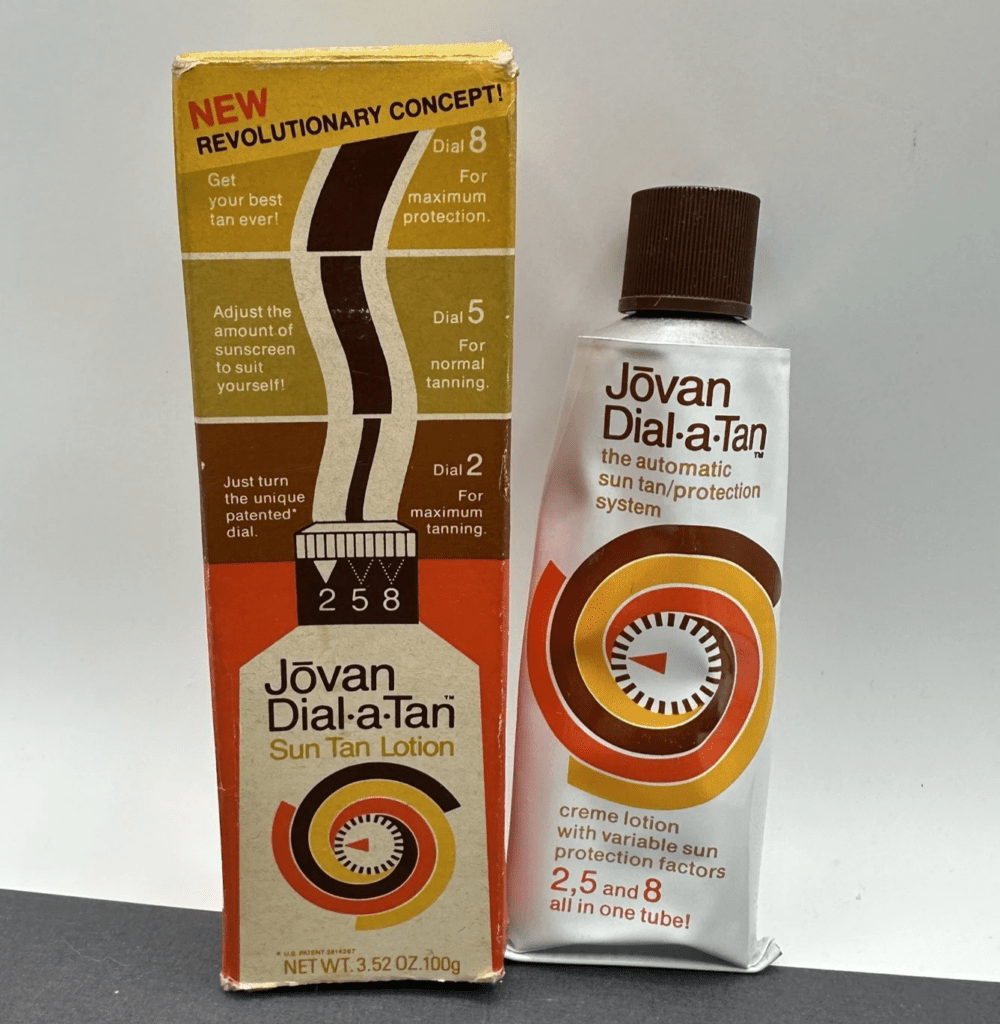
From the people who brought you musk oil, here’s a choose your own mix sun tan lotion tube. Jōvan Dial-a-Tan was introduced in 1982, with a clever concept that you could choose what amount of sun protection you wanted in your tanning lotion. Inside the tube were two chambers, one with a low sun protection factor lotion and the other with a higher protection factor lotion. On the neck of the tube was a dial. When you set the dial to 2, you got pure low protection lotion. When you set the dial to 8, the low sun protection chamber got sealed and you got all higher protection lotion. And if you picked 5, both chambers were halfway open so you got an even amount of both.
The squeezable tube worked perfectly in theory. In practice, people squeezed it unevenly, resulting in one chamber getting emptied faster. When one chamber was empty, if you set the dial to 5, you might get a blast of air from the empty tube or you might get a very uneven mix, resulting in unexpected sunburns. Unsurprisingly, Dial-a-Tan had mediocre sales and was retired in 1986.
Vintage 1980s Jōvan Dial-a-Tan Lotion Tube and Original Box, $39.99
Available from this week’s guest, HappytobeSeller
Innovation and ingenuity are things to applaud. Not every idea works as well as you think it will, as Jōvan found out with their Dial-a-Tan tube. It’s fun to see how things like cars, appliances and technology started, and how they are now.
We have a way for you to never miss one of our posts. At one time in the digital universe, this way was ingenious and innovative. Now it’s a little quaint, but it works. It’s an email subscription. Subscribe to our email newsletter and you’ll get one email a week with links to all our posts from the previous week. And rest assured, we would rather use a mimeograph machine to produce this blog than ever share your info.