
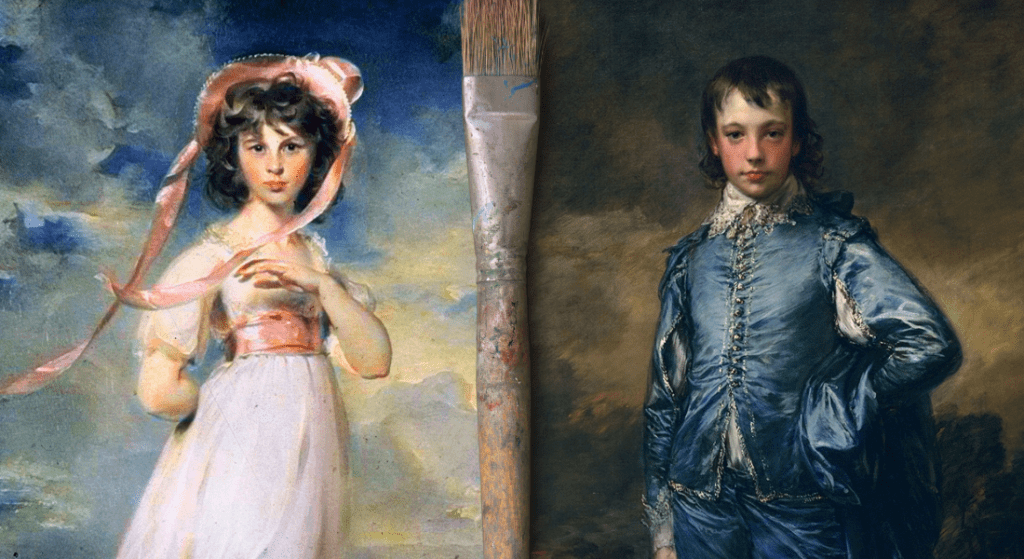
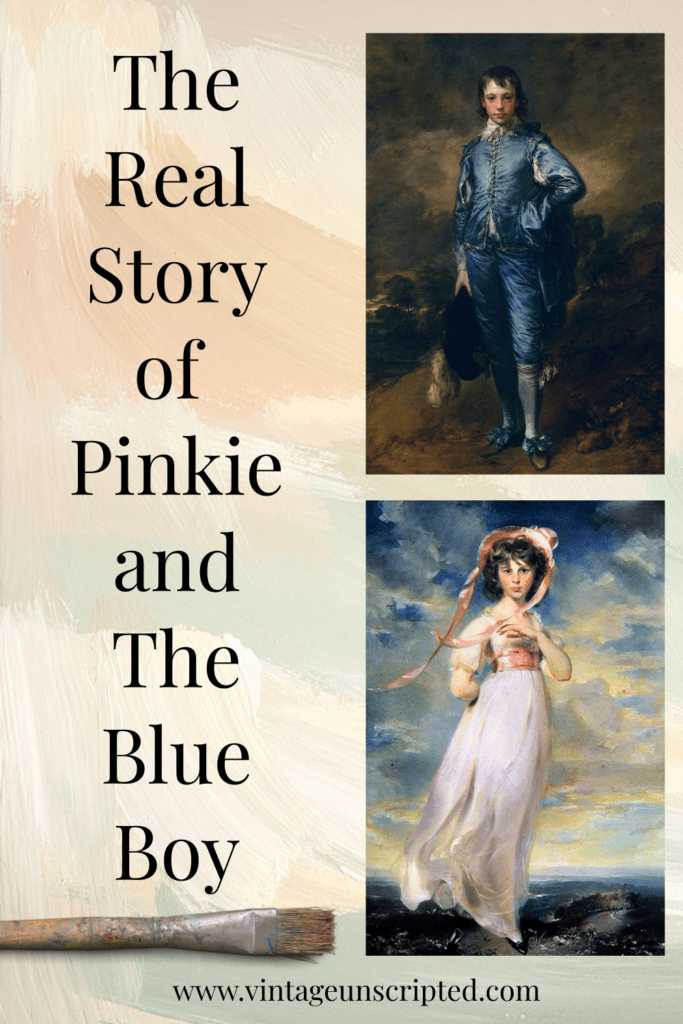
Two of the most beloved and most reproduced paintings in the world are Pinkie and The Blue Boy. Housed together at the Huntington Library in San Marino, CA, they are rich, opulent, romantic portraits. Brought to America from England in the 1920s and hung opposite each other, the public swooned, finding the paintings endlessly fascinating. In the 1940s, they entered popular culture and were reproduced on all manner of decor. Affordable prints of the pair hung in mid century homes, including Ward and June Cleaver’s house on Leave it to Beaver. Everyone knew Pinkie and The Blue Boy.
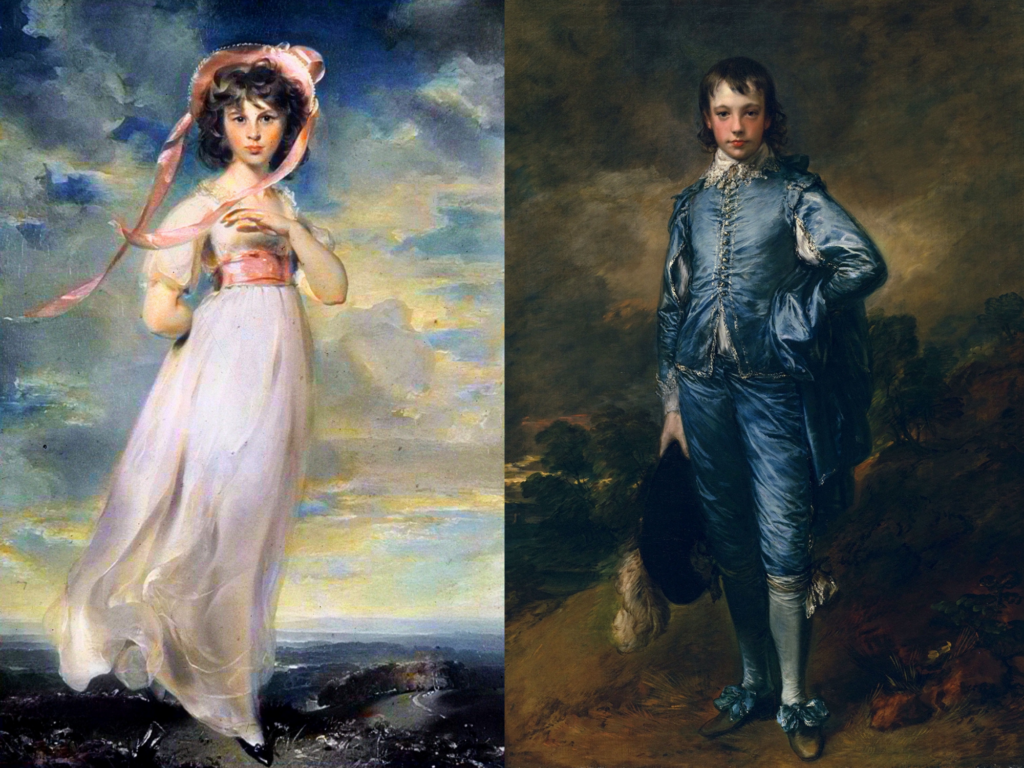
And of course, everyone imagined a love story. How could you not? They are forever captured in romantic perfection. But that story exists only in fantasy. The real story of Pinkie and The Blue Boy is not at all what you thought it was.
They were not painted by the same artist or at the same time.
The Blue Boy was painted by Thomas Gainsborough in 1770. Pinkie was painted by Thomas Lawrence in 1794. They were never exhibited together until they were united by the Huntingtons. Arabella and Henry Huntington purchased The Blue Boy in 1921 for $728,800, setting a record price for a painting. The Huntingtons purchased Pinkie in 1927. They have hung out together nearly continuously, with a few times apart for restoration or for being loaned to another museum.
Who were they?
There’s some uncertainty about The Blue Boy’s true identity. Conventional wisdom has been that the subject is Jonathan Buttall, a friend of the Gainsborough family and the first owner of the portrait. However, according to the Huntington website, an academic has suggested that it might be Gainsborough’s nephew, who is seen in other Gainsborough paintings wearing a similar suit.
Pinkie is a portrait of Sarah Goodin Barrett Moulton, painted by Lawrence at the request of her grandmother after she and her brothers left Jamaica to attend school in England. Eleven years old at the time she was painted, Pinkie, as the family called her, died a year later of an infection.
Even their clothes are from different times.
Gainsborough was an ardent admirer of Flemish Baroque painter Anthony van Dyck. The Blue Boy is dressed in historic clothing from the 1600s as a tribute to van Dyck.
Pinkie is dressed in the current fashion of the 1790s, when she was painted.
The first Blue Boy mania was in the late 1800s.
The Gainsborough painting was frequently shown at important exhibitions in England, which led to it capturing the attention of the public. People snapped up prints and tchotkes with the image. The blue suit entered popular culture, with both boys and girls wearing it as a costume for plays. The Blue Boy became the encapsulation of British high culture, which is why it was so wrenching when the painting left for America.
The joint Pinkie and Blue Boy mania in the US peaked in the 1940s -1950s.
Although there was great excitement when the two paintings were brought together by the Huntingtons in 1927, they achieved maximum popularity in the 1940s-1950s thanks to a post WWII craving for elegance, culture and romance. Manufacturers slaked that consumer desire with Pinkie and Blue Boy prints in all shapes and sizes, as well as vases, lamps, tapestries, figurines, decorative plates and just about every other decorative item you can imagine. This was possible because both paintings were were in the public domain, free of copyright, because both were painted before 1930.
Having Pinkie and The Blue Boy in your home showed that you had good taste and appreciated finer things. Having them was having Art. If you wanted artsier art, both Craft Master and the Art Award Company made kits so you could paint by number your own pair. (Modern kits are also available.)
After the mania, comes the kitschification.
Sometime in the 1960s, the every fickle gods of decor decided that Pinkie and Blue Boy were old fashioned and that modernism and minimalism were the thing. The reproductions slid into the kitsch category. This sad turn of the tide explains why so many vintage decor items featuring the pair are found at the back of closets and china hutches or in spare rooms at estate sales.
Some things are eternal.
Although Pinkie and Blue Boy are not essential decor as they once were, there are quarters where they are still much beloved. Maximalist, grandmillenial and romantic aesthetes all welcome them. And there are those of us who grew up with them in our homes, who love them as much now as then.
There is still plenty of love for the originals. When The Blue Boy traveled back to England for three weeks in 2022, 90,000 visitors turned out to see him. Stateside, the Huntington Library welcomes about 750,000 visitors each year. Although there are no specific stats, it would be hard to argue against the dynamic duo of Pinkie and The Blue Boy being one of the magnets that draw those visitors.
It would be a travesty to not include some interesting vintage finds starring Pinkie and The Blue Boy. Here are just a few of the many lovelies available.
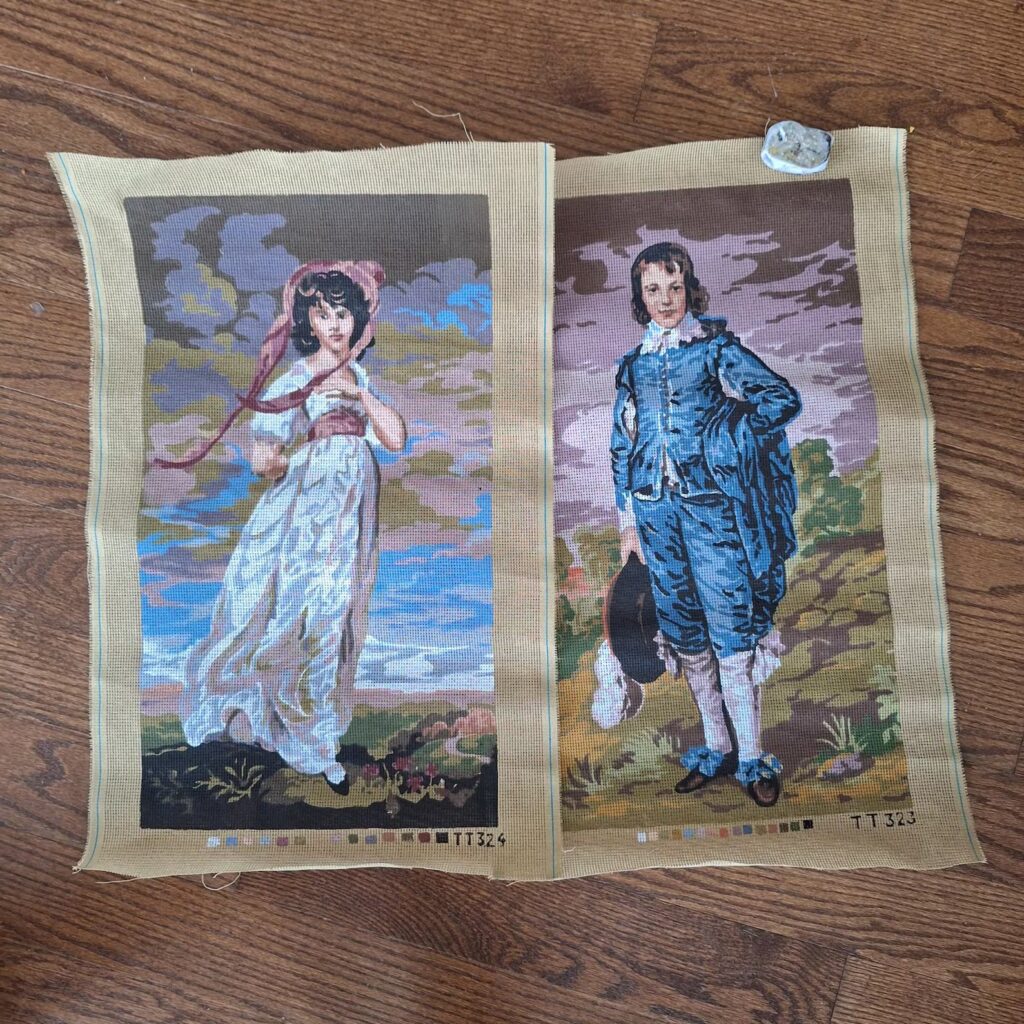
Put your needle to work on your own Pinkie and The Blue Boy with these vintage printed needlepoint canvases. All the little details would be fun to stitch. $80. Available from PopFizzQuilts.
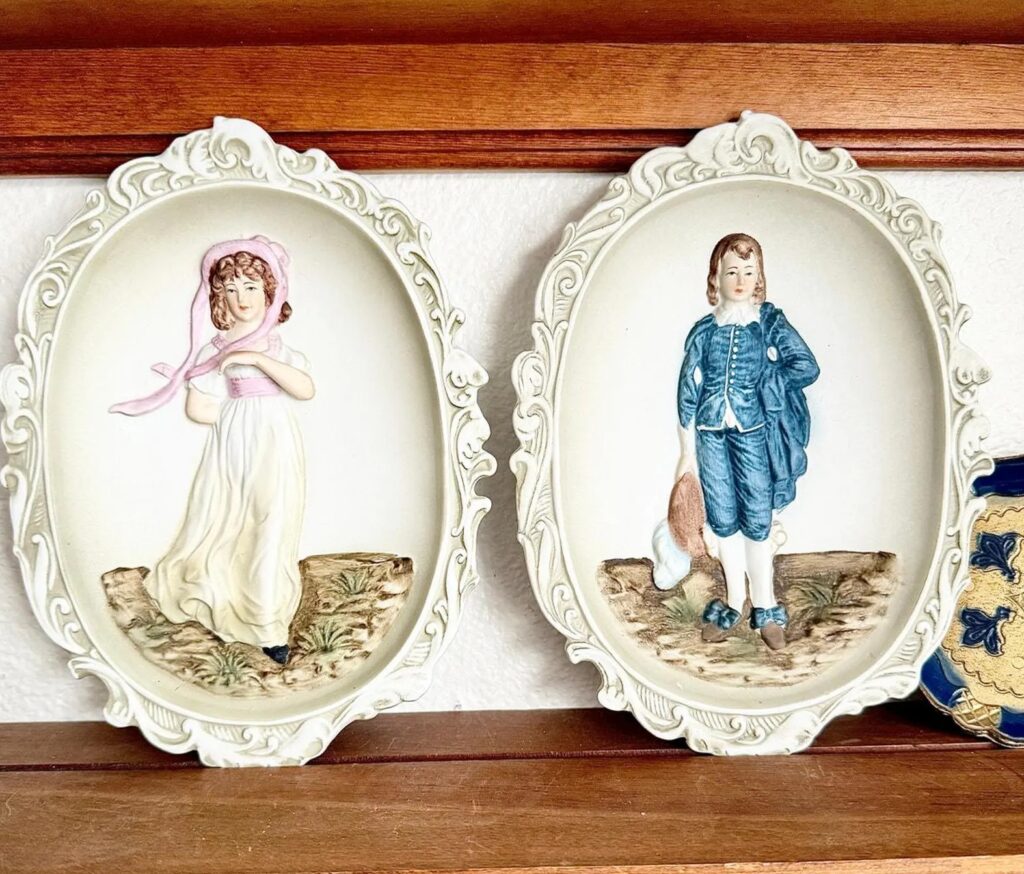
This pair of bisque wall plaques by Lefton are finely detailed and beautifully made. Imagine these in a grouping with other relief wall plaques. $50. Available from VintagebySkyanne.
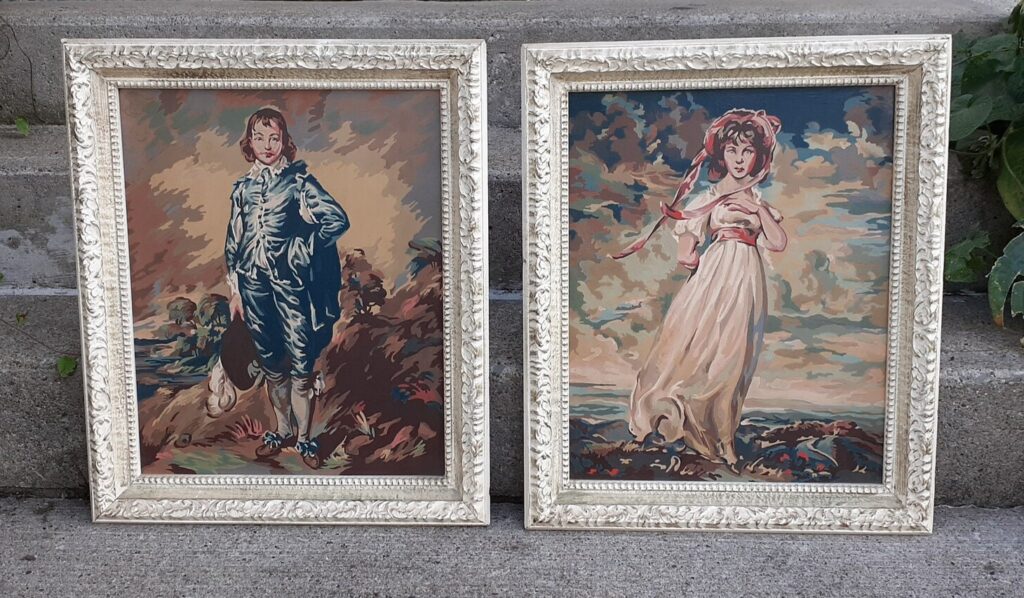
No post featuring decor inspired by Pinkie and The Blue Boy would be complete without a pair of paint by numbers. Everything about this pair is magical, right down to the frames. $249.99. Available from rivertownvintage.
There is so much more to this story, like the beef between Thomas Gainsborough and Sir Joshua Reynolds that drove Gainsborough to use blues and moody colors for The Blue Boy. Here are some links to read more:
Project Blue Boy: History, Huntington.org
Blue Boy Mania: How Gainsborough’s Masterpiece Colored Pop Culture, Huntington.org
Arts: Pinkie, a somewhat catty recap of auction activity from December, 1926, Time.com
The Blue Boy Wikipedia page, which goes into the Gainsborough-Reynolds beef
The Pinkie Wikipedia page, which gives a family history of the subject

3 comments
Such an interesting and informative article about such a charming duo. Thank You Laurie for including my pair in your tribute.
I love the story I found these to painting in a thrift store and brought them for my mother years ago now I am looking for to more to hang in my living room.
Pinkie and Blue Boy forever!