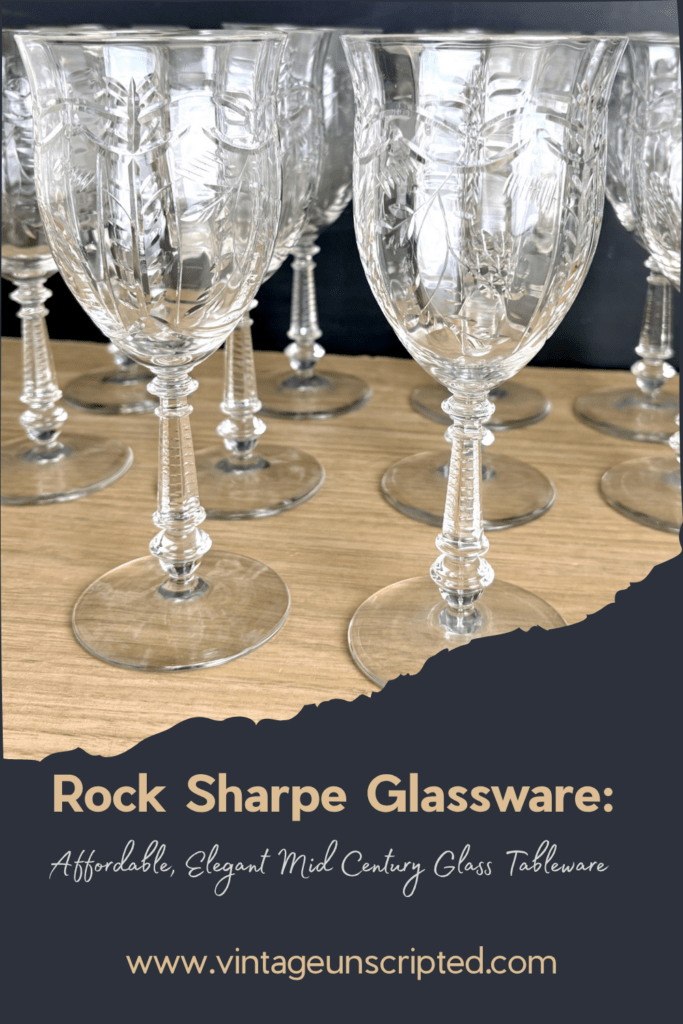
The year was 1934, give or take (no one knows exactly). The place was Buffalo, NY. Business owner Alfred Sharpe and his Vice-President of Sales Andrew Cunningham developed a line of mid priced but high quality stemware that was advertised in women’s magazines and was sold by major department stores. It was a line of aspirational glassware; an affordable, accessible product that genuinely well made. That line was Rock Sharpe glassware.
Alfred Sharpe had a twenty year history before Rock Sharpe. A former manager at Fostoria glass, Sharpe founded the Cataract Glass Company in Buffalo in 1914, which became the Cataract-Sharpe company in the early 1920s. Both companies were exclusively cutting houses. Neither made glass. High quality lead crystal “blanks” were purchased from glassmakers. Cataract and Cataract-Sharpe’s talented European (German and Czech mostly) glass cutters were steeped in Old World glass methods and pushed the envelope on cutting and polishing techniques with excellent results. The fine handmade and hand decorated stemware, tumblers and accessory tableware produced were deep cut and ornate, in keeping with the American Brilliant style of cut glass popular at the time.
There aren’t a lot of records from back then, which is frustrating for people who like all the details, like blog post writers. Add on the frustration that both companies acted as trade or wholesale cutting houses, making pieces for stores and other sellers so nothing was branded with the Cataract-Sharpe name. No catalogs, no markings, nothing for reference. They are probably made a lot of pieces sold and collected today, with the maker designated as “unknown.” Experts in American Brilliant glass have identified some Cataract pieces, through some magical research means. We admire them.
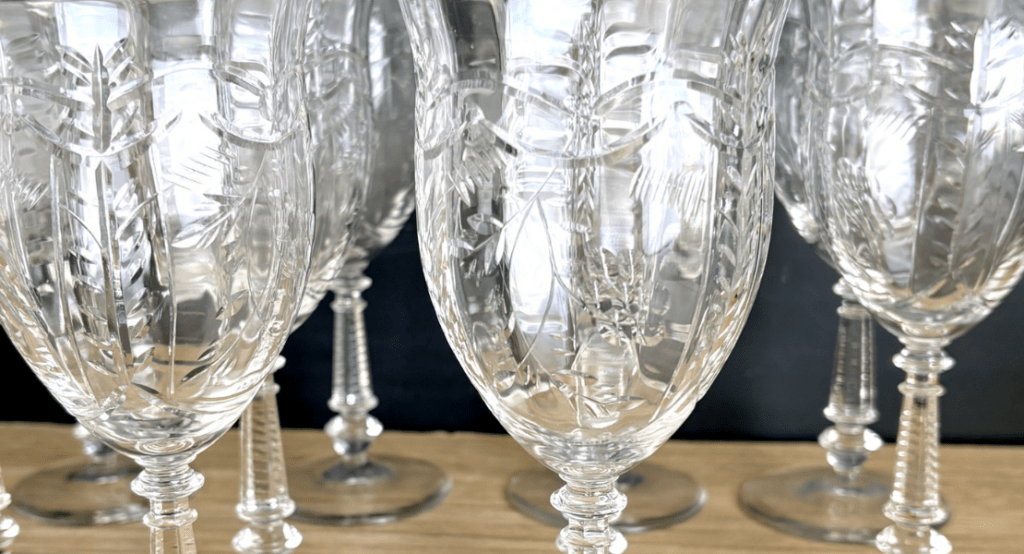
Rock Sharpe glassware is where the company’s paper trail begins, because it was the first glassware they made that was bore their name. There are advertisements and catalogs that provide documentation of the different patterns that decorated the different shapes of glassware.
As mentioned before, Rock Sharpe was positioned to be an affordable luxury, high quality glassware at middle market prices. Although it was produced during the Depression Glass era, it was an entirely different animal. The majority of depression glass was colored, sold in five and dime stores and given away as a premium with groceries and cleaning products. It was molded, with no decoration after the fact. Rock Sharpe was always colorless, always cut by hand and always sold in finer department stores.
Libbey, Heisey and Bryce Brothers were the main supplies of handmade glass blanks to Cataract-Sharp in the 1930s. Libbey figured out how to machine make stemware for the restaurant industry in the late 1930s, so they provided Cataract-Sharp with both hand and machine made blanks until WWII, when restrictions on production ground glassware making to a halt.

Stay with me here. After the war, in 1947, Cataract-Sharp was acquired by Libbey. Libbey itself had been acquired by bottle, jar and industrial packaging maker Owens-Illinois in 1935 as an add-on to expand the company into consumer tableware. (Since you asked, Owens-Illinois was formed when the Owens Bottle Machine Corporation merged with the Illinois Glass Company in 1929.) Libbey’s consumer tableware was a very small slice of the Owens-Illinois business. The point of adding Cataract-Sharp to Libbey was to add a higher end glassware above Libbey’s mass produced machine made pieces. It was a smaller slice of the already small slice. Arthur Sharpe stayed on, running the operation, which was renamed Sharpe, Inc.
In 1950, Libbey moved Sharpe Inc. from Buffalo to Toledo, OH. The Libbey factory that made their handmade as opposed to machine made glassware was torn down in 1951, ending that process completely for Libbey. After that, Sharpe, Inc. had to rely on machine made Libbey blanks or contract with other makers for handmade blanks. The hand cutting that had been the hallmark of Rock Sharpe before the acquisition was scaled way back and diminished in quality. Another possible difference is that the skilled artisans from Buffalo might not have followed the company to Toledo. At the end of the day, hand cutting didn’t fit Libbey’s drive towards automation. Molded patterns were faster to make. That is probably what led to the discontinuation of the Rock Sharpe line in the late 1950s.
There is a difference between Rock Sharpe glassware pre and post acquisition by Libbey. Cataract-Sharp was oriented for quality. Libbey was oriented towards mass machine production for commercial use. While some of the blanks Libbey provided to Cataract-Sharpe were machine made, the glasses were always hand finished by the skilled workers in Buffalo. After the acquisition, Rock Sharpe glasses were mostly made from high quality soda-lime blanks from Libbey, not lead crystal like they were under Cataract-Sharpe. This means that pre-acquisition glasses are more likely to have a nice sustained ring if you ting the rim. Post acquisition glasses will ring a little, but no where near as grandly. Also, because of the glass change, pre-acquisition glasses have more detailed patterns since leaded glass is softer and easier to cut. High quality soda lime is harder and no where near as forgiving, so the cut work had to be simplified.
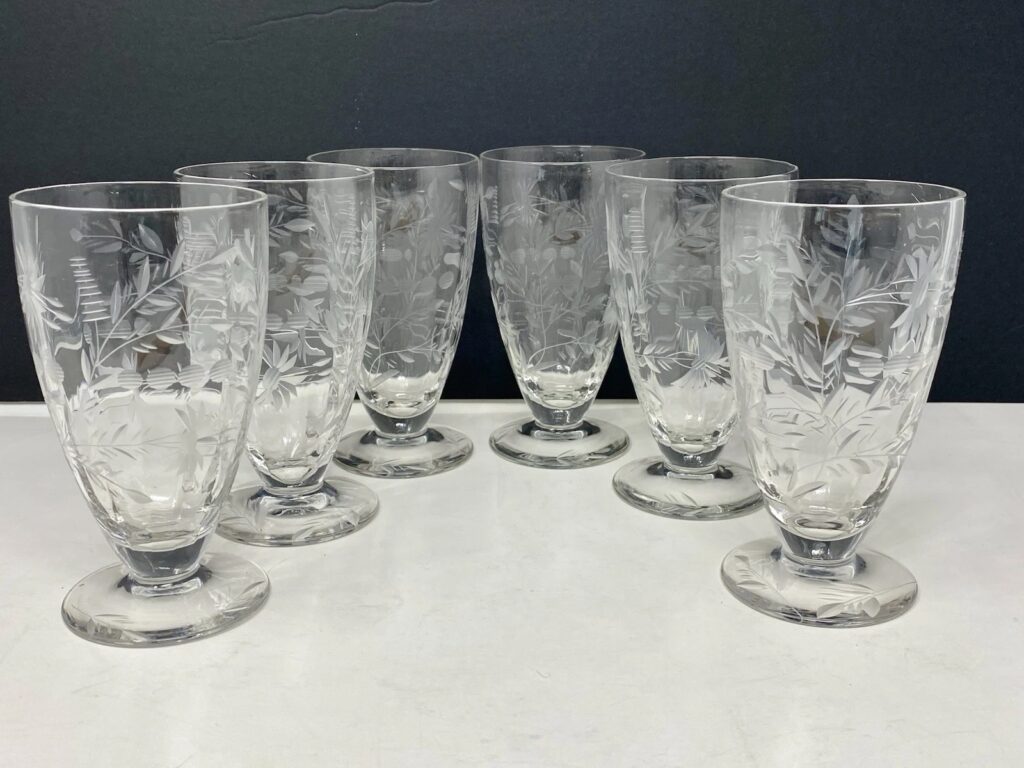
In today’s market, the pre-war pre-acquisition glassware is considered more desirable because of the quality difference. Back in the day, the most popular pattern was Charleston. What’s popular today is a matter of opinion, there’s no one keeping stats, but Romance, Normandy, Halifax and Marina are often noted.
Some of the patterns extended from the Cataract-Sharpe days into the Libbey days. It would be fascinating to be able to compare before and after pieces.
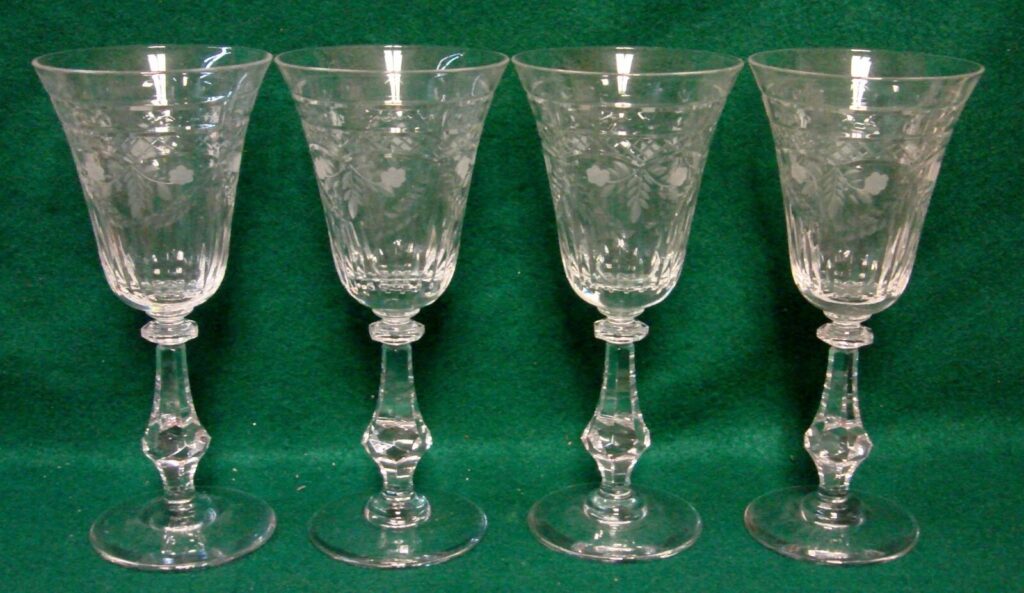
Not every pattern has a name. The blanks used have been given numbers for collector use. Many different patterns could be cut into the same blank. On Replacements.com, there are 32 patterns that use the 3005 stem blank. Some have names, some only have numbers that were possibly ascribed later.
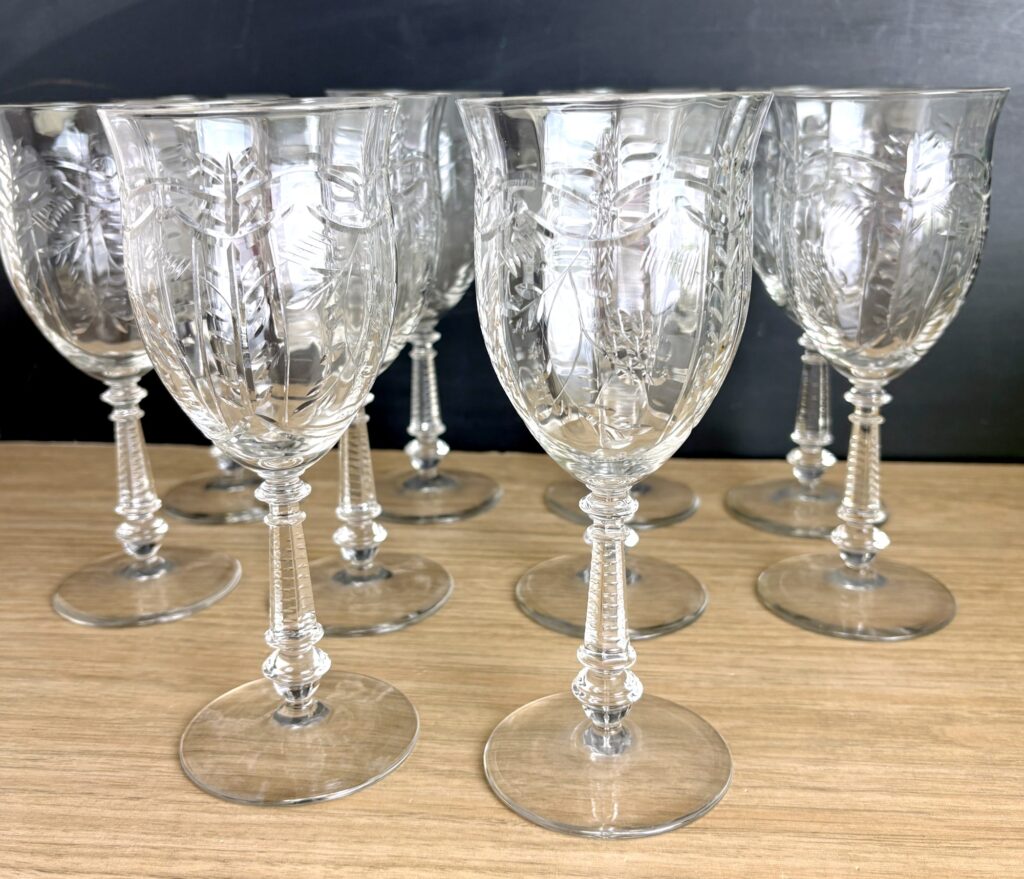
If you are attempting to replace pieces that have fallen asunder, the first place to start is to identify the stem as its the easiest thing to match, and then look at all the patterns.
If you’re looking to outfit yourself with a stemware set, there is no better brand to collect than Rock Sharpe. It’s pretty. It’s durable. It’s available on the vintage market. And it is infinitely nicer than anything you will pick up at a big box store.
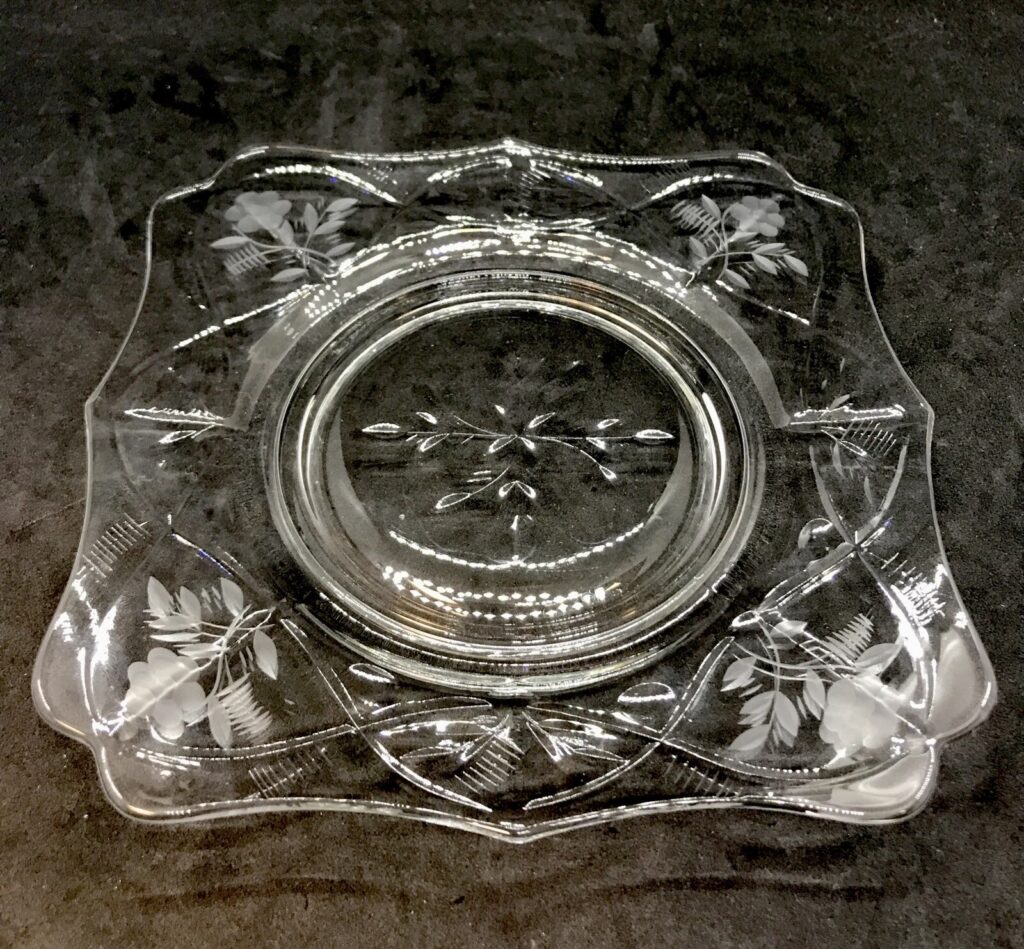
Rock Sharpe also included luncheon and dessert plates with some of their lines, which add extra swagger to your table for special events.
As a postscript to Libbey’s foray into fine glassware, they took one more run at it with the 1818 line, a machine molded handcut-esque line that debuted in 1959. There were four patterns, named after Colonial America locations: Jamestown, Raleigh, Williamsburg and Yorktown. Libbey’s Hail Mary attempt to compete with other prestige cut glassware market using machine production didn’t work. The 1818 line was only in production for two or three years, and it’s demise marked the departure of Libbey from the fine glassware market.