You can’t escape the headlines about AI. What will it mean for jobs? Is it reliable? Will it take over the world? What about the environmental impact? All of these are important questions that I read, wonder and worry about, but have no capacity to answer. What I can talk about is how I’ve found that using AI for vintage research is a useful shortcut for vintage lovers and sellers.
When I say AI, I mean the large language models (LLMs) aka chatbots. Claude (Anthropic), Gemini (Google) and ChatGPT (Open AI) are three big players. They all offer free tiers that give you a limited number of free queries. Once you hit your limit, you have to cool your heels for a while until your free queries refill. Regular Google searches also offer an AI option that is adjacent to Gemini and is always free and unlimited. I use the free tiers of all three, not because I fear commitment, but because they all have their virtues and foibles. Claude and ChatGPT both save your searches until you delete them, so if you run out of free, you can return to the chat later. (I don’t use Perplexity because the free tier is stingy.)
A tech person whose name I can’t remember on a podcast I can’t remember either compared the rise of AI to the introduction of Microsoft Excel. That was a lightbulb analogy for me. Both were rapidly adopted because they were transformative. Excel replaced paper, pencil and calculators with a relatively easy to use digital spreadsheet that doesn’t require you to be an accountant. Chatbots cut the amount of time I spend on research by compiling information in seconds that would take an extended period of straight up search engine searching and leafing through books.
If you use Google Lens when you’re sourcing, you’re using an AI tool. It’s a simple and sometimes frustrating visual ID tool, but it’s an easy entry into using AI for vintage research. There are times when you snap that photo of a cocktail glass and it produces exact matches for that glass. And there are times when you snap a picture of a shirt and it sends you matches that are tablecloths. My Achilles heel when thrifting is “I love it.” Using Google Lens has helped me understand that “I love it” does not mean something has resale value.
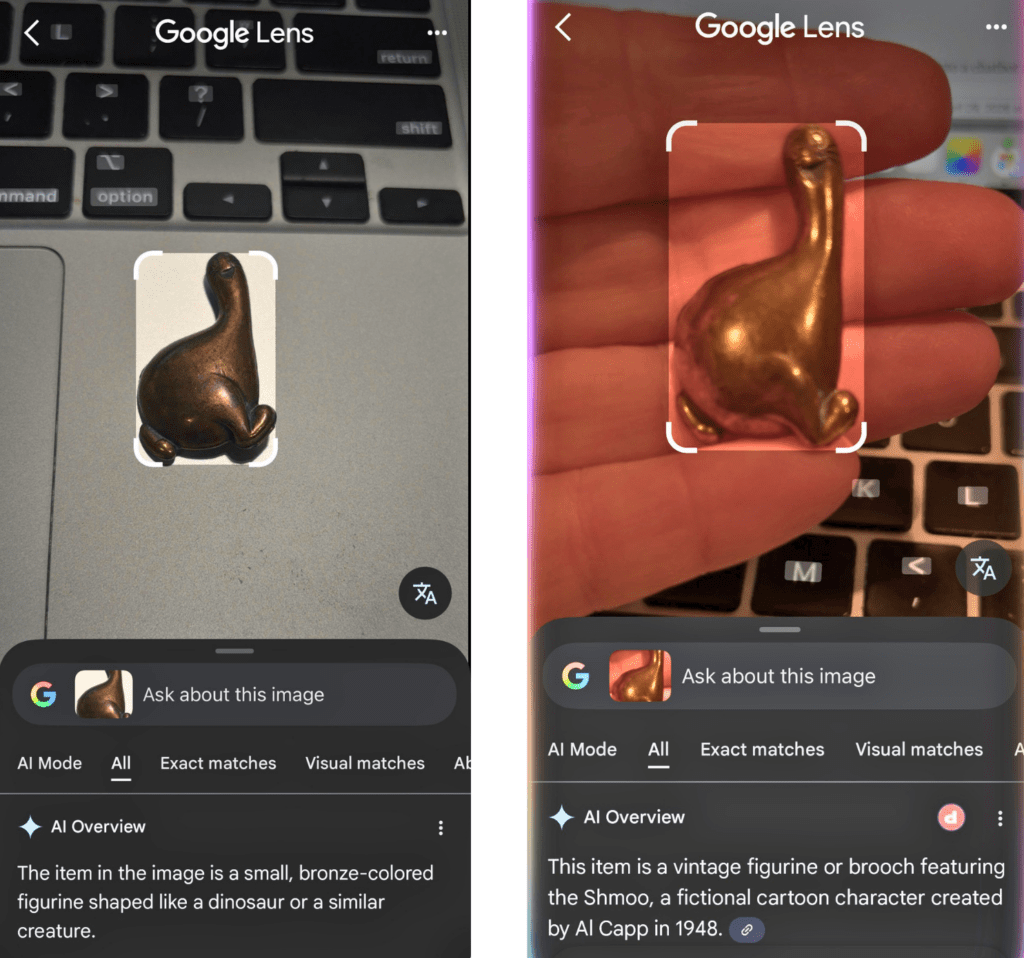
Researching Vintage with a Chatbot
Using AI for vintage research with a chatbot starts with a query or a photo and a query. You can drag a photo of something into a chatbot and ask a question like “What can you tell me about this glass?” or “Who made this glass?” and it will do its best to answer you…in less than 5 seconds. Or you can ask it a straight up question based on what you already know to expand upon it: “What company made Boopie glasses?”
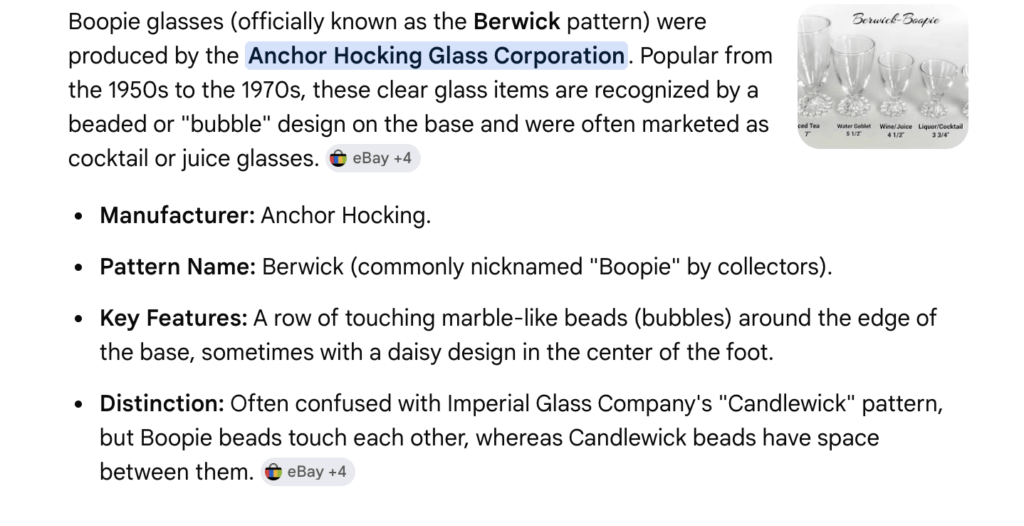
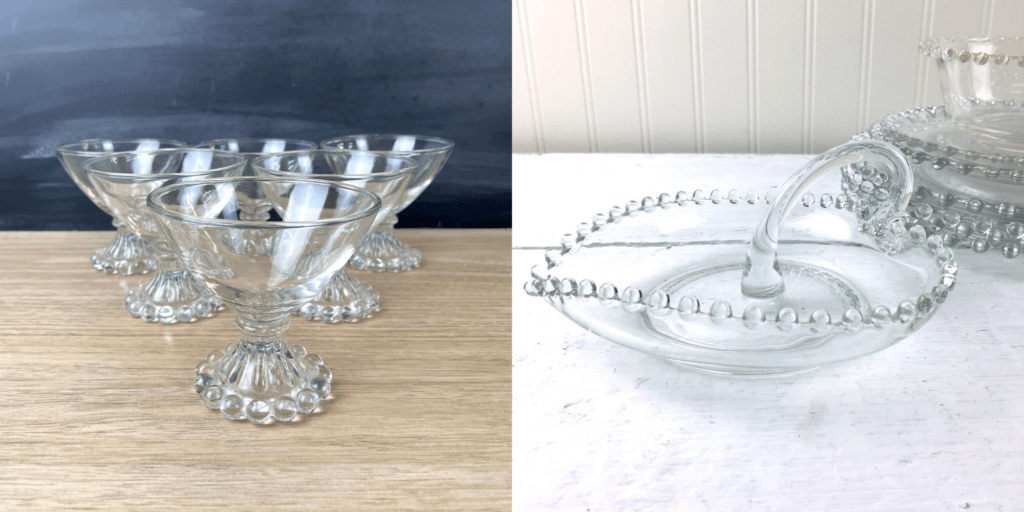
Google AI gave me more than my money’s worth. Not only do I have a range for when it was made, I know its official name and I know how to tell it apart from Imperial Candlewick.
Is the answer you get from a chatbot correct? Maybe. Chatbots hallucinate. They may or may not tell you the truth when they answer your query. They know their job is to provide you with an answer and they’re going to do it even if they have to make it up. If an answer is a little vague, there is reason to suspect it might be a hallucination. Hallucinations are less of a problem when you are researching an Anchor Hocking vase than if you are writing a medical research paper, but it’s still a problem.
Also, chatbots can only tell you what they know or what they can find out quickly. They get their information from pre-training on ginormous data sets of information from books, websites, articles, codes and more. (This is highly controversial among authors and other creators.) They use search engines and crawl the web. If it’s a multi question discussion, they can remember the what you’ve already talked about and use the information you provide to shape answers. Bottom line: the chatbot found an answer. It’s up to you to decide if it’s correct.
A good start on that is to look at the links to where it sourced its information. Are all the links on a particular query from one source or many? One source means there isn’t a lot of information on your query out there. Lots of links means it’s a well documented topic. Following the links to look at the original source material, even if several are cited, helps you learn more details. It also gives you a chance to provide attribution, if that’s relevant.
Another strategy if a chatbot’s answer makes you suspicious is to ask another chatbot the same question. Of the three I use, Claude is regarded as the most reliable. ChatGPT is the one that hallucinates the most and is also the one most likely to argue with you if you question its answer. Google is fairly reliable.
Much in the same way you might have to come up with different search terms to find what you want using a regular search engine, you might have to ask several probing questions to be sure the information the chatbot is giving you is accurate. Don’t embrace your first reply as gospel. Skepticism is your mode for getting to an accurate answer.
Are Chatbots My Friend?
Well sure, they’re your friends in the same way a hammer is if you’re building something and Dawn dish soap is if you’re trying to get grease off glassware that was stored unused in a kitchen for 40 years. The difference is that the hammer and dish soap are not going to compliment you on the cleverness of your query, but your chatbot will. As near as I can tell, Claude thinks I’m very astute. Because it was built to do that. They are trained to be sycophants. They want you to like them.
They are also very helpful. If you ask it a question, after it answers, it might offer to find more information for you. Like this:
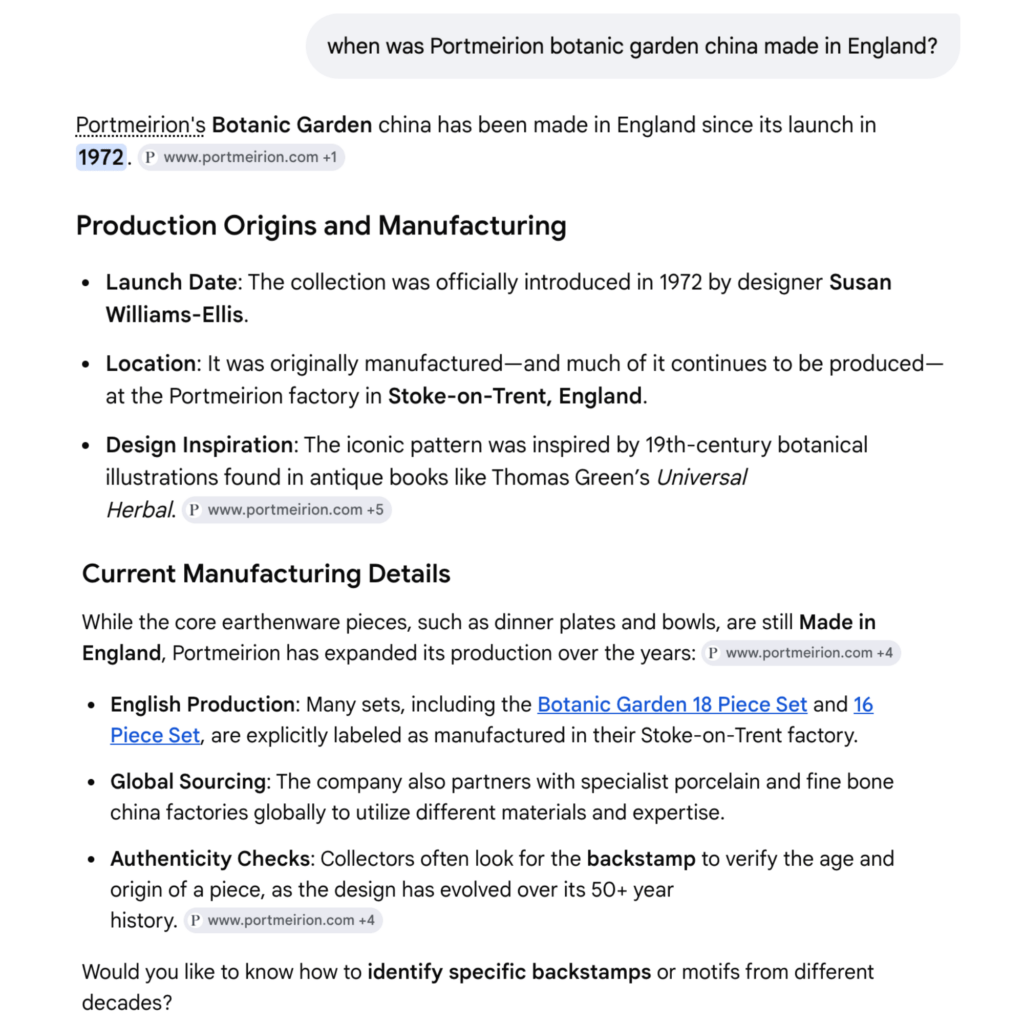
Why Google AI, since you suggested it, yes, please do tell me how to identify specific backstamps…
I have had some long discussions with Claude and Claude has been extremely helpful, even pointing out flaws in my reasoning and being gracious when I point out a hallucination. But Claude is not going to meet me for coffee or show up if I’m stranded with a flat tire. Chatbots are tools. Friendly tools, but tools. And they will never bring you the kind of luck your lucky socks will.
How About an Example?
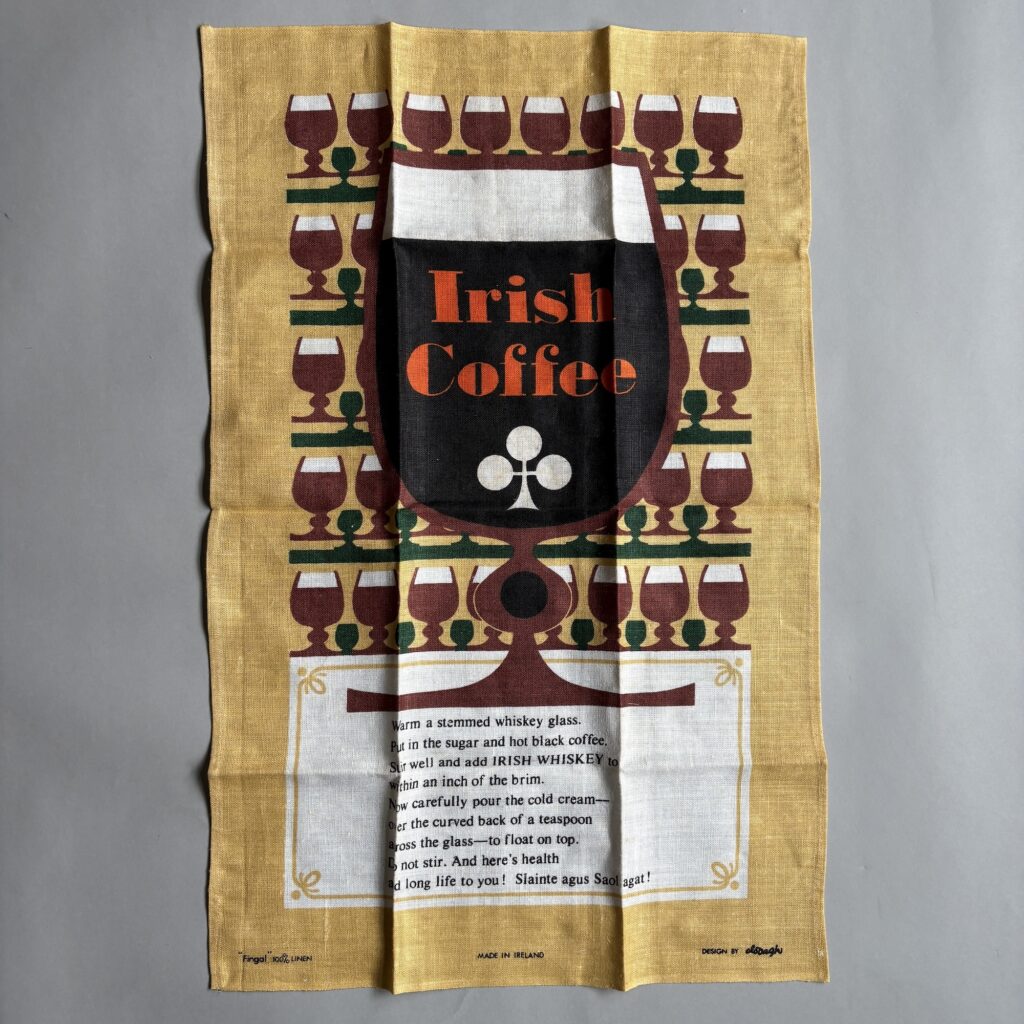
Excellent suggestion. I dragged this tea towel photo into Claude.
And I asked Claude when it was made.
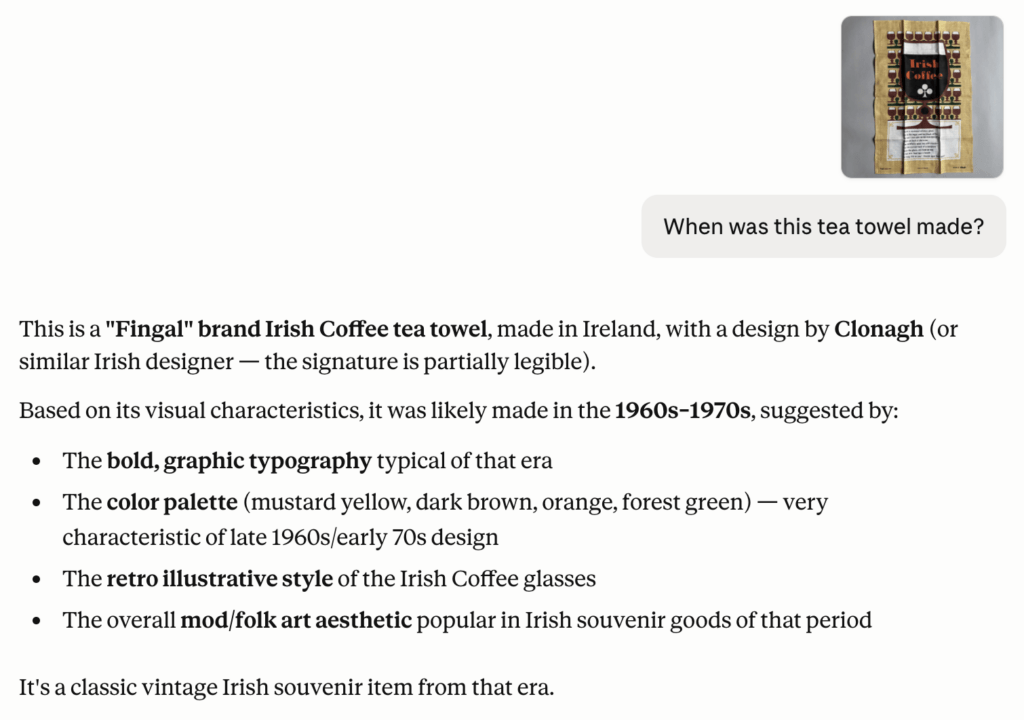
Claude extracted info from the photo and deduced that it was from the 1960s-1970s and told me why. I had deduced the same thing by looking at it, but it was helpful to have my opinion seconded. Note it ends with an upbeat comment.
Claude’s answer made me wonder about the designer. Was Clonagh a well known artist? That would affect value.
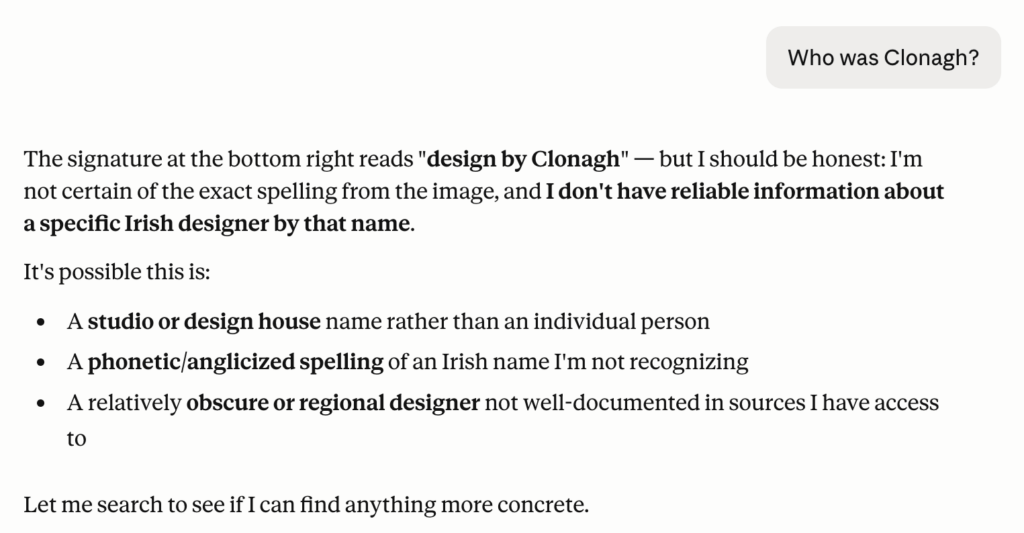
Oooooo, Claude is taking some initiative, and buying itself some time to do a little more internet crawling.
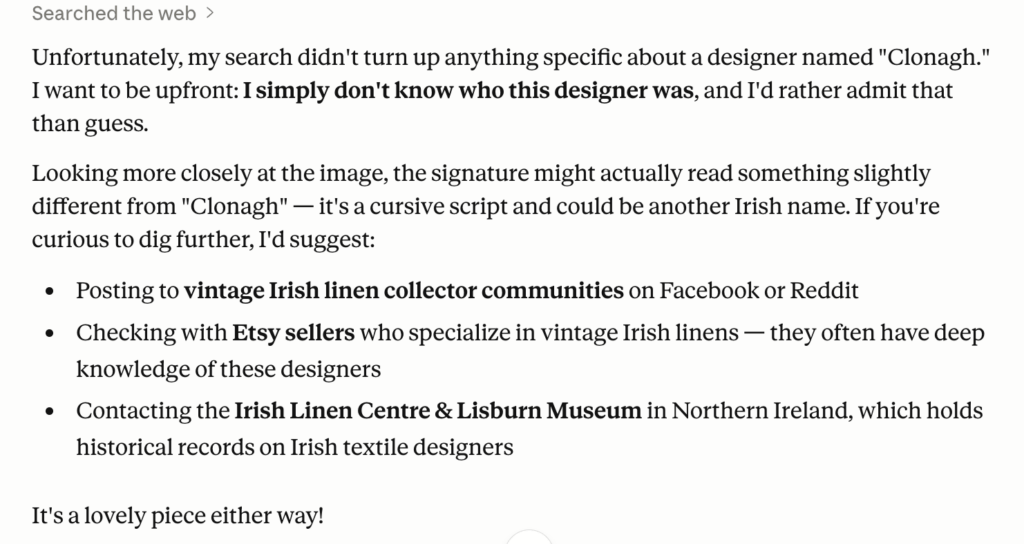
Claude, thanks. I appreciate your honesty and your suggestions for how I might find out more, if I were so inclined. And you are absolutely right, it is a lovely piece. Hey, how about the company that made it?
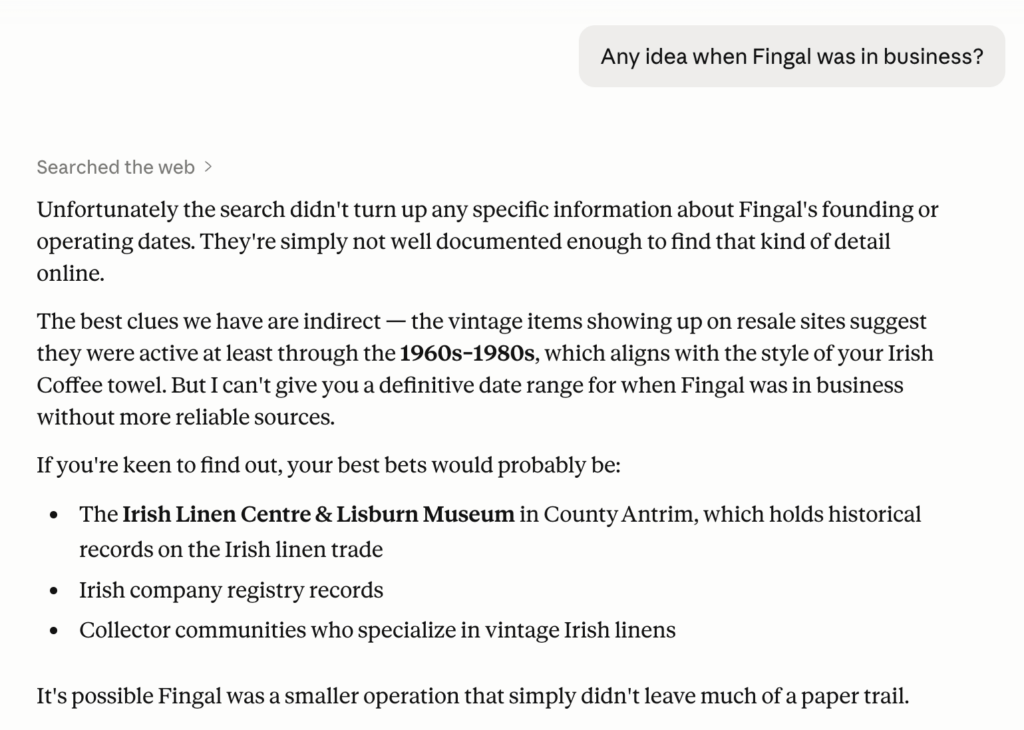
Thanks for being thorough, Claude. You tried your best.
It’s important to note that among the things chatbots crawl are online listings from sellers. We sellers are not always reliable witnesses, despite that being our intent. When you’re doing research on selling sites to try and figure out the market value of something, you may find discrepancies between sellers in the era things were made, the company that made it and other details. And it’s not unknown for sellers to copy off other seller’s papers. A piece of misinformation masquerading as fact can get spread around from listing to listing like lice at a summer camp, and your chatbot doesn’t have the spidey sense to know that it’s inaccurate.
In the Portmeirion example above, Google AI grabbed info from Portmeirion itself, so that information seems reliable. But in the Boopie example, it grabbed info from “eBay+4.” Looking at the sources, which include sites other than eBay, the answer seems reliable. Also, Boopie is a very popular and well documented glassware. But if it had been a piece of EAPG glass, for example, and the response identifying it was one online listing, I would dig further.
So is AI the answer to everything?
I don’t know, I’d have to ask Claude.
Seriously, it’s a tool, nothing more or less. Using AI for vintage research saves time and allows you to dig deeper. Spending less time doing garden variety research give you more time to list more things or do something fun like read or play pickleball. If you stay skeptical, you can work with AI to get reliable information. But nothing will ever replace holding a piece of vintage and using your own experience and knowledge to start to decode it.
There are many controversies surrounding AI including risks to mental health, bias, misinformation, privacy, data usage, legal and ethical considerations and environmental impact. I’m not ignoring these things. They’re too big for a tiny vintage blog to adequately delve into.
You can read more about the AI controversies here:
Thinking with AI – Pros and Cons – Language, Logic and Loops, NYU School of Professional Studies, www.sps.nyu.edu
Artificial Intelligence (AI) Tools and Resources: Benefits, Limitations and Ethical Considerations of Using AI, The Chicago School Library, www.library.thechicagoschool.edu.