
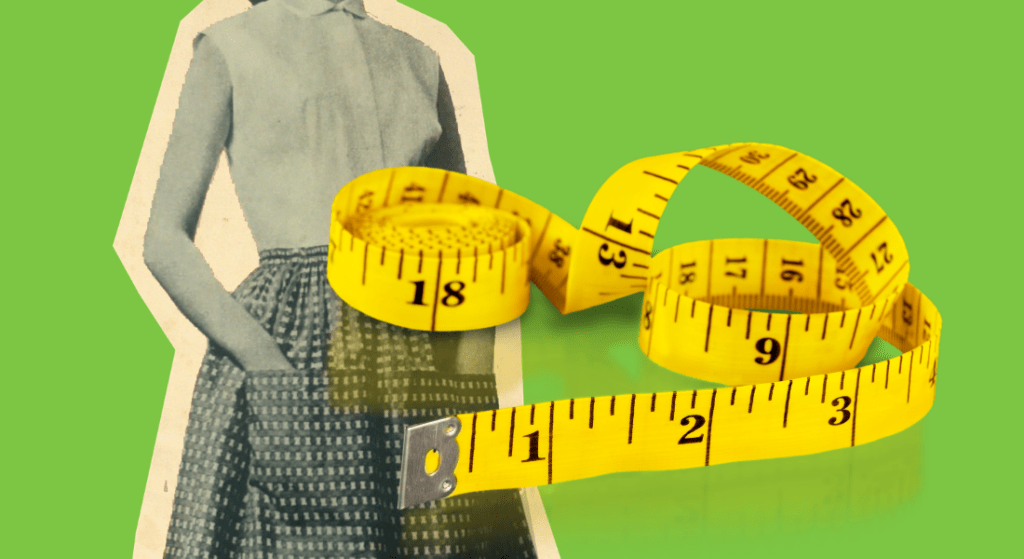
When you’re shopping for vintage clothing, particularly online so you can’t physically hold it, decoding vintage women’s clothing sizing is confusing. It’s from the 1960s. It’s tagged as size 16. I wear a size 16. So why does it look like a Barbie top compared to one of my shirts?
That difference is brought to you through the magic of sizing drift, which is the long-term, slow increase in the actual measurements of garments, despite them being labeled with the same size number. There are three reasons sizing drift happens.
First, people got bigger. If you’ve ever held up anything with a waistband from the 1950s or 1960s, you’ve probably asked yourself “Did women have rib cages back then?” Some waistbands are so tiny that it’s inconceivable that an adult human could actually wear it. The average American woman in 2020 weighs about 30 pounds more than a woman in 1960. Today’s average woman weighs what the average man did in 1960. And we only got a half an inch taller. (Duly noted there is no such thing as an average woman.)
Secondly, vanity sizing took control of size markings. Clothing makers knew that even though people were getting larger, they preferred smaller size tags on their clothes. So brands shifted size markings down. Vanity sizing led to makers starting to use size 0 in the 1990s and size 00 in the Y2K era–size numbers were pushed so low for vanity’s sake that they ran out of numbers for small sizes and had to go into the aughts.
Thirdly, in the mid 90s, manufacturers started using S, M, L alpha sizing. Stretchy things like t-shirts and dainties had been measured that way long before then, but in the 90s, stretchy, forgiving materials like Lycra and its friends burst into the casual clothing market. A 1960s cotton shirt had to be the proper size if you wanted it to button, a top with Lycra had more range. Manufacturers loved this. They could make garments in three or four alpha sizes instead of ten or more numerical sizes. International manufacturers loved it–S, M, L worked around the world. More alpha sizes were added in the 2010s, expanding the range to include XXXS through XXXL.
Are there any kind of mandatory standardized size guidelines?
Nope.
That’s why sizing varies so much by brand. I fit Gap size 16 pants, but the only way I can wear LL Bean size 16 pants is if I wear them under my buns, which is a fine look for a 90s sk8tr boi, but bad cosplay on a minimally feral old lady.
There have been attempts at standardized size guidelines for women’s clothing in the US.
During the Great Depression (1938-1941), statisticians Ruth O’Brien and William Grant, tried to solve this situation by weighing then taking 58 specific measurements on 14,698 women from across the US. In a shocking development, it turns out that women’s shapes vary greatly, so standardizing sizes was not easily done. Their final recommendation was this, as described by Wikipedia:
“…They proposed a three-part sizing system. Each size would be the combination of a single number representing an upper body measurement, plus an indicator for height (short, regular, and long) and an indication for girth (slim, regular, and stout). The various combinations of height and girth resulted in nine sizes for each numerical upper-body measurement, which was highly impractical for manufacturing.”
Not only were the sizing indicators unwieldy, the data was also suspect. The subject pool of women measured was heavily skewed towards low income women who participated to earn the small stipend. Many of these women were undernourished and thin. Also, women of color were completely omitted.
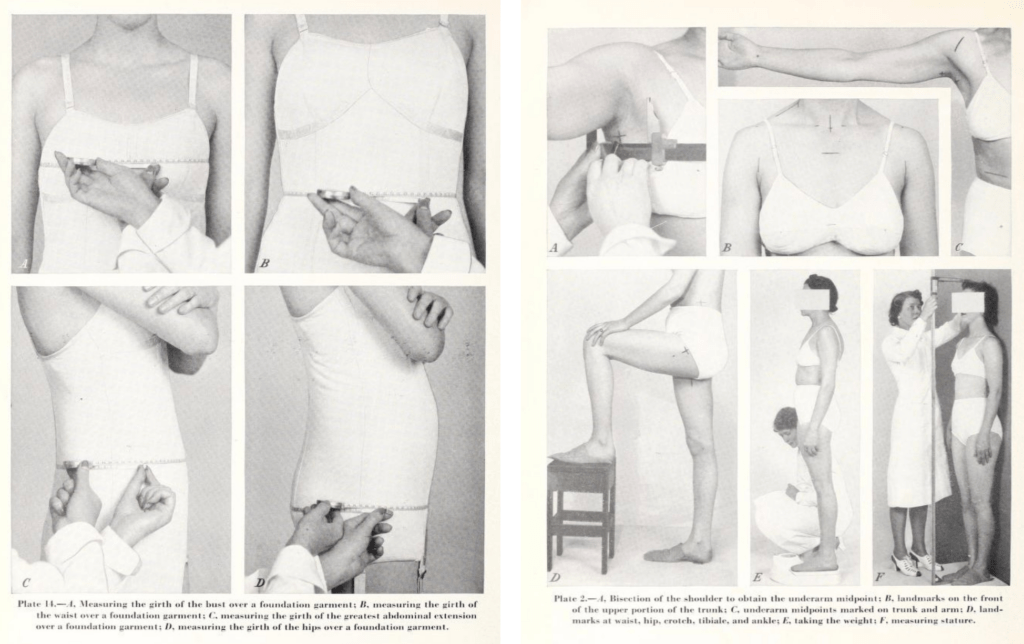
This study and their sizing indicator recommendations were scrapped.
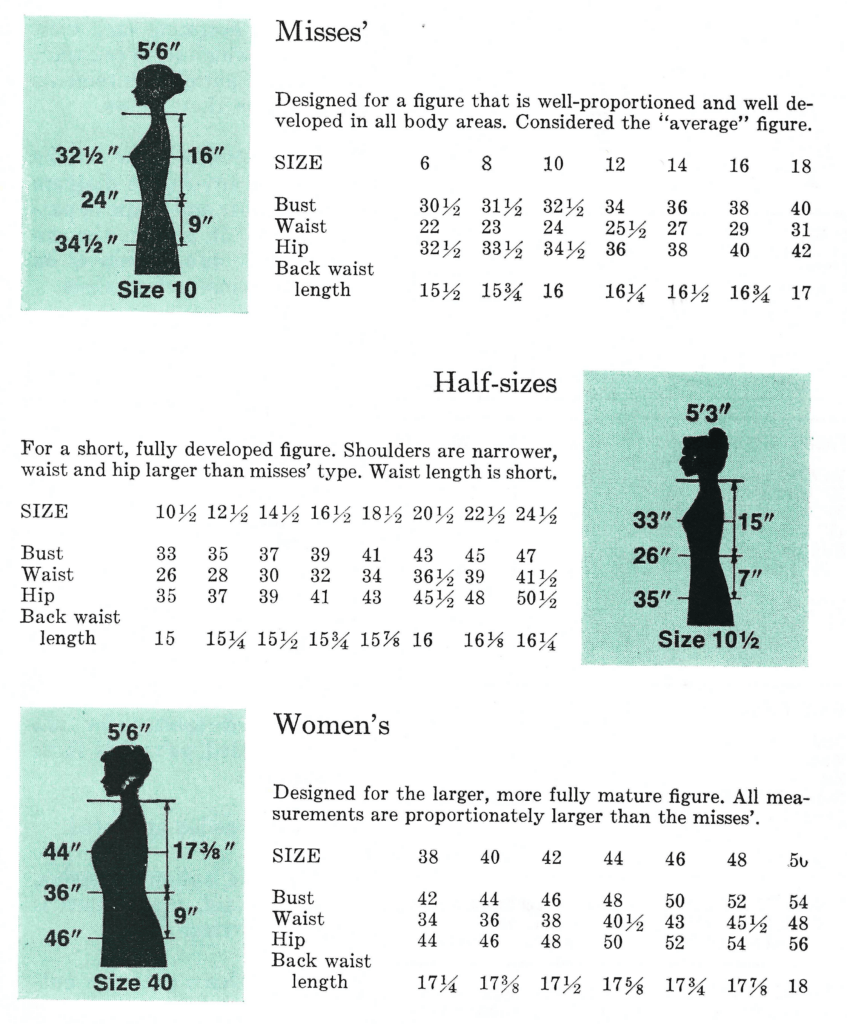
The next attempt at standardization was from the National Bureau of Standards in 1958, published as Commercial Standard CS215-58. It had a couple of problems. Their sizing was based on the O’Brien and Grant study, despite it being discredited. And there was great emphasis on the “hourglass figure.” Wikipedia describes their sizing system thusly:
“…using only the bust size to create an arbitrary standard of sizes ranging from 8 to 38, with an indication for height (short, regular, and tall) and lower-body girth (plus or minus).”
The clothing industry held its nose and signed on, despite the flaws. CS215-58 was revised and made voluntary in 1970, and tossed into the dustbin in 1983.
In 1995, the American Society for Testing and Materials (ASTM) published some voluntary standards. It was based on the 1970s revision of CS215-58, and focused on the “Misses” prototype, a 5’5″ woman with that damned hourglass figure again. The same year, ASTM also issued standards for women over age 55, acknowledging that body shapes change with age. (Now that’s a revelation.)
ASTM revised their guidelines in 2011 and again in 2021. The most current guidelines include data from 3D body scans, but have not been widely adopted. They’re mostly used by smaller scale makers who need a baseline before they establish their own sizing parameters. Bigger companies use their own vanity sizing.
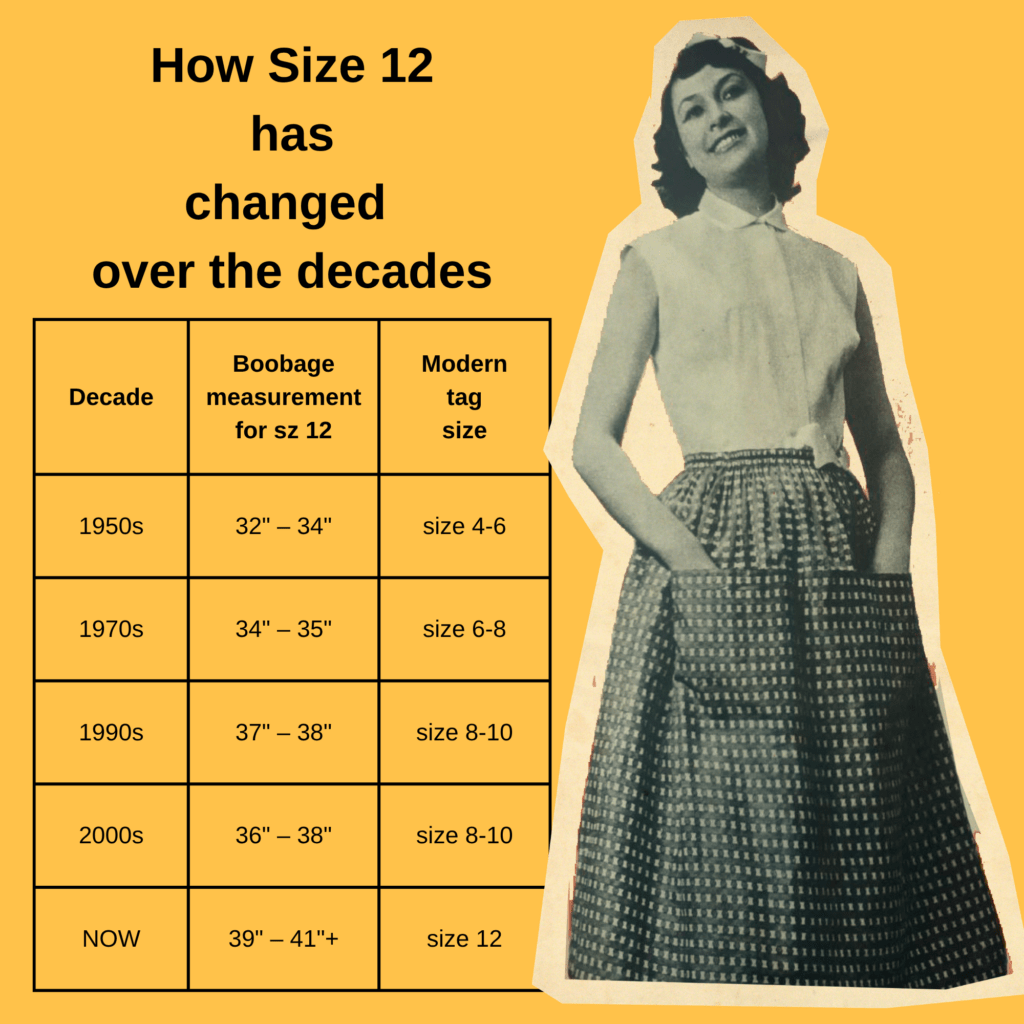
How different are the sizes over the decades?
Sizing from the 1950s and 1960s is the farthest from modern sizing. A 60s dress labeled with size 12 would fit a modern size 4-6. Classic piece of trivia: Marilyn Monroe wore a 1950s size 12.
A 70s size 12 is about a modern 6 or 8. Personal anecdote: I was the largest person in our friend group in high school, wearing a juniors size 11/12 or 13/14. My size 6 teen daughter tried on my prom dress and could not get it zipped.
By the 1980s, vanity sizing took over because the government had scrapped the standards. An 80s size 12 would fit a modern 6 or 8, although there is a world of variations between brands on what was a size 12 was.
The 1990s sizing is ballpark to modern size reality. A size 12 from 1995 would fit like a modern size 10.
Y2K had some weirdness in sizing. Aggressive vanity sizing (thanks to fast fashion), led to the introduction of size 00. Instead of a Y2K size 12 being close to a modern size 12, its like a modern 6 t0 8.
Are changes in the bust size of garments over the years illustrative of size changes?
Yes.
How can I ever buy vintage clothes if sizing is so unpredictable?
It’s easy. Step 1: ignore the tags because they are amusing artifacts and not actual data. Check the garment’s measurements against something similar that fits you well.
If this seems like a lot of work, consider that you have to do the same thing when buying modern clothes unless you are so familiar with a brand that you know what size you wear. One brand might specify that a large fits sizes 10-12 and another brand might specify large fits sizes 12-14. A shirt from one maker that fits you just right might be a 12, a shirt from another maker that fits you just right might be a 10. That’s why online retailers have size charts and free returns. (Another personal story: if I had checked the measurements before I ordered my Taylor Swift Lover cardigan instead of being lazy and ordering my standard XL, I would have discovered that the Taylor Swift store has unisex sizing, meaning the XL is bigger than a woman’s usual XL. My Lover cardigan is so oversized on me that I could strap three corgis to my body, put on the sweater and smuggle them into a hotel without the clerk even blinking.)
Again, for vintage shopping, never trust the tags. Use the measurement data. There are general rules of thumb on guestimating the modern size of a vintage garment that are often cited, but since there are variations between makers, none will ever be as reliable as a measuring tape.
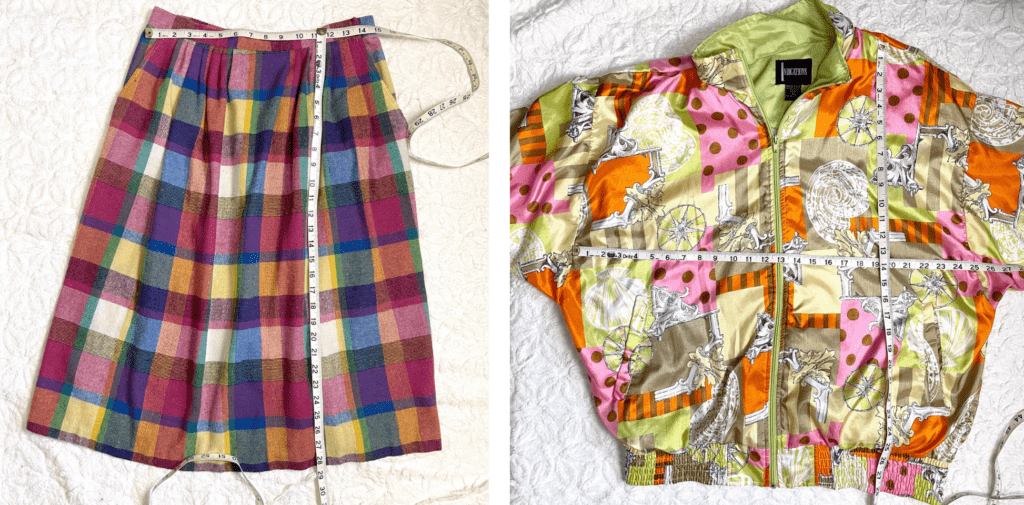
Online sellers include relevant laid flat measurements in the description. Depending on the garment, it might include:
- shoulder to shoulder (vintage people were smaller, vintage garments are scaled smaller)
- pit to pit
- waist
- sleeve length
- shoulder to hem
- shoulder to waist
- hip
- inseam
Compare those measurements to a similar garment that fits you well. If it’s a 70s fitted blouse, compare the measurements to a modern fitted blouse from your closet. If it’s an oversized 80s sweater, compare it to something you own that’s oversized.
If you’re shopping in person, try it on if that’s an option. Try it on over a tank top if there’s no dressing room. As a failsafe, keep general clothing measurements for things like jeans and shirts in the notes app on your phone and carry a tiny retractable measuring tape.
If you’re buying online, check the seller’s return policy.
And promise yourself you won’t buy a medium vintage skirt from the 70s because you wear a medium now unless you want to wear it as a leg warmer.
This seems complicated…is it worth it?
I can’t believe you’re asking that…a thousand times yes! Even clothing sold in discount stores back in the day is often made with better materials and has better tailoring than fast fashion clothing you can buy today. And if you do some vintage brand research, you can get some vintage luxury brands that were hot, hot, hot for a period of time but are mostly forgotten now for the same price as something from a fast fashion store. Some designers/makers whose vintage garments fit that category are Halston, Jaeger, Nipon, Anne Klein, Mondi, Escada, Basler, Cachet, Henri Bendel, and from the jeans world, Sasson, Landlubber and Bugle Boy. You can find more by skimming through vintage Vogue, Mademoiselle and Seventeen magazines from the 1970s and 1980s.
These sources were helpful in writing this post:
One Size Fits None: Inside the fight to take back the fitting room, Time.com, explains vanity sizing.
Americans Slightly Taller, Much Heavier than 40 Years Ago, CDC press release, 2004. Gives actual weight changes over time.
Women’s Measurements for Garment and Pattern Construction, USDA, 1941. Booklet from the O’Brien and Grant study.
US Standard Clothing Sizes, Wikipedia.


1 comment
Hi Laurie, found your website on my phone and will definitely save it to my computer. My sister is a quilter and likes to deal with vintage fabric so I’m definitely going to let her know about your website as well. Thank you for the sizes. Those are awesome but it’s also nice to see you deal with vintage fabrics as well an added bonus to me finding your website.