
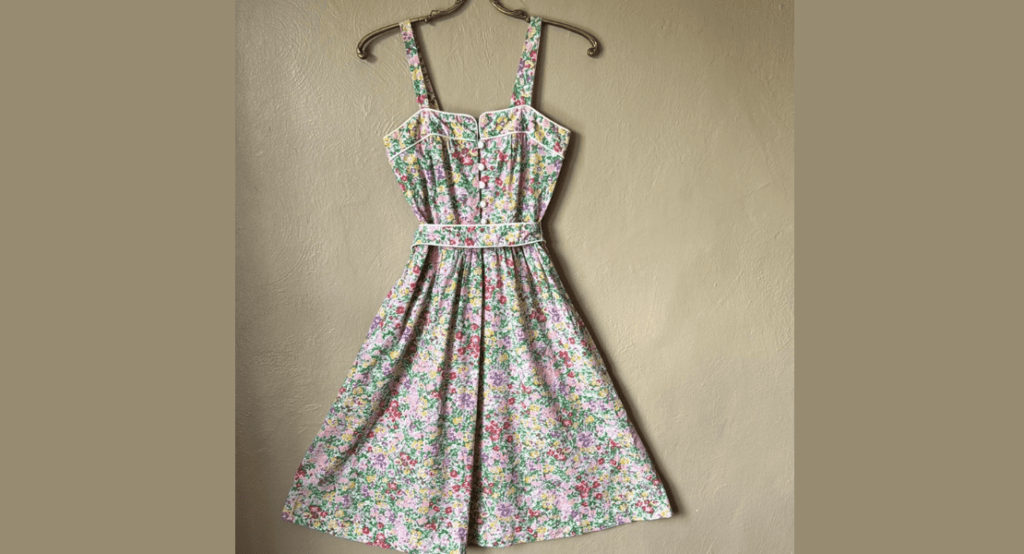
You might think we’ve lost our minds, but we miss the poplins, chambrays, cottons and oxford cloth that were popular for summer clothing in the 70s, 80s and 90s because we miss ironing and starching them until they were so crisp a collar edge could slice a loaf of bread. Don’t get us wrong, we are perfectly happy with the modern blends and knits that are ready right out of the dryer. You didn’t have to iron things back then, but you did because there was something satisfying about achieving pressing perfection. We have two pieces in this week’s fresh to market vintage that harken back to then.
Ironing and starching the skirt on the Lanz sundress so it twirls flawlessly…putting the point on the collar and the crease on the sleeves of the plaid shirt that lasts all day…there was something zen about doing it. Marie Kondo, author of The Life Changing Magic of Tidying Up, suggests “apply firm, loving pressure and thank your clothes for supporting you” while you fold them. Ironing is kind of the same thing. You really see and appreciate your clothes as you smooth every bit of a garment.
Of course lots of people still regularly iron. We are never happier than when we have a pile of vintage aprons to list, a hot iron, our mom’s ironing board and a big can of spray starch. But maybe ironing other things might be good, if only to relax a little.
If you are anti-ironing, don’t worry. The corde clutch and the little tatted heart definitely don’t need you to press them.
Black Corde Clutch
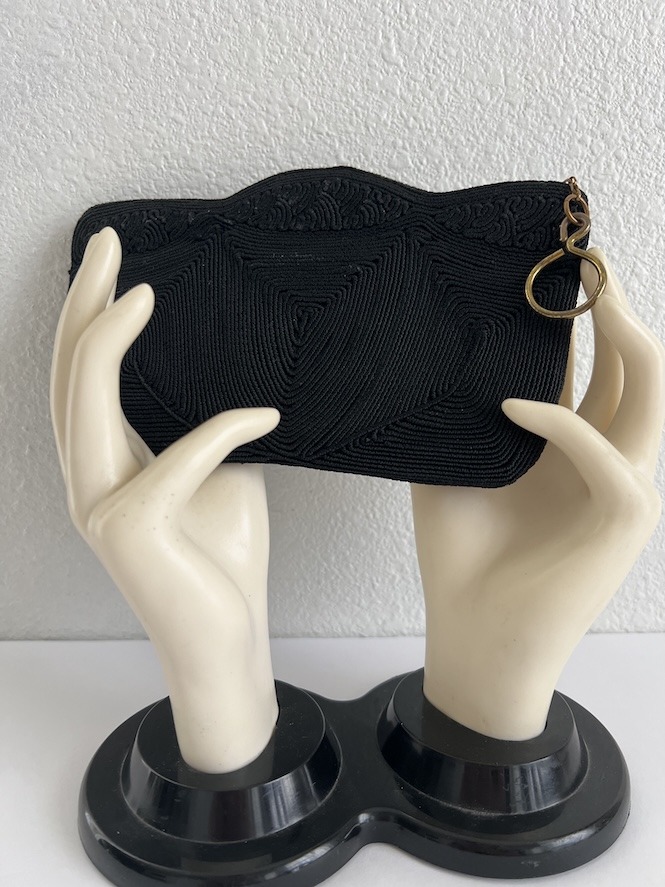
Corde purses and handbags were most popular in the 1940s. That was partly due to the rationing of materials used during the war years. This small clutch is the perfect size for an evening outing. It features a center zippered pocket with two open compartments, one on either side. The brass ring slides onto a finger making it easy to carry. The history of Corde purses is fascinating and features twists and turns in the story. You can read about in this article from the Vintage Purse Museum.
Black Corde Clutch/Purse, $22.95
Pam, Vintage Renude
Vintage Tatted Heart, Framed c 1990s
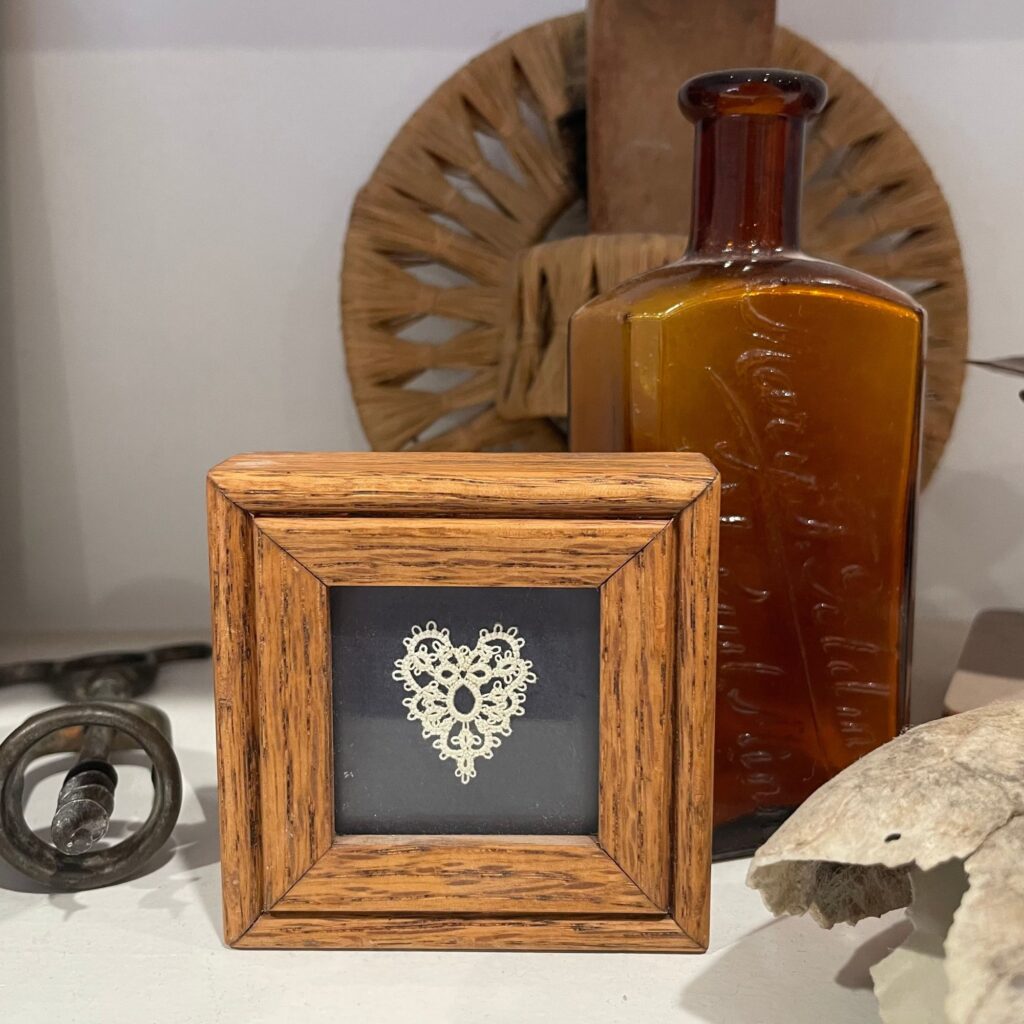
I’m positive that I was a fabric artist in a prior life because I have an enormous appreciation for anything sewn, quilted, crocheted, or, in this case, tatted. The “prior life” comment is because I have to admit my fine motor skills this time around are better suited to keyboarding than to anything arty. If you’re unfamiliar with this art form, let your fingers do the walking online, and you’ll discover all sorts of tutorials. This particular piece is attributed to THE MAD TATTER, J. Felzier of Lincoln, Nebraska
Framed Tatted Heart, $35
Linda, Selective Salvage
1990s Preppy Plaid Men’s Shirt
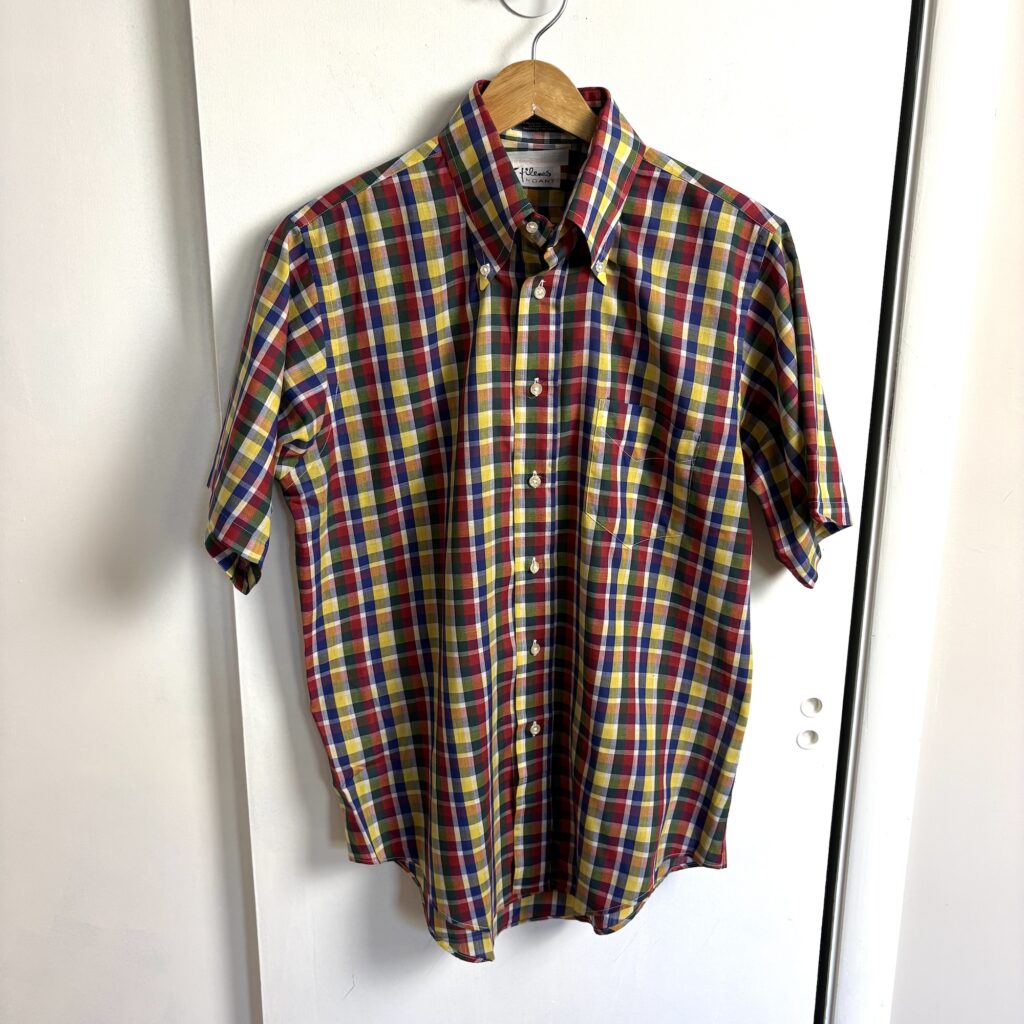
If you’re going to be a plaid shirt, go mad and be primary colors. And then, be a little boxy and wild because that’s the 1990s for you.
We wrote about decoding women’s vintage sizing, but we didn’t touch men’s. So it was a surprise to us that this 1990s men’s shirt, tagged as a medium, would fit as a modern large. Of course, that assumes the wearer doesn’t want to be true to the original era and wear it loose. But it was still a surprise.
It turns out while women’s sizing changes are chaotic, men’s are more subtle and sneakier. Sizes have changed–in the 50s, a 22″ pit to pit measure would be an XX-large. In the 70s and 80s, it would be a x-large. In the 90s, it would be a medium or a large. And now, it would be a large, because the assumption is you want a closer fit than 90s baggy style. So what do you do to figure out if something fits? Get your tape measure, check the pit to pit measurement of something that fits you well against the pit to pit of the shirt you’re interested in. When it comes to buying men’s or women’s vintage clothing online, ignore the tagged size. Only your tape measure knows if it will fit.
1990 Primary Color Plaid Filene’s By Gant Button Down Short Sleeve Shirt, $24.
Laurie, NextStage Vintage
Vintage Lanz Originals Sundress
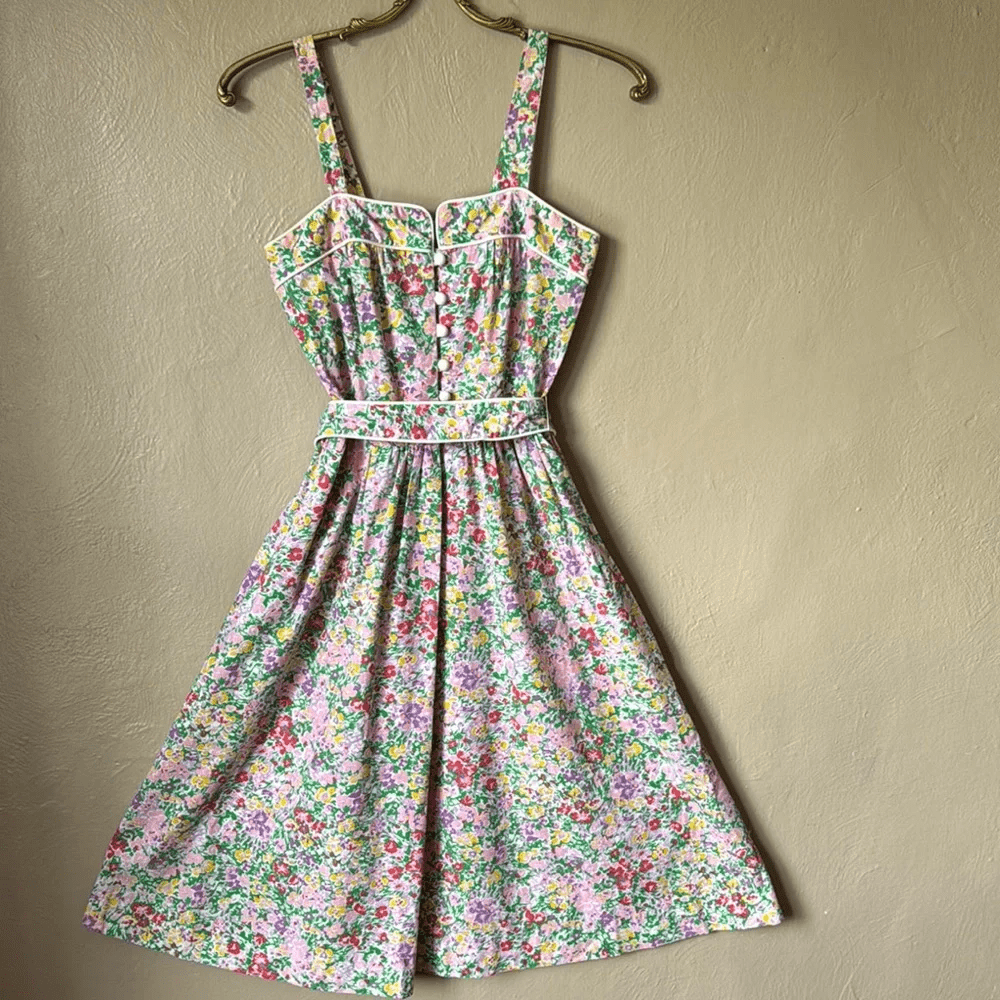
Sweet, romantic, twirly vintage sundresses are not everyone’s cup of tea. But if you like a good twirl, a vintage Lanz sundress can make you weak at the knees.
Lanz started out in Salzburg, Austria in 1922, making traditional Austrian garb and ski wear. In the 1930s, one of the founders emigrated to the US and opened boutiques in New York and Los Angeles. By the late 1940s, the American part of the company had split from the Austrian company, and had new owners who began making clothing designed for the young woman who went to luncheons and tea parties. They kept some of the key elements from the Austrian clothing, like fine fabric prints and high necklines, but they added twists like halter backs. These dresses were sold in high end department stores and advertised in fashion magazines like Vogue, maintaining their pedigree position through the 1950s -1960s.
In the 70s-80s, how we dressed changed, but Lanz Originals didn’t follow the trend and continued to make romantic dresses, many of them tea length. These weren’t dresses a woman could wear to the office and they weren’t on trend, so demand lessened. The brand migrated down to regular department stores, and eventually ceased operations around Y2K. (A separate company, Lanz of Salzburg, continues to make the legendary snuggly flannel nightgowns.)
Lanz Originals, particularly those from the 50s and 60s, are very sought after by vintage lovers. The dresses from the 70s and later are not the same quality or high style, however the sundresses from that era remain popular. Who doesn’t like a good twirl?
Vintage Lanz Original Floral Sundress, Size XS, $140
Available from Laura at lorkathack
Did all that talk of ironing scare you? We probably shouldn’t mention we have a whole post about ironing and ironing history.
Speaking of pressing issues, in this busy world, sometimes you get pressed for time and forget to check what’s new on Vintage Unscripted. The solution is easy. Subscribe to our email newsletter. One email a week and never a bit of spam. We would rather throw our wet laundry in the dryer with a lip balm in the pocket of our jeans than ever share your information.