You’re probably seen vintage pieces labeled as made from celluloid, like the toothpick holder in this week’s fresh to market vintage, but do you know what celluloid actually is? It’s one of the earliest plastics, invented by American John Wesley Hyatt in 1869. According to Collectors Weekly, Hyatt was working with nitrocellulose in an attempt to make a synthetic billiard ball and win a $10,000 prize from a maker of billiard equipment. Balls were made of ivory up until then, but ivory warped and cracked over time. Hyatt discovered that adding camphor to nitrocellulose made a plasticized substance that could be molded, and instead of taking the prize, he started his own billiard ball company.
Celluloid had one inconvenience, it was highly flammable. Nitrocellulose being the main component, it was like making plastic with the same materials as smokeless gunpowder. But it was cheap and looked luxe, so people loved it then and still love it now. Celluloid was used to make things like hair combs, collar stays, jewelry, toys, vanity sets and novelties like the toothpick holder. If you see names like French Ivory, Ivorine, Ivoroid and Pyralin on vanity and decor items, those are other names for celluloid. Interestingly billiard balls coated with celluloid never caught on because they occasionally caused small sparks when they clacked together.
You can test a plastic piece to see if it’s celluloid by running it under hot water and sniffing for a camphor smell. Don’t use the hot pin test! Celluloid is perfectly safe and attractive as decor, but should not be exposed to heat sources.
So now that we’ve cleared up the what is celluloid question, let’s move on to the rest of this week’s fresh to market vintage.
Celluloid Toothpick Holder & 3 Tins c 1920s
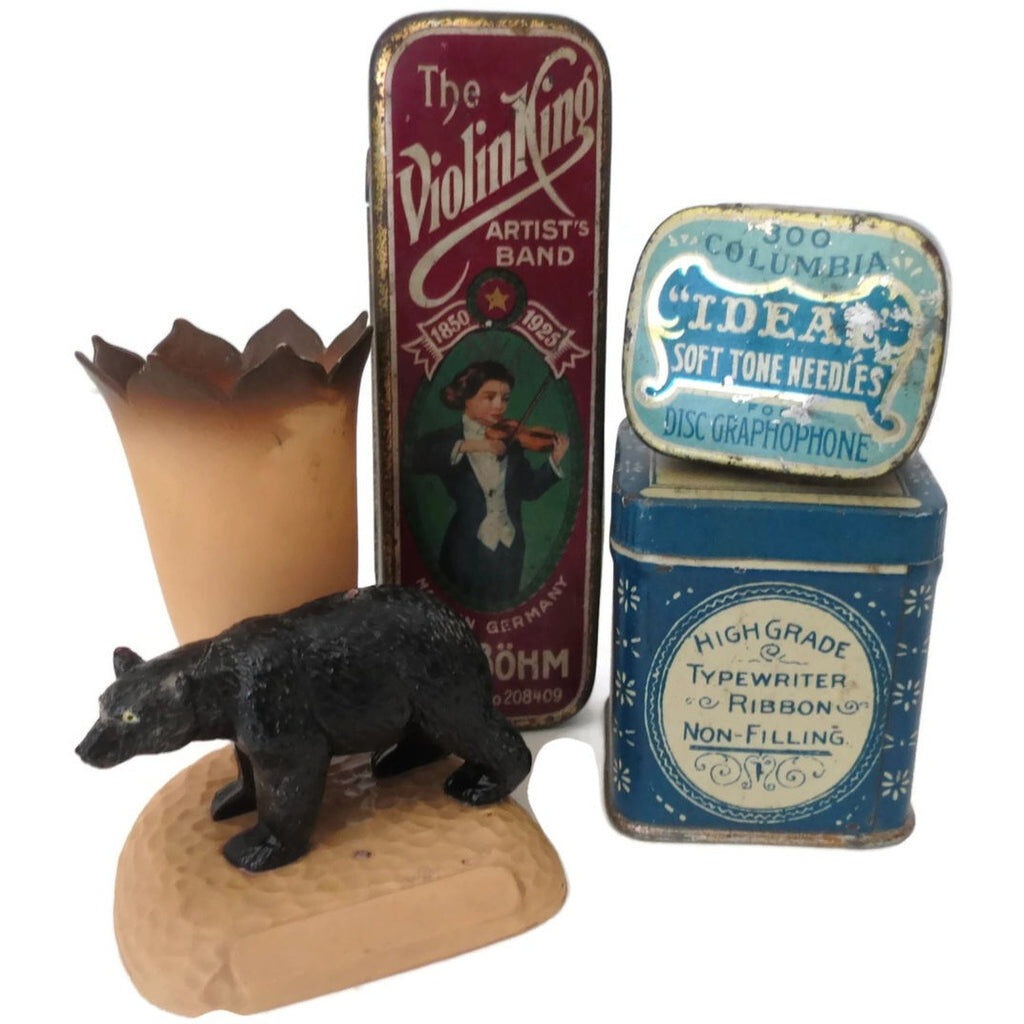
Instant collection of vintage smalls – a celluloid match or toothpick holder + 3 different tins dating to the 1920s. The holder is presumed to be a souvenir from one of the big national parks, and the tins are reminders of the days when the containers outlived the contents.
Vintage Smalls, Celluloid Holder and Three Tins, $35
Linda, Selective Salvage
Pineapple Cut Bangle
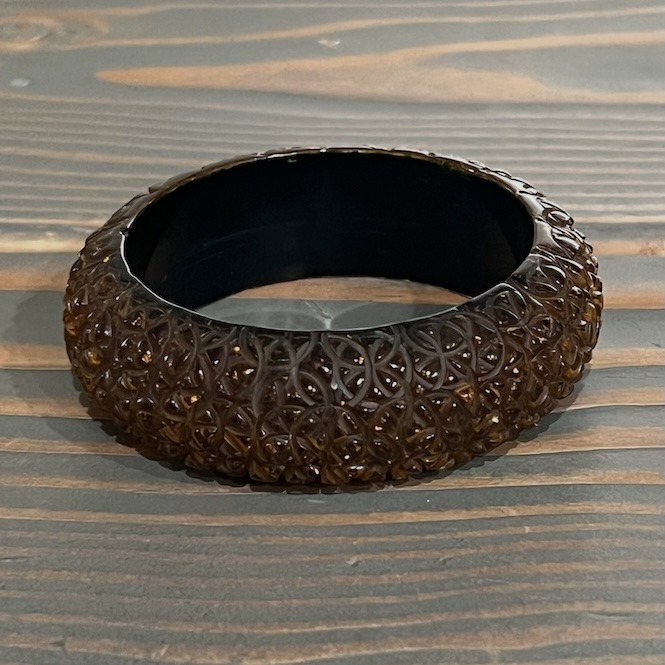
Root beer brown bangle in a pattern known as pineapple cut. Made of lucite with a deep blue interior. When held to the light the color is spectacular. Worn on its own or as part of a stack, this bracelet plays well with Bakelite at a much lower cost. If you’ve started your holiday shopping, this could well be an option for a jewelry lover.
Root Beer Brown Chunky Bangle, $ 32.95
Pam, Vintage Renude
1930s Crown Ducal First Thanksgiving Plate
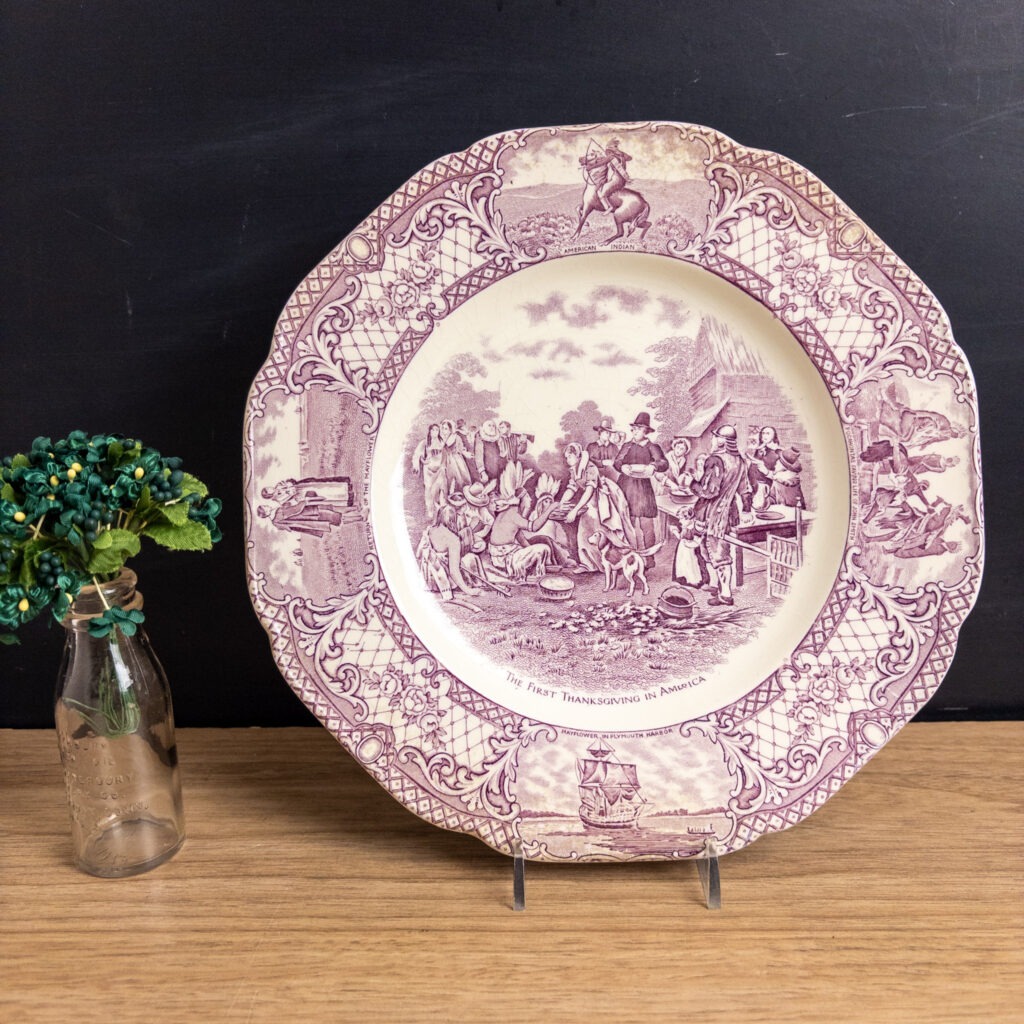
In the 1930s, Americans were in the Colonial Revival mood, celebrating George Washington’s birthday bicentennial and the opening of the first Colonial Williamsburg restorations. Crown Ducal, a Staffordshire pottery, produced three collections of plates to tempt American buyers, including the Colonial America series of 12 transferware plates with historic scenes. The First Thanksgiving in America is one of those plates. The mulberry color makes it particularly appealing on the wall.
1930s Crown Ducal First Thanksgiving Decorative Transferware Plate, $35.
Laurie, NextStage Vintage
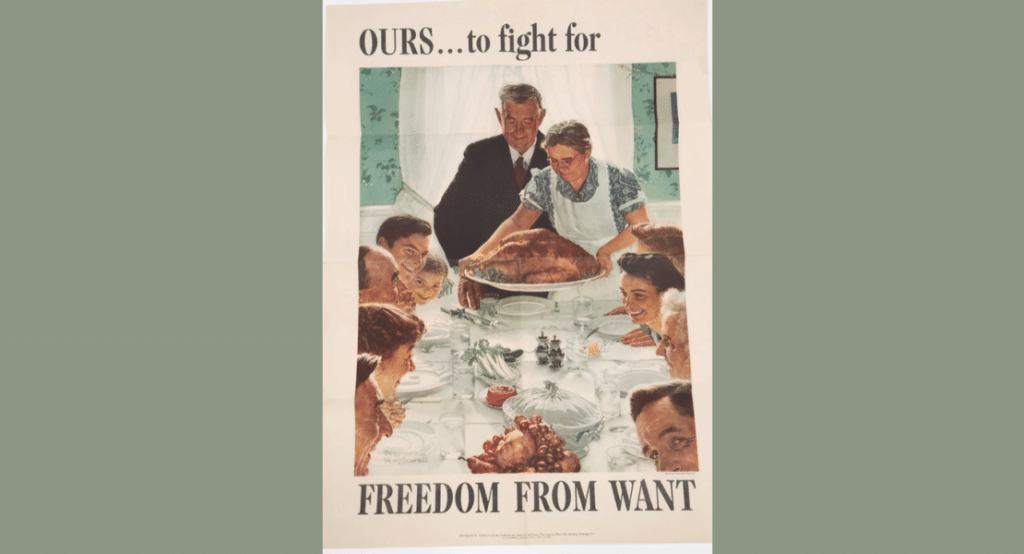
WWII Freedom from Want Poster
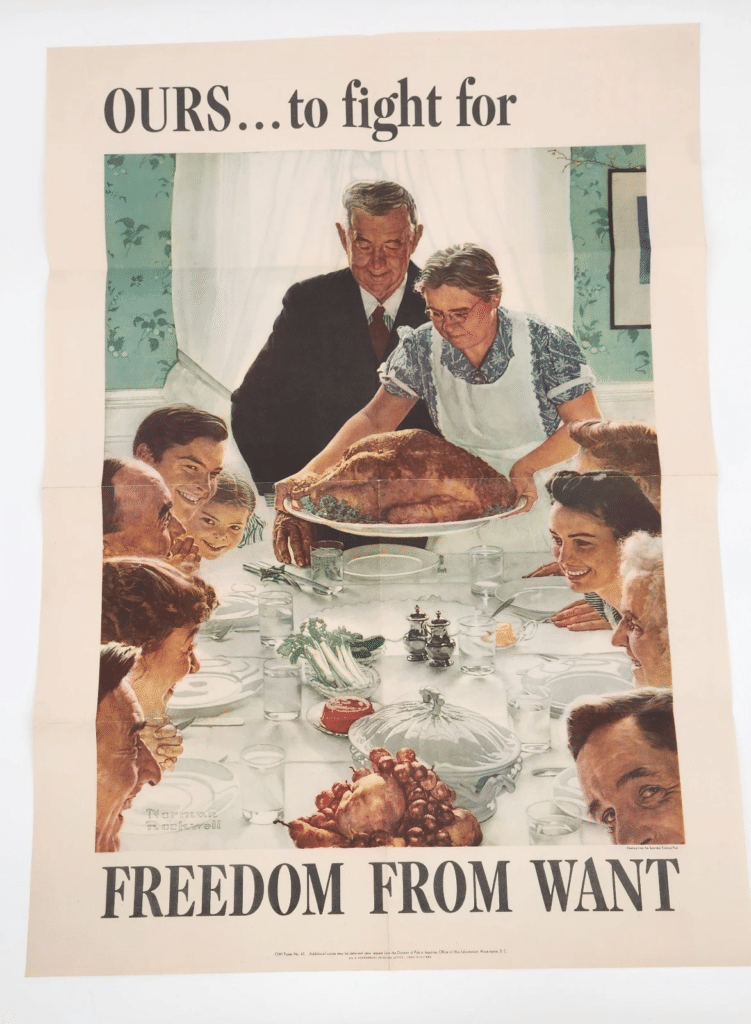
It would be hard to identify a single most famous or most beloved Norman Rockwell illustration, but certainly the Four Freedoms series would be near the top of the list. In January, 1941, President Franklin Roosevelt used the State of the Union address to describe the fundamental human rights the US was fighting for. Inspired, Rockwell sketched the Four Freedoms: Speech, Worship, Want and Fear. He originally contacted the Office of War Information (OWI) in Washington, but they turned them down cold. Their response, “The last war, you illustrators did the posters. This war, we’re going to use fine arts men, real artists.”
The Saturday Evening Post, an enormously popular and influential magazine that Rockwell worked with as their premier cover illustrator, felt quite differently. They commissioned the paintings and paired them with essays about each freedom. The response was spontaneous and gigantic. To meet demand, the Post printed 25,000 reproduction sets of all four paintings.
And the OWI made a sharp course reversal, printing 2.5 million sets for their War Bond drives. This poster is from one of those sets. The folds were for mailing purposes, so they could be sent to schools, post offices, factories and civic groups. It’s a genuine piece of American history by one of America’s foremost illustrators.
OWI Poster No. 45, Freedom From Want, 1943, $239.00
Available from this week’s guest, The Estate Kings
You can see the Four Freedoms paintings as well as many of Rockwell’s iconic images in the flesh at the Norman Rockwell Museum in Stockbridge, Massachusetts. We may or may not have been leaking from our eyes in the Four Freedoms room on our visit many years ago. Through May, there is a special exhibition, Exploring Calvin and Hobbes, the very idea of which makes our tail thump with glee.
Would you have thought about the iconic Freedom From Want at all this week before Thanksgiving if you didn’t see it here? And did it make your heart fuzzy and warm? That is a good reason to subscribe to our email newsletter. You get one email a week with links to all our posts from the previous week. Some will make your brain happy, others will warm your heart and some will make you laugh. And rest assured, we would be more likely to surrender the TV to others so they can watch a show about snakes when the Macy’s Thanksgiving Parade is on than to share your information.


