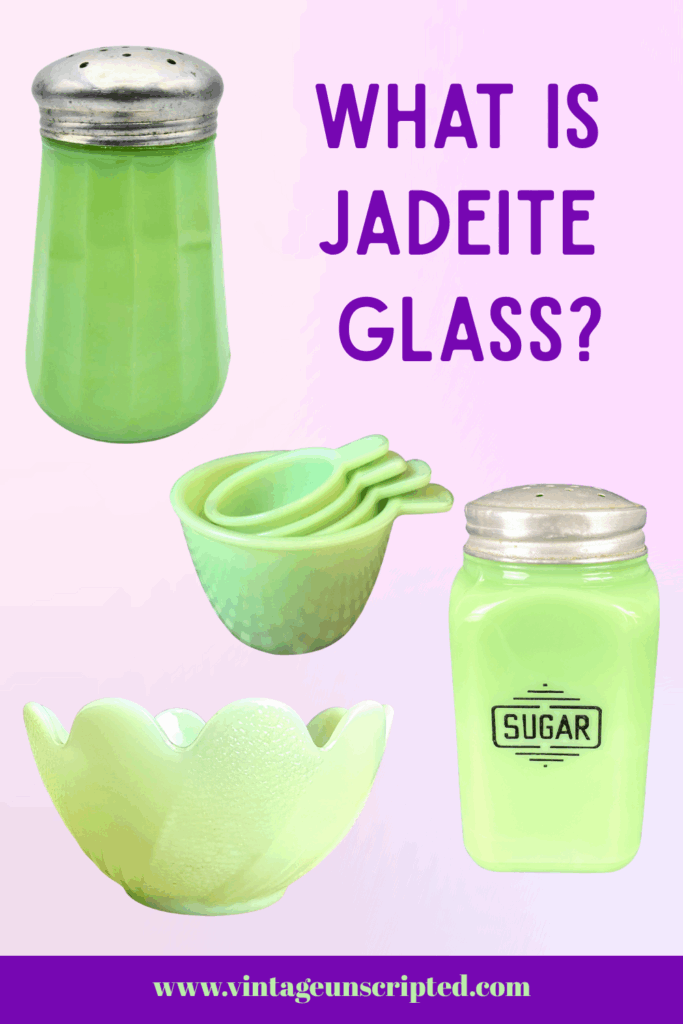
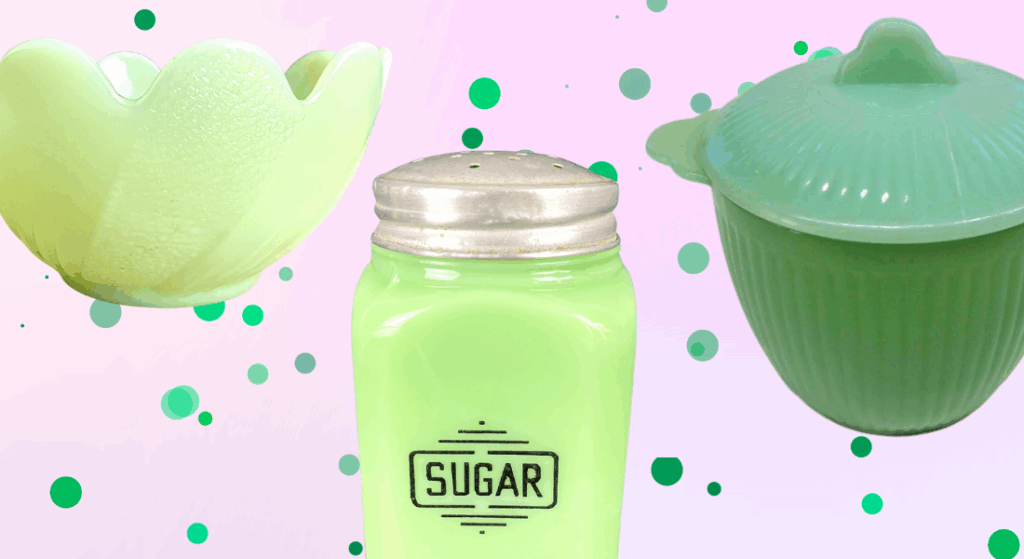
Jadeite is an opaque milky green glass that was made from the 1930s-1960s. The three key makers were the McKee Glass Company and the Jeanette Glass Company, both located in Jeanette, PA, and both producing jadite starting a year apart in 1931 and 1932. Anchor Hocking, located in Lancaster, OH, began producing their legendary Fire King Jade-ite in the 1940s. Fire King is by far the most common maker you’ll find in the wild.
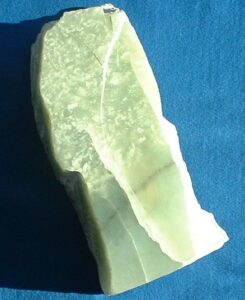 The name jadeite is taken from the gorgeous green stone. In the 1920s and 1930s, Asian decor was trendy in the US. Carved jadeite stone was considered exotic and was out of the price range of the average American, especially during the Great Depression. McKee’s Skokie green and Jeanette’s jadeite were made to capitalize on that trend, providing housewives with fashionable glassware that was marketed as durable, sanitary and cheerful.
It caught on. In the 1930s, kitchens were starting to be modernized and more streamlined. Enamel stoves, chrome fixtures and white cabinetry were popular. The soft pastel green glass in all it’s streamlined shapes fit right in.
This paragraph is for us “How it’s made” nerds. Jadeite glass is a soda-lime glass. 90% of the window glass and glass containers in the world are made from soda-lime glass. The lime, by the way, is calcium hydroxide–a white powder that has nothing to do with limes or the green color. Colorants included chromium oxide, copper oxide and, in pre WWII McKee and Jeannette jadeite, uranium oxide. (One of the ways to test early jadeite is to stick it under a black light and see if it fluoresces.) Opacifiers like titanium dioxide, bone ash and fluorides were also added.
About the spelling of jadeite, there are three variations. The stone is spelled “jadeite.” McKee Glass also spells it “Jadeite,” which is the most common spelling today. Jeannette Glass spells it “Jadite.” And Anchor Hocking/Fire-King spells it “Jade-ite.”
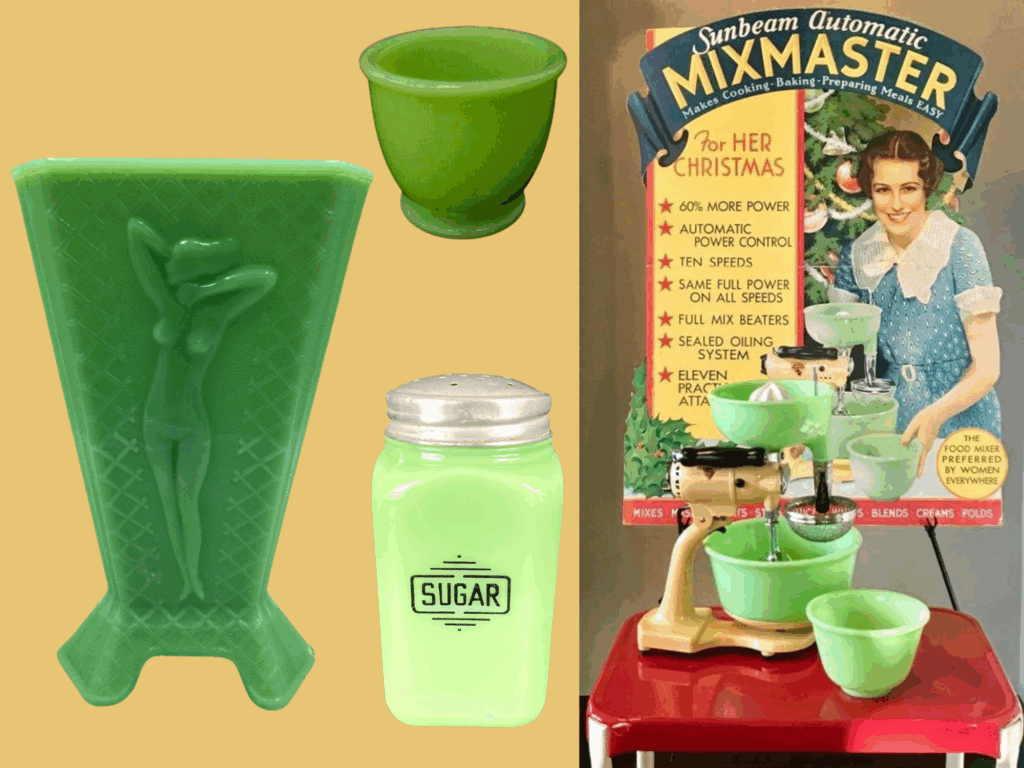
McKee’s jadeite lines were Skokie green, Jade green (which was slightly darker), Laurel dinnerware (which was also made in Seville Yellow, French Ivory, and Poudre Blue) and Clico (a combination of jadeite and black glass). While most pieces were functional, they also made some decorative pieces like the vase below. McKee jadeite is nearly always marked with a McK inside a circle.
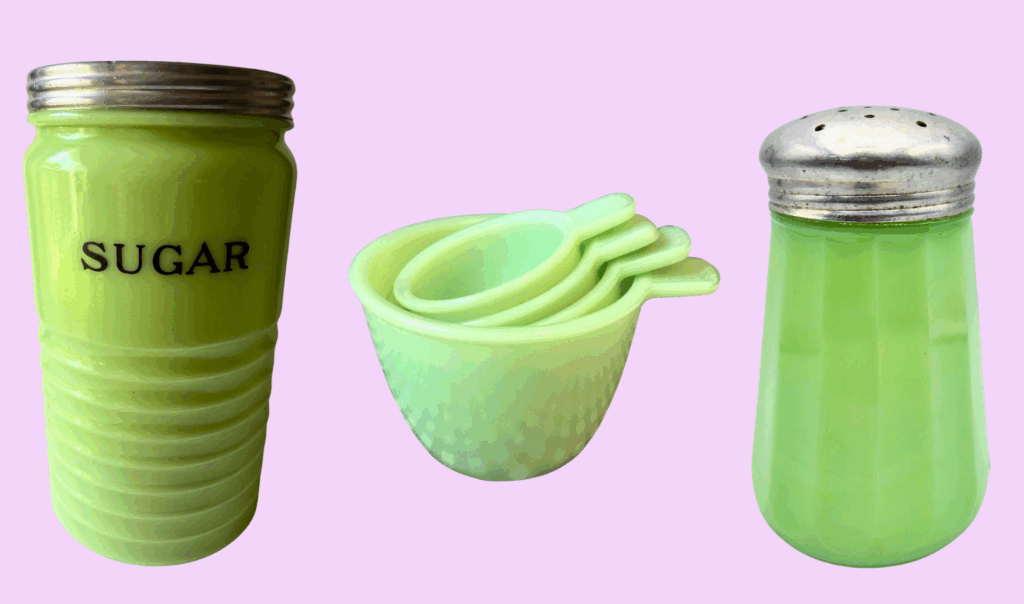
The Jeannette Glass Company made mostly utilitarian kitchen pieces in light and dark green shades. Regrettably, most Jeannette jadeite is unmarked, except for a few early pieces with a J in a triangle. Real or Repro has a fabulous blog post about reproduction Jeannette measuring cups that are nearly identical to the originals.
Regular readers of the blog will know that there’s nothing I like better than vintage companies suing each other for copyright or patent infringement. The court cases read like soap operas. Jeannette, PA, was booming in the 1930s, boasting seven large glass companies, of which McKee and Jeannette were the largest. But search as I might, I did not turn up any kind of legal proceeding relating to jadeite glass. How can that be? Both companies produced jadeite a year apart and some of the pieces are so similar it’s hard to tell them apart. Surely they can’t have co-existed…but they did. As it turns out, glass colors aren’t considered proprietary. Also, Depression Glass was made to hit a good price point and be available in quantity. Lots of the patterns for this utilitarian glass were generic to keep down costs and to make it easy for buyers to mix and match.
Now on to the third king of jadeite…Anchor Hocking Fire-King may have been the last to get in the jadeite green game, but was the most expansive. Their Jade-ite, introduced in 1945, is almost always marked. Patterns included Philbe (1937-1938), Jane Ray (made from 1945-1963), Alice (1945-1948), Charm (1950-1956), Sheaves of Wheat (1957-1959) and Shell (1960s), as well as scads of restaurant ware.
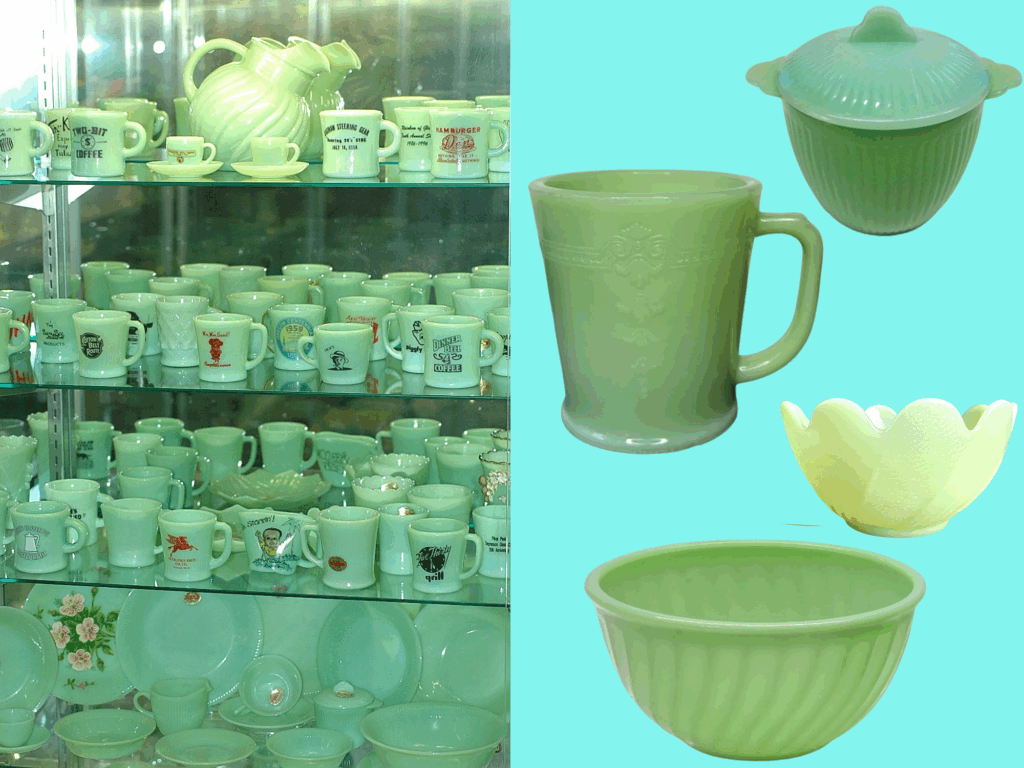
Prices for jadeite are all over the place, depending on rarity, condition and demand. Plenty of Anchor Hocking pieces are affordable for a beginning collector. Other pieces, like the Philbe mug in the middle above which sold recently for $650, are for the rarified collector.
You can’t talk about jadeite without talking about reproductions and fakes. Martha Stewart, who has an excellent collection of true vintage jadeite, had a line of reproduction pieces in her 1990s Martha By Mail catalog. Not going to lie, those pieces are beautiful. According to Good Things by David, Martha’s reproduction pieces were made from the late 90s until 2004 by Fenton, Mosser and L.E. Smith, all fine quality glass makers. She sparked a renewed love of vintage jadeite, and ironically, her catalog pieces are now also considered vintage.
There are lots of Chinese imported jadeite pieces in big box stores. Joanna Gaines had reproduction pieces in her Hearth & Home line for Target. Even Cracker Barrel restaurants have been known to sell jadeite in their gift shop.
Why does it matter if jadeite is true vintage or reproduction? If you’re a collector, it matters a lot. But collectors are more likely to know stuff and so are less likely to fall for a fake. But it’s scary and difficult you are a generalist seller with limited jadeite knowledge. You don’t want to sell a repro claiming it’s real, so you have to sink lots of time into research. And if you’re a casual buyer who wants a piece or two, you don’t want to pay true vintage prices for a reproduction.
One sure tell it’s a repro is if a site is selling “vintage style” jadeite. “Vintage style” and “vintage inspired” are not vintage. Another tell is if an Etsy or eBay seller has an endless supply of vintage jadeite cake stands, for example. Unless they stumbled upon a jadeite cake stand hoarder, chances are they are reproductions. Real or Repro has a great piece on “New Jadeite Kitchen Glass.” Fire King Grill also has a helpful post, “Jadeite Dishes: Real or Reproduction? How to Tell.”