
Before they were a decorating must have, Reader’s Digest Condensed Books were a book world phenomenon. Much like paint by number sets democratized art, they democratized literature by condensing multiple full length books into manageable anthologies. Three to five fiction and non-fiction titles were edited down to fit in a single volume sold via mail subscription, with quarterly delivery. They were fast to read, easy to own because they were affordable and created an instant library in the home.
Why the Reader’s Digest Condensed Books are a Classic
Volumes were published continuously from 1950 until 2012. They are still much beloved among those who grew up with them and loved anew by younger admirers who appreciate the look of the books. Even reluctant readers were drawn to them because it was short work to enjoy a good story. Peak popularity was in the 1950s and 1960s. There are no reliable sales figures for those years, but 10 million copies were sold yearly in the 1980s in just the US alone. Worldwide sales in the 80s were over 21 million books a year.
History of Reader’s Digest Condensed Books
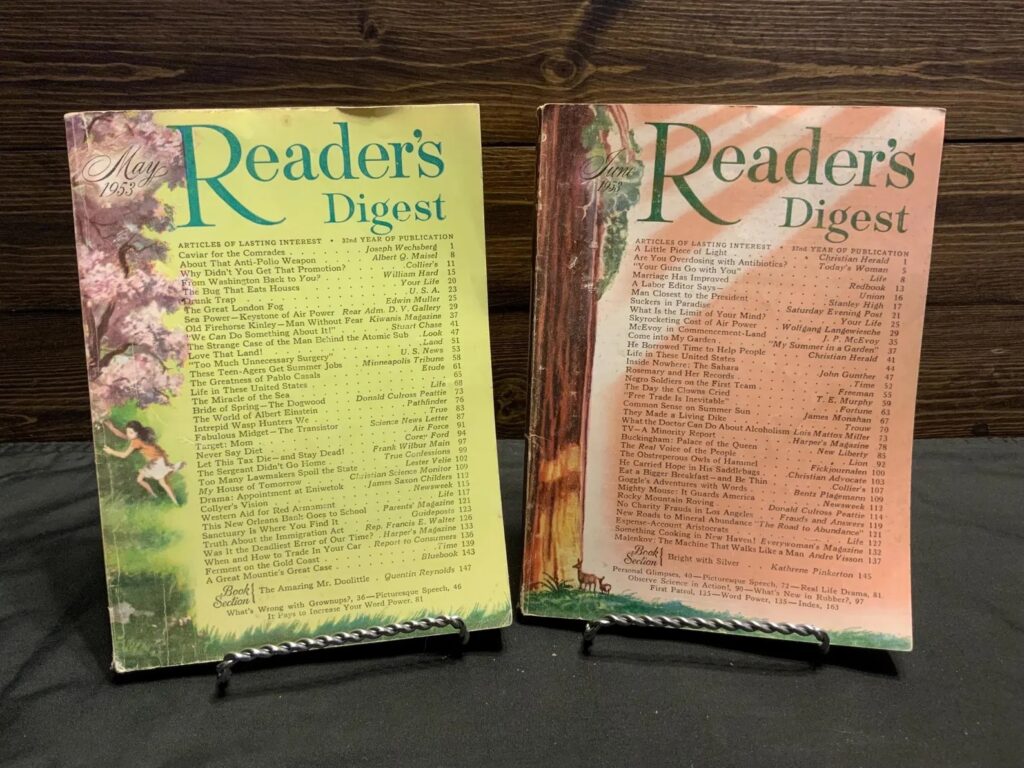
Before we cover the Condensed Books’ history, we should first introduce Reader’s Digest magazine. Launched in 1922 by a husband and wife team, the pocket-sized magazine featured condensed/shortened versions of articles from other magazines, making them more convenient and easier to read. Regular humor and public interest features were added later, as was a condensed version of a book or a book excerpt. From the 1950s to 1980s, there were very few coffee tables, waiting rooms or bathrooms that did not have a copy of readily accessible. Reader’s Digest also was a leader in publishing large print, braille and international editions.
Starting in 1950, the Reader’s Digest Company produced four condensed book volumes a year, marketed by direct mail and sold on a subscription basis. The three-five books included in each anthology were shorted with the permission of the author, and were prepared by a crew of editors and abridgers. The foremost of those was John S. Zinsser, the editor from 1951-1987 who oversaw the editing of over 800 books.
In his New York Times obituary, Zinsser’s son Stephen said “He believed ardently in the Digest’s populist mission of making well-written books with strong stories and interesting characters available to people who might not otherwise be readers.”
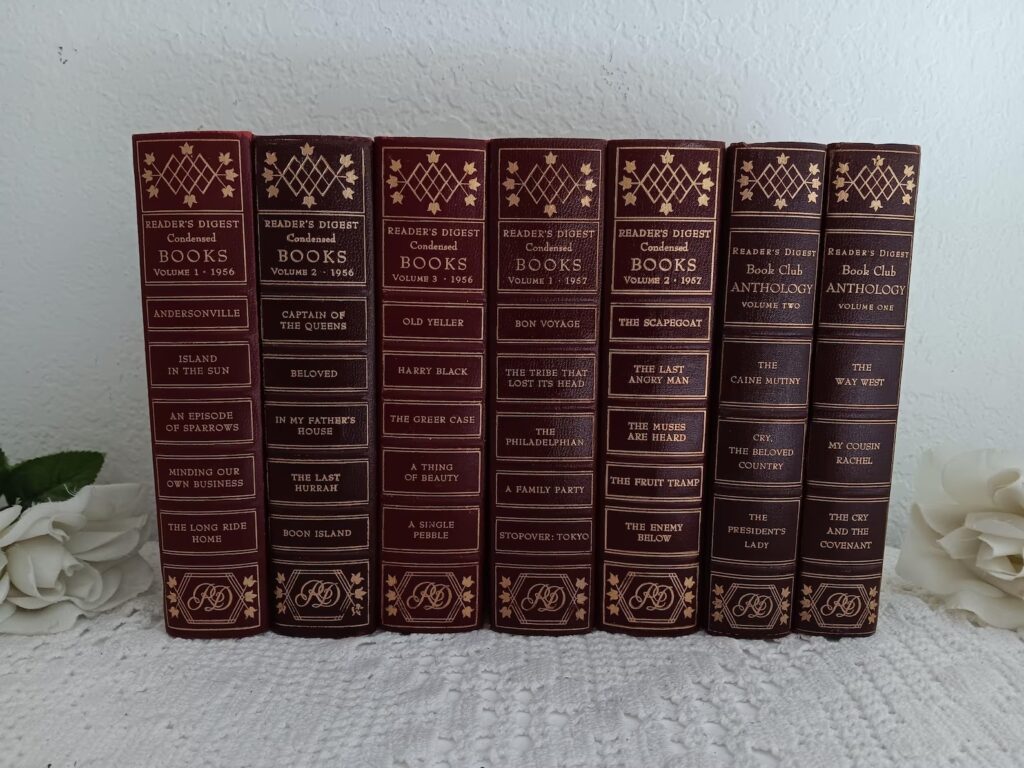
The key to shortening the books was keeping the main plot, the main themes and the main characters, and eliminating subplots, run-on descriptions, and the places where books dragged. Original illustrations drawn just for the condensed books were added, with credit given to the artist either in the masthead at the front of the book or on an acknowledgement page at the end.
The authors featured over the years is a who’s who of literature. To drop a few names: Agatha Christie, Dick Francis, Mary Higgins Clark, James Michener, Arthur Hailey, James Patterson, Lisa Scottoline, John Steinbeck, William Faulkner, Belva Plain, James Herriot, Peter Benchley, Pearl S. Buck, and Sandra Brown are among the multitude of authors who agreed to have their books edited and included.
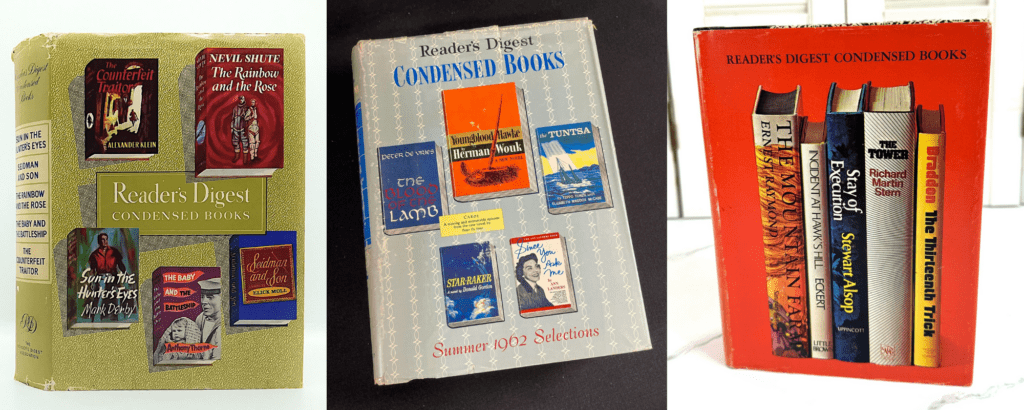
The books themselves were hardcovers with dust jackets. The dust jackets were designed inside the Reader’s Digest art department, with art commissioned from freelance illustrators that highlighted the content inside. They were art directed to have a cohesive look, one that was family friendly, appealing and definitely not controversial. Dust jackets were illustrated until the 1970s when more photographs were used. By the 1990s, the covers had a more modern graphic style.
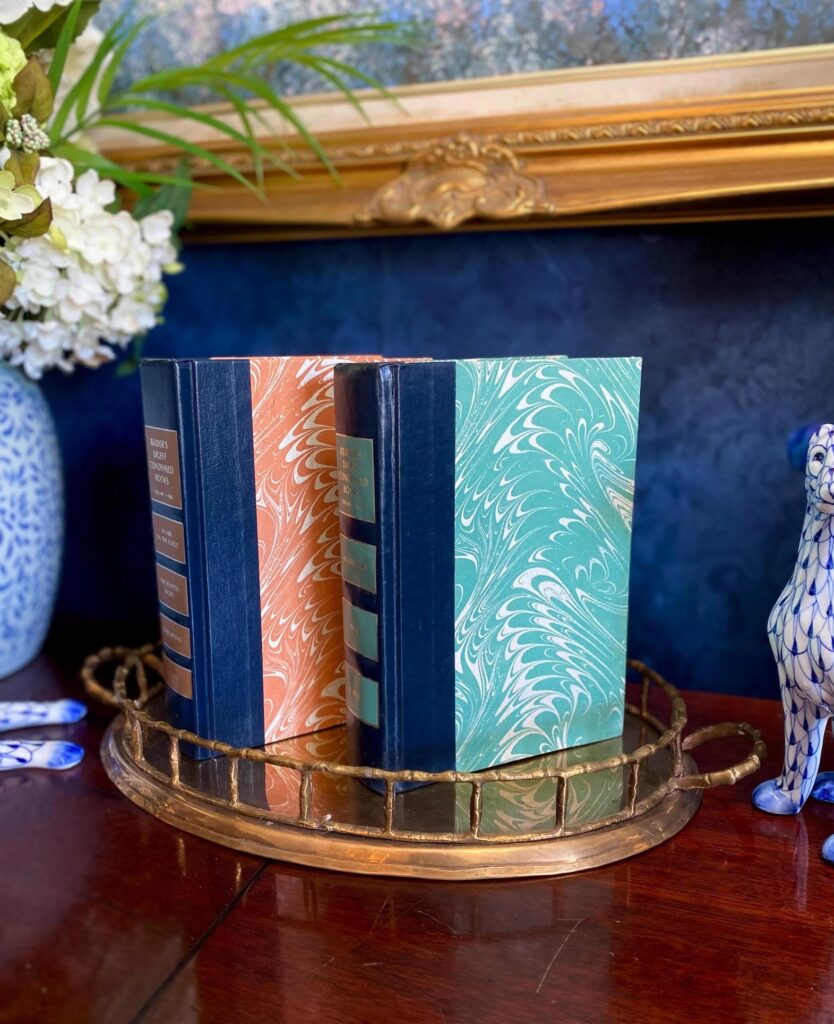
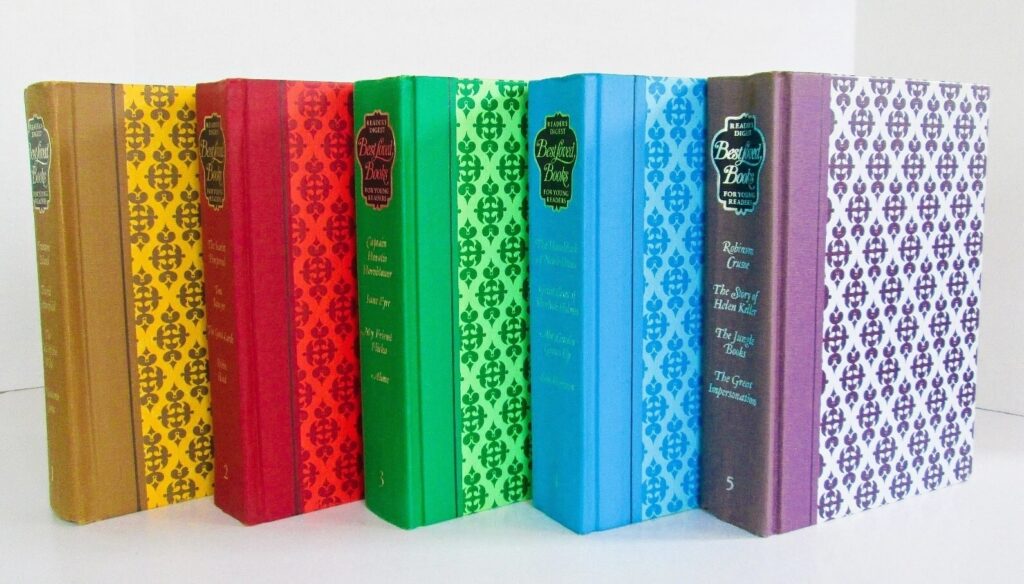
Once the dust jacket is off, the binding itself is the thing of beauty that makes them so collectible now. The binding materials aren’t luxe: chipboard covered with printed paper, faux leatherette and occasionally cloth. But the look is dynamite. And bless their hearts, the books are all the same size, so books from different decades can cohabit shelves harmoniously.
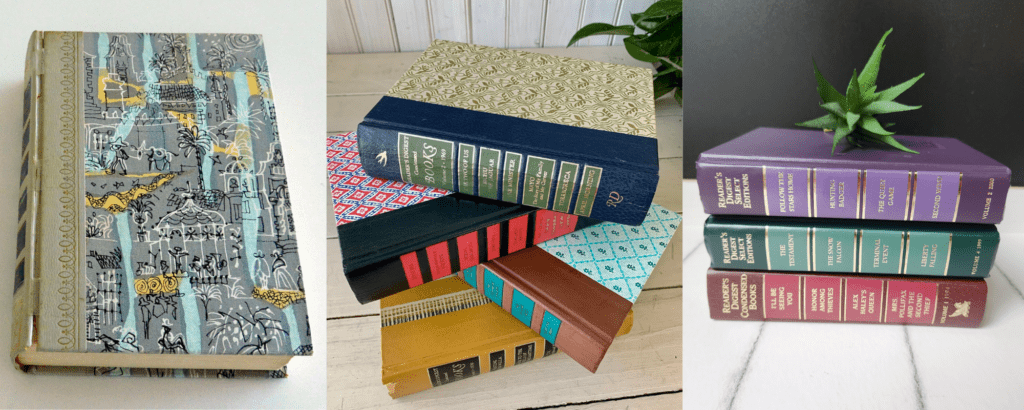
Until the 1990s, the front and the back covers are gorgeous printed paper, with a wrap around covering on the spine that extends part way across the front and back. The spines are gold stamped with the pertinent edition details and the titles of the books. In the 1990s, the spines are still beautiful and the covers are a matching color. After the 1997 rebrand to Reader’s Digest Select Editions, the look of the hardcovers remained the same and some softcovers were added.
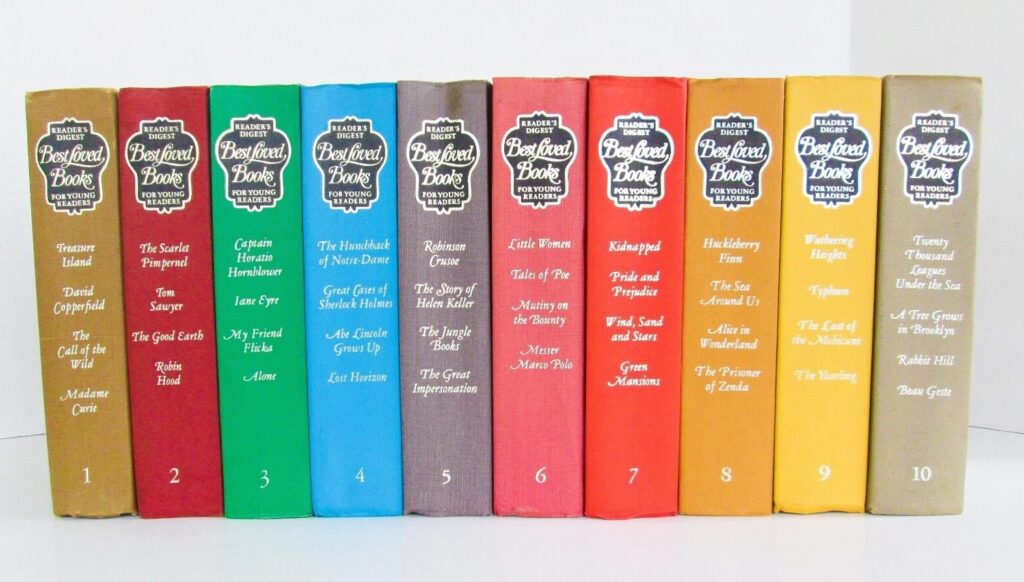
It’s hard to pick a favorite design element between the printed cover papers or the elegant spines. The spines were often color coded as well as numbered, so they made quite an visual impact on a shelf. Some years the spines are staid and traditional, some are colored and buoyant.
Reader’s Digest Condensed Book Controversies
As with paint by number kits, Reader’s Digest Condensed Books had their fans and their foes.
Critics disdained them for ruining the original works by diluting an author’s literary voice, oversimplifying complex plots, deleting character development and taking out the racy bits. They were viewed as commercial rather than as works of art.
On the other side, fans looked at them as gateways for getting people who were over scheduled or not book lovers to read. They were low cost and arrived conveniently by mail. They were safe because they were edited to be wholesome. People who didn’t read might actually read an abridged novel. And they created home libraries that were attractive and handy
Both sides are right. Bear in mind that the authors consented and received royalties. Kurt Vonnegut, who disparaged the series, allowed his books Slaughterhouse-Five, Jailbird and Slapstick to be used. And it’s possible the series gave readers enough of a taste that they might go on to read entire books by the same author.

The Decline of Reader’s Digest Condensed Books
By the 1990s, there were many kinds of media competing for people’s attention. Audiobooks were more available. You could be told a story on your drive to work instead of reading one in the evening. Digital media and e-readers gave people immediate book gratification. You didn’t need to wait to receive your quarterly anthology. The Reader’s Digest Company was slow to embrace technology, and paid the price for it.
There was also more subscription service competition. Other publishers wanted to replicate Reader’s Digest’s success. Genre mail subscription services run by publishers sprung up like dandelions on a lawn. Books were written exclusively for those book subscription clubs, and readers loved the comfort of predictable plots and fast reads. There was also higher end competition like the Easton Press and the Franklin Library that produced classic literature in leather bound volumes, with high quality paper and printing.
The final shove into decline for Reader’s Digest Condensed Books was that the readership was graying, and new readers were not interested.
The Decor Revival of Reader’s Digest Condensed Books
Book stacks and color arranging the books in your library hit the decor scene 10-15 years ago and have continued to be popular thanks to social media. There are not many things as pretty in the book world as a vintage Reader’s Digest Condensed Book, as you can see from the books featured in this post.
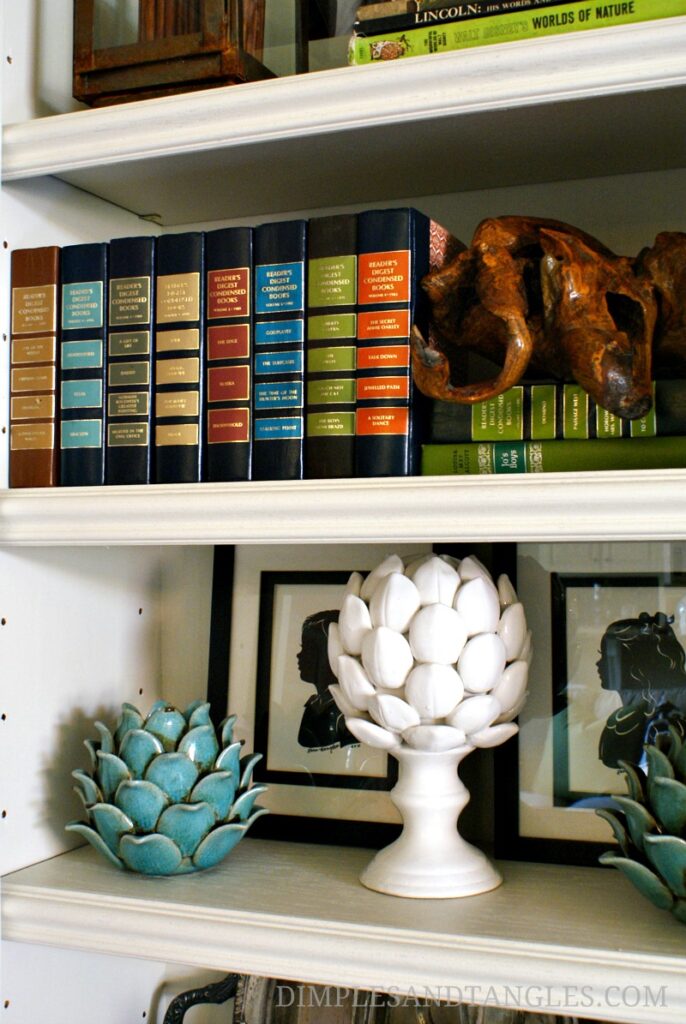
It’s also popular to craft with them. Using one to create a hollow book safe, turning one into a junk journal, creating folded page art…Pinterest is full of ideas for crafting with Reader’s Digest Condensed Books.
And let’s not forget the TikTok bookshelf wealth decor trend that exploded in 2023. Previous book decor was for appearance. Bookshelf wealth is for authenticity. You fill your library with books you actually have read and loved, add in personal artifacts and quirky art, pile on the layers and add some traditional cozy decor. This is not a trend for minimalists–but it’s a book maximalist’s dream world. We submit that in a world where we are all still pressed for time, there’s no reason not at have some of your bookshelf wealth be Reader’s Digest Condensed Books.
NOTE: This post focused on the book anthologies for adults. Reader’s Digest also produced a line of condensed books called “Best Loved Books for Young Readers” from 1966-1968 and their bindings are also scrumptious.
Read More:
The Wikipedia page for Reader’s Digest Condensed Books has a list of all the volumes and titles contained therein.
Unrepentant Confession: Reader’s Digest Condensed Books, Whistlestoppers.com
Why “Bookshelf Wealth” is 2024’s First Major Design Trend, ArchitecturalDigest.com