Have you ever picked up a milky white glass casserole at a thrift or estate sale and flipped it over to find out it’s made by a company called Glasbake? And you wondered to yourself, “What the heck is Glasbake?” You’ve come to the right place. Glasbake was a maker of glass kitchenware, never as successful as Pyrex or Fire-King, but still worthy attention from collectors. Here’s it’s story…
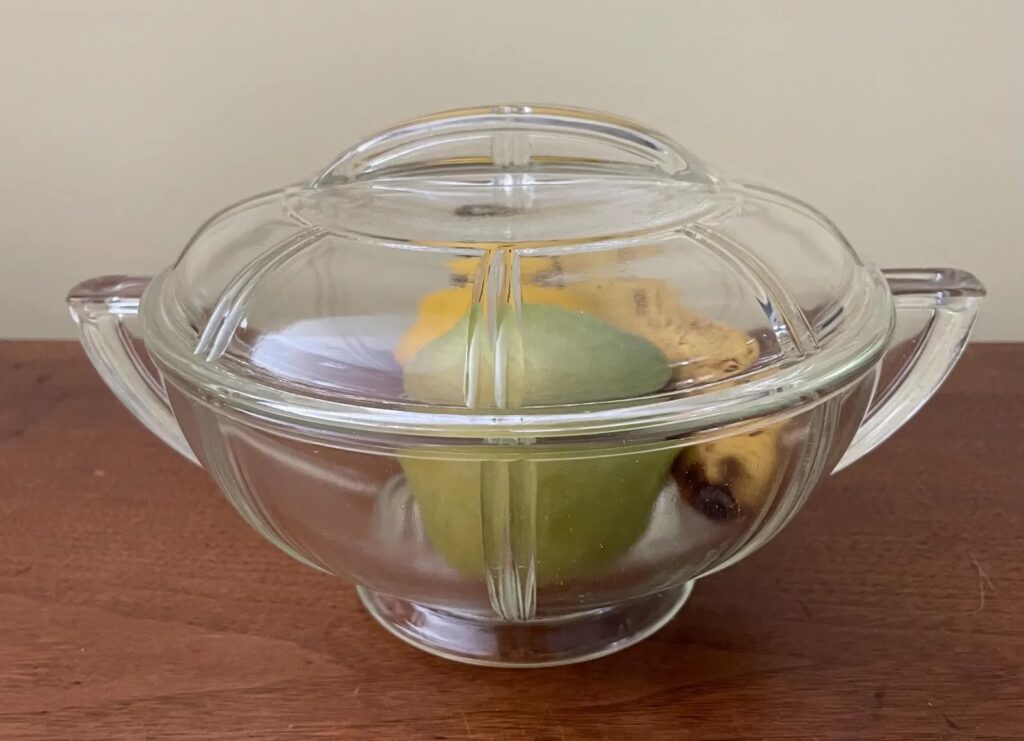
Glasbake was developed by the McKee Glass company of Jeannette, PA in 1917, hot on the heels of Pyrex, which was introduced by Corning in 1915. In the beginning, Glasbake made clear, highly functional ovenware from soda-lime glass, which baked like a dream, but was more likely to have a thermal shock breakage incident than Pyrex’s borosilicate glass.
After the line was acquired from McKee by neighboring competitor Jeannette Glass in 1937, it expanded to include more pieces like custard cups, pie plates, fridgies and mixing bowls.
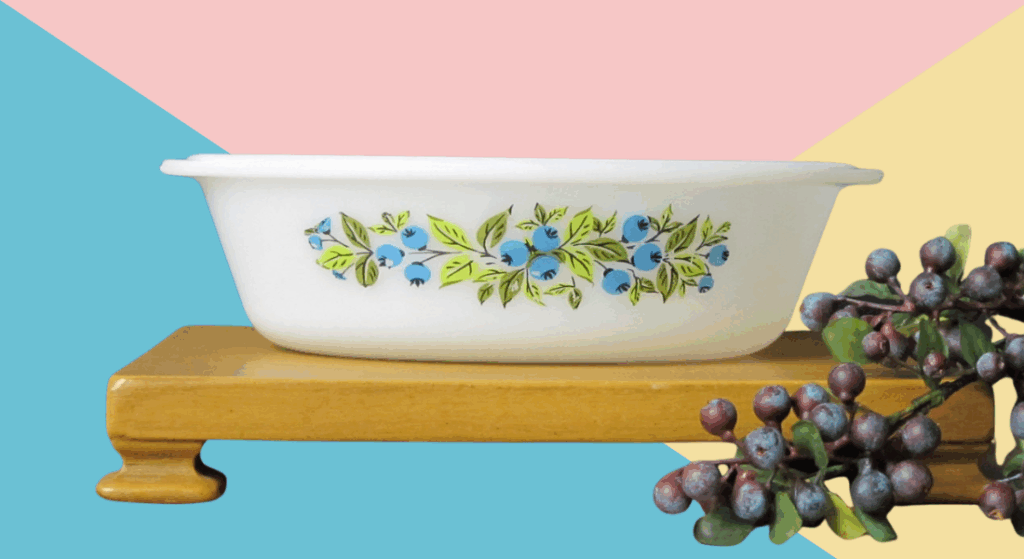
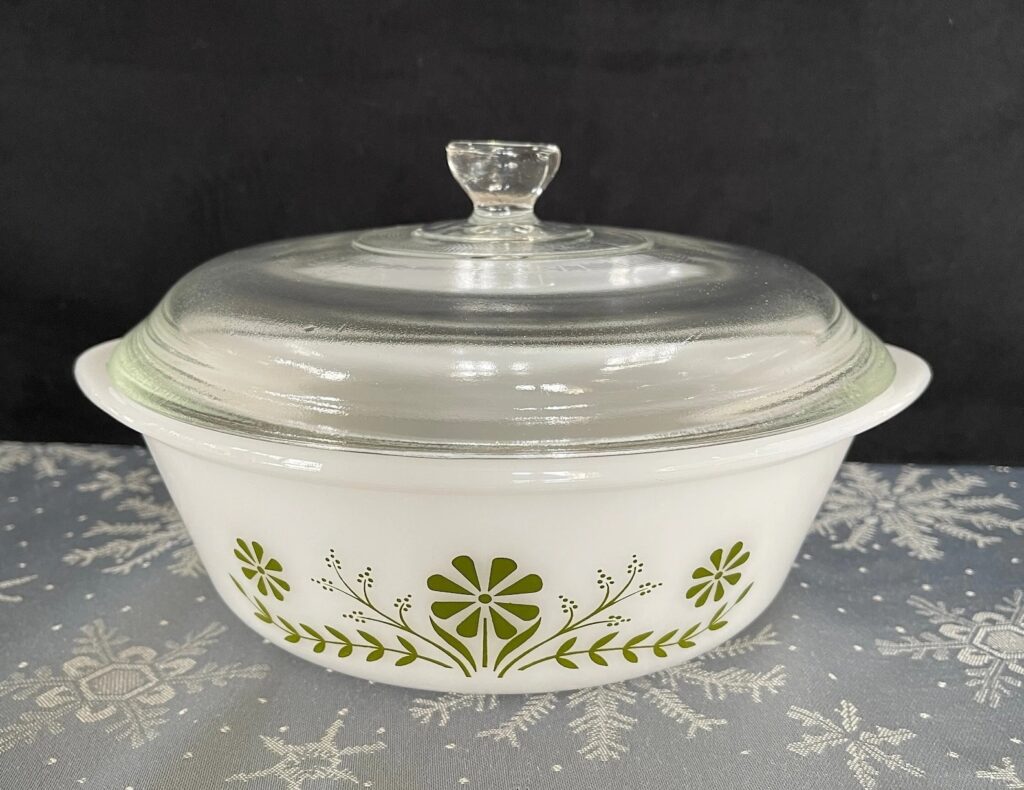
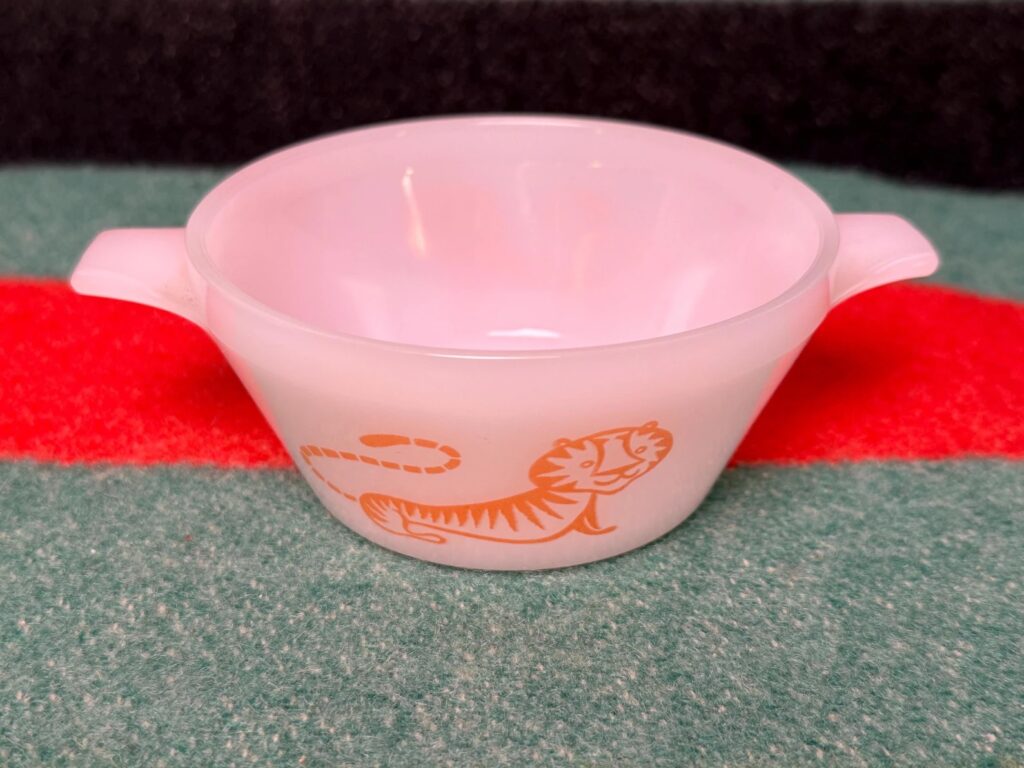
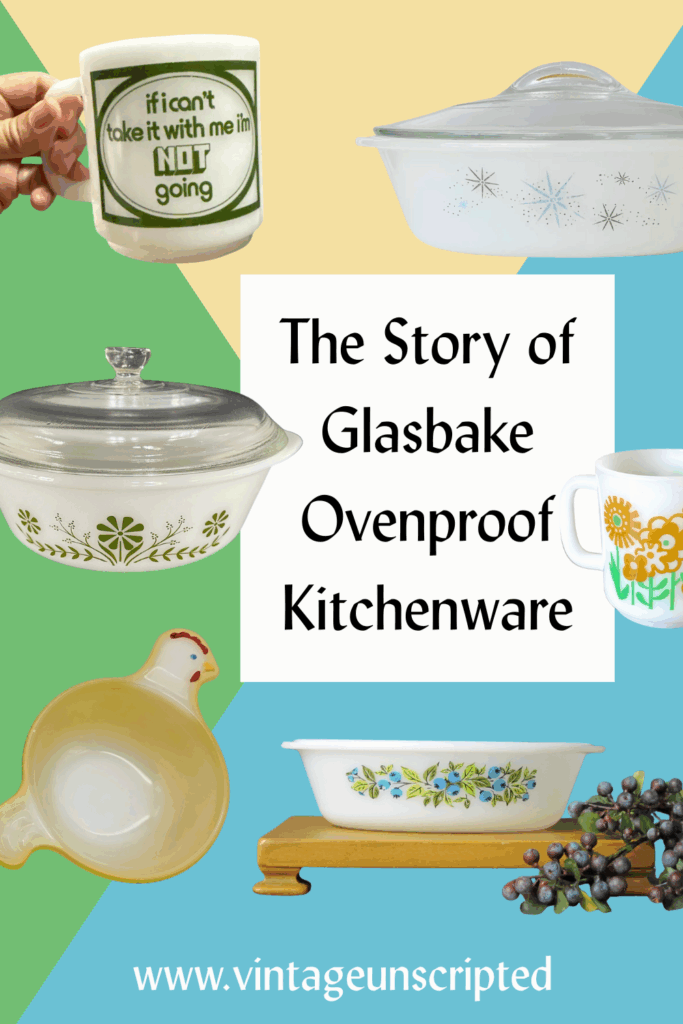
In the 40s – 60s, after a short period of using opal white glass, Glasbake switched to milky white glass like Pyrex, and pattern decals were added. These patterns didn’t have given names, but there were lines with the same pattern applied across many different pieces so you could outfit your whole kitchen. Popular patterns were the daisies, Currier and Ives (as part of the Royal China line), blueberries, vegetables, blue onion, a Grecian motif, and blue pinwheel among others. The rarest patterns are thought to be pink harlequin (used on mugs), lucky in love (hearts and clover), and Pennsylvania Dutch (found only on 1.5 qt casseroles). As a smaller company, Glasbake was able to make smaller runs of different patterns, so there are some elusive pieces out there.
Glass colors amber and smoky brown were added in the 1970s.
Regrettably, there isn’t a lot of documentation available to know exactly what patterns Glasbake made. There aren’t a lot of existing catalogs or factory records.
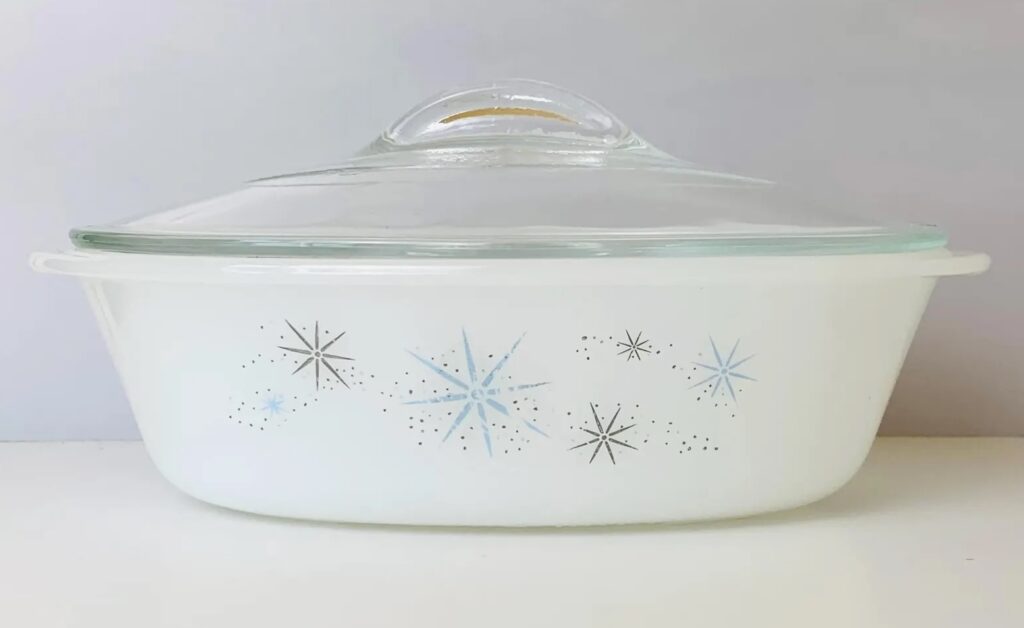
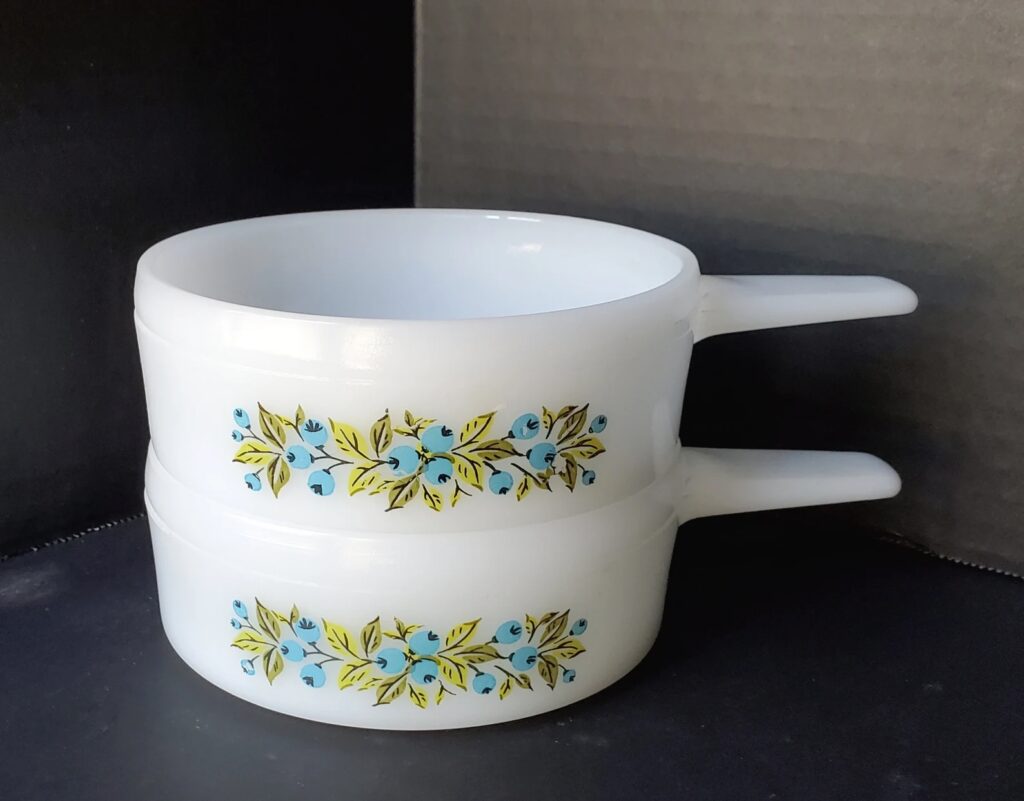
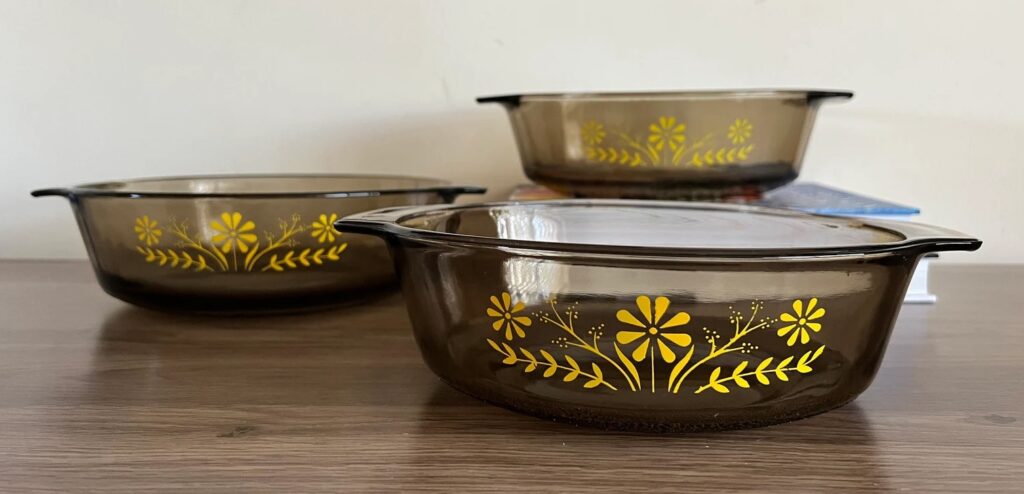
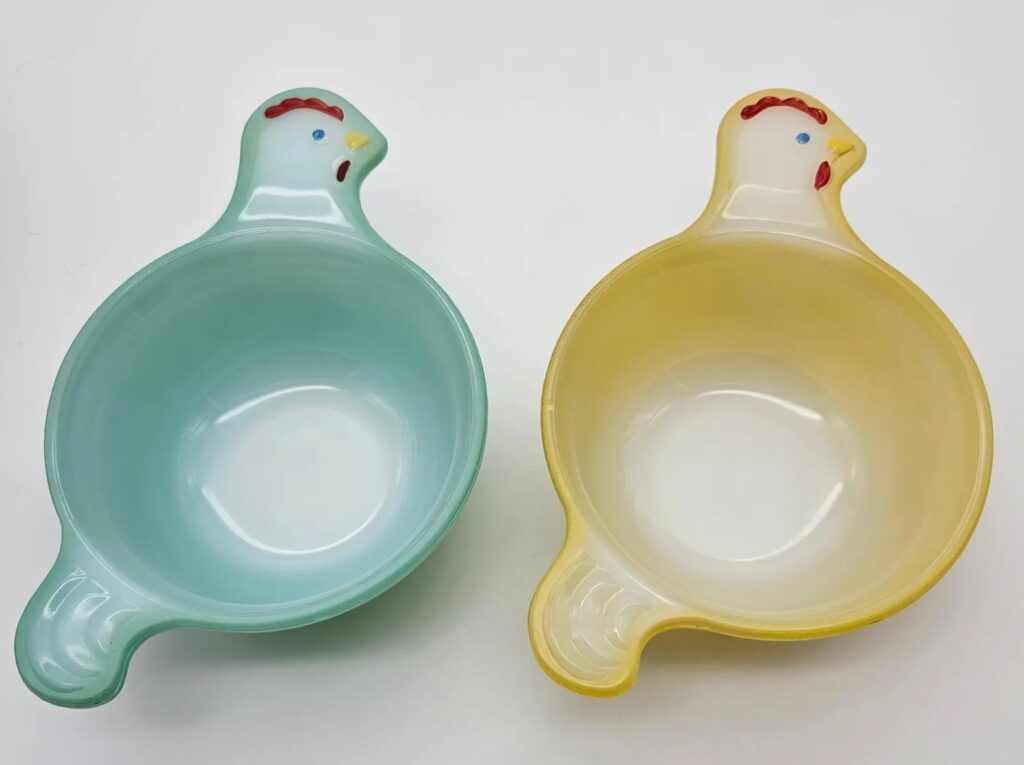
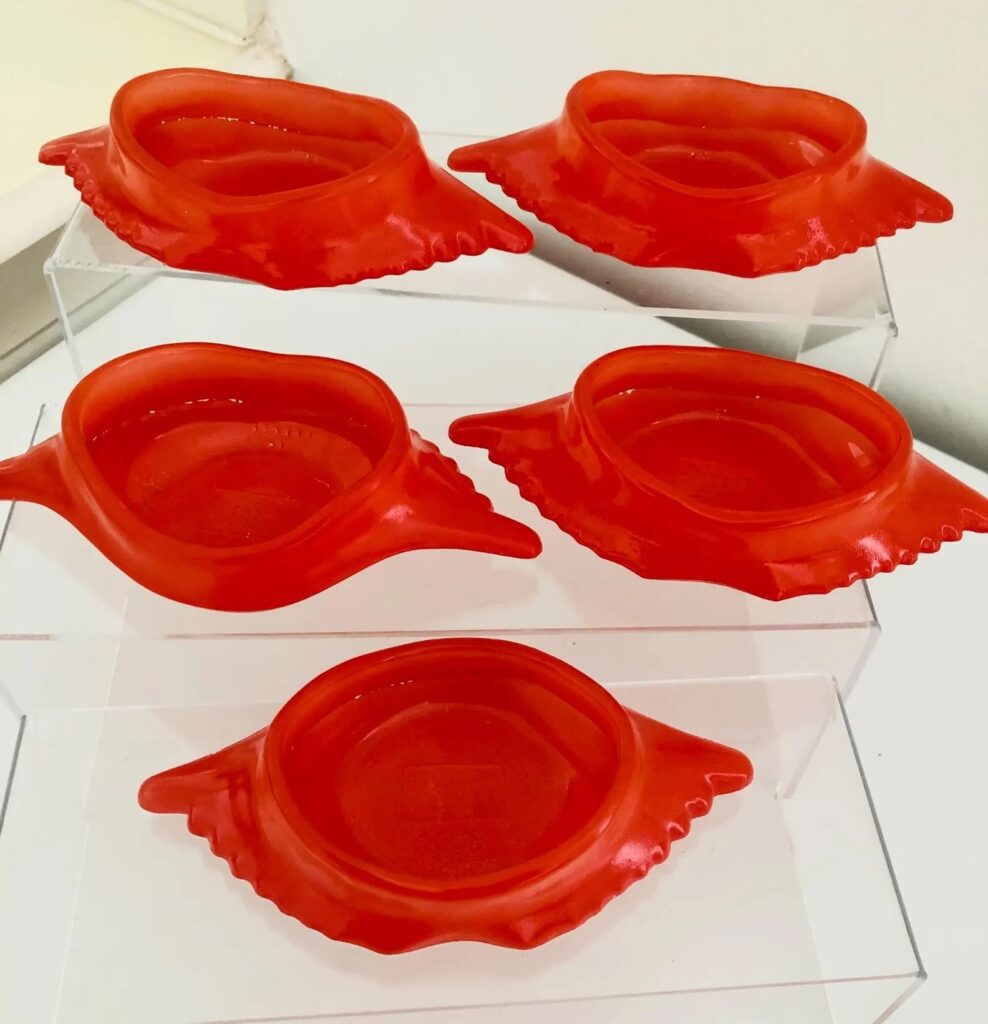
In the 60s and 70s, Glasbake made pieces with fired-on finishes including turquoise, pink, yellow, avocado green (of course) and peach. Like all vintage fired-on finishes, finding these with the colors still sharp and not faded by dishwasher desecration is a thrill.
Any post about Glasbake would be criminally neglectful if it failed to mention their mugs. There are so many. Some were made as regular kitchenware. Some were made as giftware. Many were made as advertising pieces. They are all awesome. Collecting Glasbake mugs would be a righteous hobby indeed.
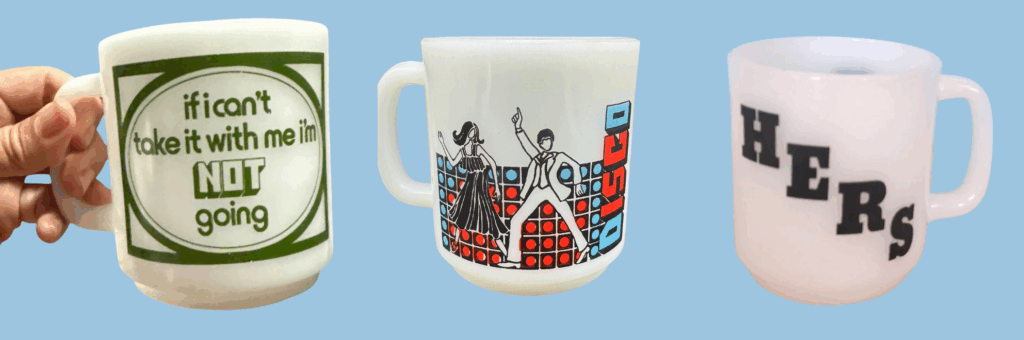
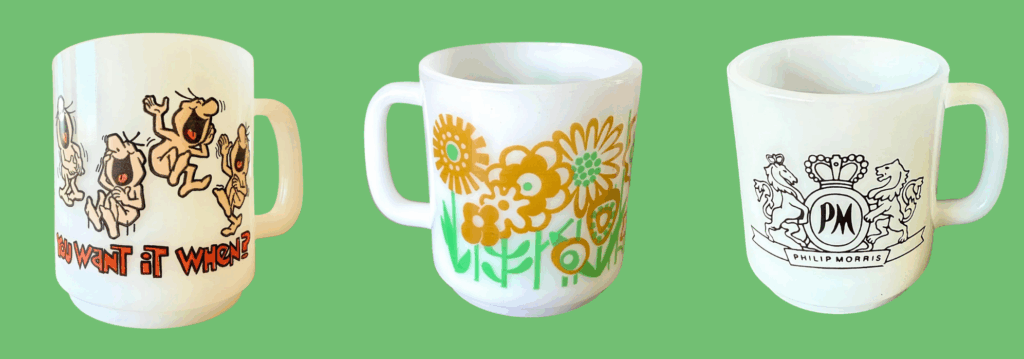
From the top left:
If I can’t take it with me mug from TheAddict on Etsy, $19.
Disco mug from AtomicPetes on Etsy, $175.
Hers mug from SconnieScores on Etsy, $12.
You want it when? mug from FancyLittleThrifts on Etsy, 24.99.
Floral design mug from TheTatteredShelf on Etsy, $14.98.
Phillip Morris advertising mug from AnniesOldStuff on Etsy, $15.
In the pecking order of resilient glass kitchenware, Glasbake lived in Pyrex’s shadow from inception until production ceased in 1983 when the mothership, Jeannette Glass, closed. Pyrex was always the queen. It continues to be the premium brand with the largest marketing budget and greatest distribution. Anchor Hocking’s Fire-King, introduced in the 1940s, owned the middle tier. Fire-King was often given out as a premium by supermarkets and gas stations, and carved out a solid second place in sales volume. Glasbake was the smallest of the three and was always the value brand. It was sold in discount stores, given out as a supermarket premium like Fire-King, and branded with advertising as promotional products.
Identifying Glasbake pieces is pretty easy because most pieces are marked. The early McKee pieces might also have “McKee” or “McK” in addition to Glasbake in raised letters on the base. Early Jeannette pieces have Glasbake and “Made in USA.” Later pieces may add a J- number, like J-235, to indicate the mold number. Pieces from the 1970s and 1980s might just have a J- number.
So now you know the history of Glasbake, a scrappy little brand that was never the top banana, but still made a mark on the kitchen history of the US and continues to make a mark on the vintage glass kitchenware collectibles market.



5 comments
Oh Laurie,
This is so much fun to view and read. Thank you. It is so wonderful that someone is honoring Glasbake. There are so many sweet designs and they deserve to be shown off. Hopefully someone will be inspired to compile enough info and photos to publish a book. I would be a buyer. I have never seen some of the mugs shown here!
I have been a buyer/seller of vintage and antique items for 35 years and have a love for glass and china. I am especially enamored with the local company items near Pittsburgh, cannons burg, New Castle, Jeannette Etc. I was born in McKeesport so am familiar with Glasbake and their whimsical patterns.
I have two J522 loaf pans with blue cornflower design that belonged to my grandmother. I am trying to determine their age.
Wanda, I’m not a Glasbake expert, but with some internet sleuthing I was able to find out that the J indicates it was made by Jeanette and that the blue cornfloweresque patterns were likely made in the 1960s, possibly the 1970s. There aren’t many specific pattern dates available for Glasbake like there are for Pyrex.
I just picked up 5 little Glasbake bowls. They are probably about 1/2 a cup. Each one has Glasbake on the bottom in a little ribbon. On top of the brand, there is a number, and under the brand name, there is a 77. All of the numbers above Glasbake are different. Any thoughts on what that means?
That is an excellent question. There isn’t much documentation of Glasbake products, but the internet is pretty sure that the Glasbake in a ribbon mark was used during the Jeanette period, likely between 1961-1983. Since “77” seems to be used by a lot of different products, it might be for a year? Or it could be a mold number that got reused and the second number is for the year? Sorry I can’t be more helpful.