The lore of the tiki culture and cocktails starts in the 1930s, a bleak time in America when the idea of escaping to a tropical island was overwhelmingly alluring. Hollywood churned out movies in the 30s and 40s that made exchanging your dreary, stressful life for a fantasy life in the South Pacific seem actionable. Tiki style was further embraced by Americans in the 1940s as soldiers returned from WWII with memories, souvenirs and stories about tropical landscapes. The 50s and 60s were boom years for tiki, especially after Hawaii became a state in 1959. People built tiki bars in their homes. Tiki bars and restaurants flourished. And through all those golden years right up to today, the Mai Tai was the reigning king of tiki cocktails.
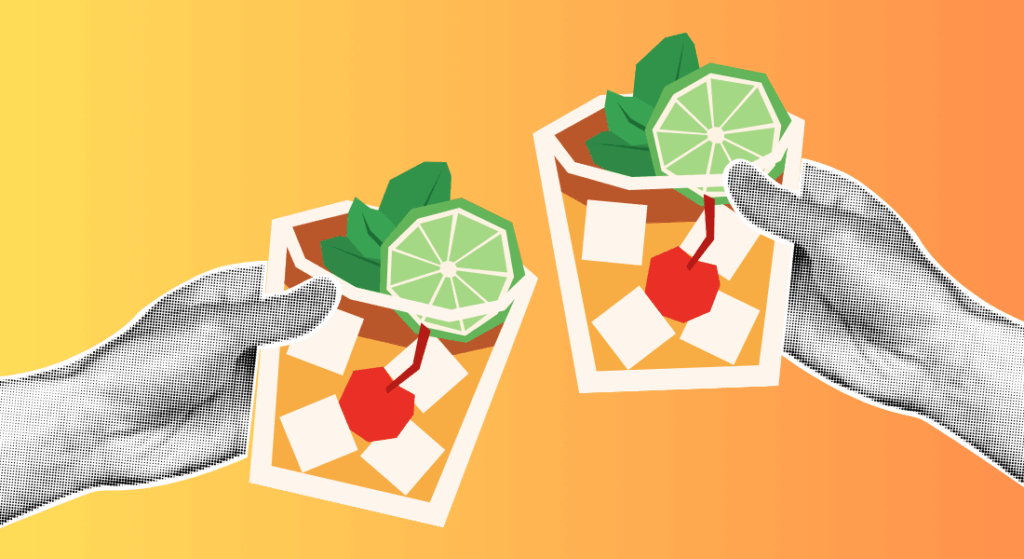
A basic recipe for the Mai Tai, adapted from the Tahitian “maita’i” meaning “good,” includes white rum, dark rum, orange curaçao, lime juice, and orgeat/almond syrup. Needless to say, there are gazillions of variations. But to get to the bottom of the Mai Tai origin story, you have to go back to the 1930s. Stay tuned, it’s going to get a little spicy.
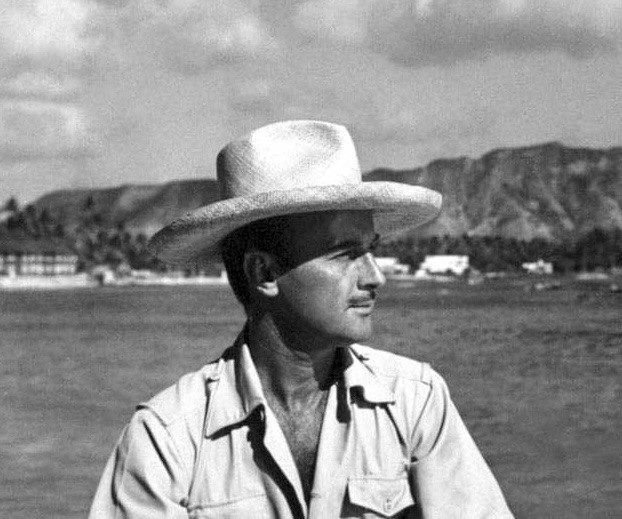
Donn Beach, aka Don the Beachcomber, opened his Hollywood tiki bar in 1933. Decorated with finds from his Caribbean travels, the vibe was mysterious and adventurous like a hidden Polynesian grotto that served exotic rum cocktails. Donn treated his cocktail recipes like state secrets, writing them in code in his bar manual. A reconstructed recipe for what he called the Mai Tai Swizzle has these ingredients:
- 1 oz Dark Jamaican rum
- 1 oz Gold rum (e.g., from Martinique or Puerto Rico)
- ½ oz Cointreau (orange liqueur)
- ¼ oz Lime juice (fresh)
- ¼ oz Falernum (a Caribbean spiced syrup with lime, almond, and clove)
- 2 dashes Angostura bitters
- 6 drops Pernod (anise liqueur)
- Dash Grenadine
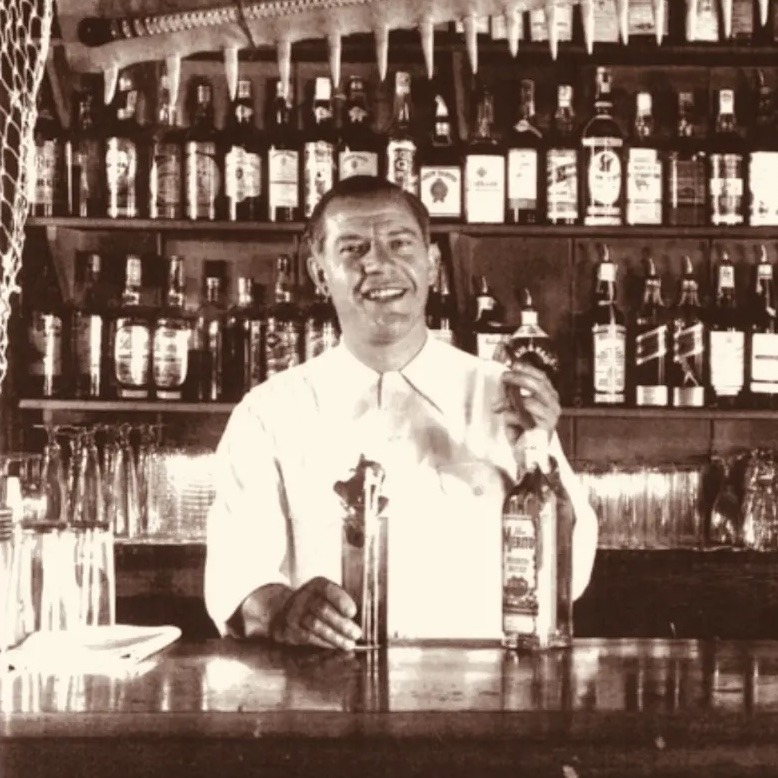
Meanwhile, Victor Bergeron aka Trader Vic opened his Oakland, CA saloon, Hinky Dinks, in 1934. Intrigued by the South Pacific fantasy, he visited master bartenders and tiki bars, including Don the Beachcomber, to learn the way of rum cocktails. Hinky Dinks became the Bamboo Room, which became Trader Vic’s. The atmosphere at Trader Vic’s offered a refined, escapist South Pacific style, very different from Don the Beachcomber’s grotto.
Trader Vic’s added a Mai Tai to his menu in 1944. The ingredients were:
- 2 oz 17-year-old J. Wray & Nephew Jamaican rum
- 1/2 oz Holland De Kuyper orange curaçao
- 1/2 oz French Garnier orgeat syrup
- 1/4 oz rock candy syrup
- Juice of one fresh lime (about 1 oz)
In comparison, Trader Vic’s version is simpler and takes less skill to make than Don the Beachcomber’s complex Mai Tai Swizzle. The taste is not the same either. I wouldn’t be making something that involves eight ingredients, drops and dashes, but I sure would order one in a bar.
However, the plot thickens. Don had a cocktail called the Q.B. Cooler on his menu that had complex flavors, but was more similar in taste to Vic’s Mai Tai. The ingredients were:
- 1½ oz Gold Virgin Islands rum
- ¾ oz Dark Jamaican rum
- ¾ oz Light Puerto Rican rum
- ½ oz Cointreau (orange liqueur)
- ½ oz Falernum (Caribbean almond-spice syrup)
- ½ oz Honey mix (equal parts honey and water)
- ¾ oz Lime juice (fresh)
- ½ oz Orange juice (fresh)
- 2 dashes Pernod (anise liqueur)
- 2 dashes Angostura bitters
- 1 oz Club soda (optional, to top)
Again, complicated with 11 ingredients, but was more interesting, and importantly close to the taste of Trader Vic’s.
That sets us up for the spicy bit–a beef between Trader Vic and Don the Beachcomber. Both men claimed to have invented the Mai Tai. And it was mostly a he said, he said for point of pride until Don the Beachcomber himself or an entity using his name licensed “Don the Beachcomber” to the Sun-Vac Company for use on a premade Mai Tai mix sometime between 1968-1970.
Trader Vic had trademarked, not copyrighted, the term “Mai Tai” in the 1950s, which gave his company the sole right to sell drinks and products under that name. The cocktail was never copyrighted because you can’t copyright a list of ingredients. (The original trademark has now expired.)
Naturally, Trader Vic took exception to “Mai Tai” being used and sued. Who he sued is unclear. The legal records are sketchy, the story relies on media reports and affidavits, so no one knows if he sued Don himself or the Sun-Vac company. Don maintained that the Mai Tai was copied from the Q.B. Cooler. Vic said the hell it was, it was his creation. There was apparently an out of court settlement, and it was decided that Vic had invented the Mai Tai.
To sum it up…Don the Beachcomber opened his restaurant first, serving rum cocktails. There is no question that Trader Vic was inspired by Don the Beachcomber’s cocktails, developed stripped down versions, and made the Mai Tai the famous drink we enjoy now. He remained adamant that the Mai Tai was his creation. Both men were responsible for sparking the rise of tiki culture and restaurants. And there is no dispute that Don the Beachcomber is the original and sole inventor of the Zombie cocktail, another tiki classic.
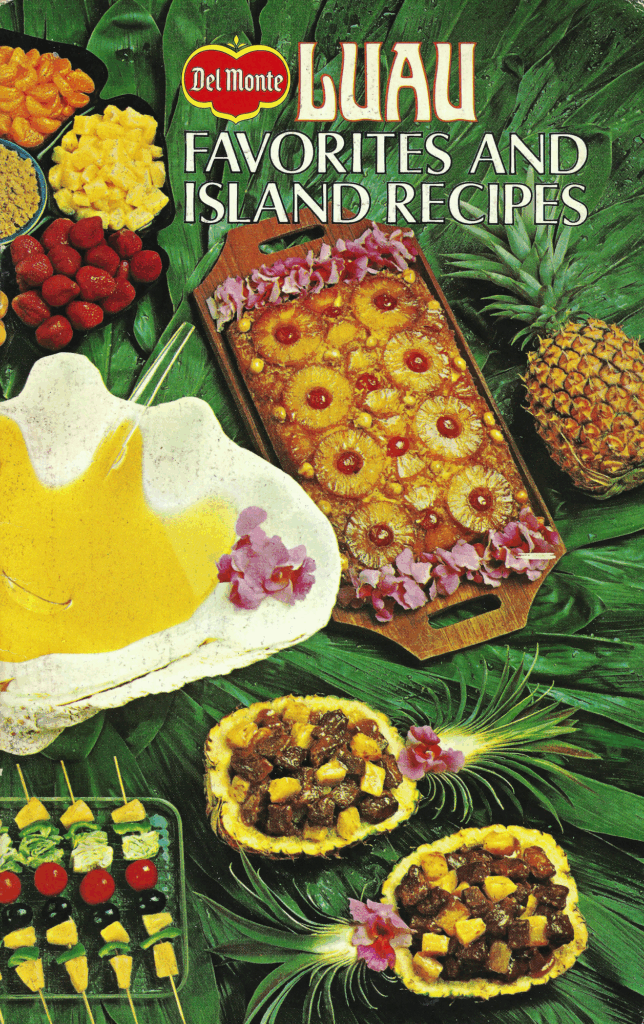
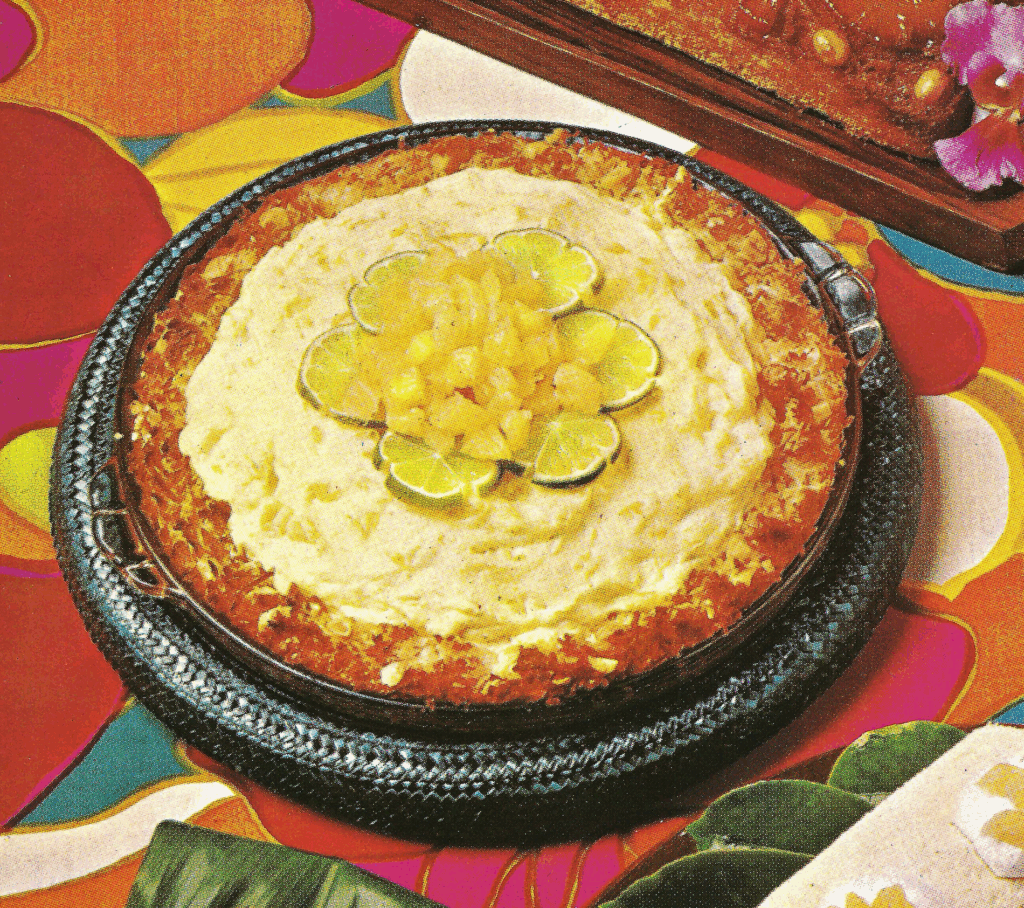
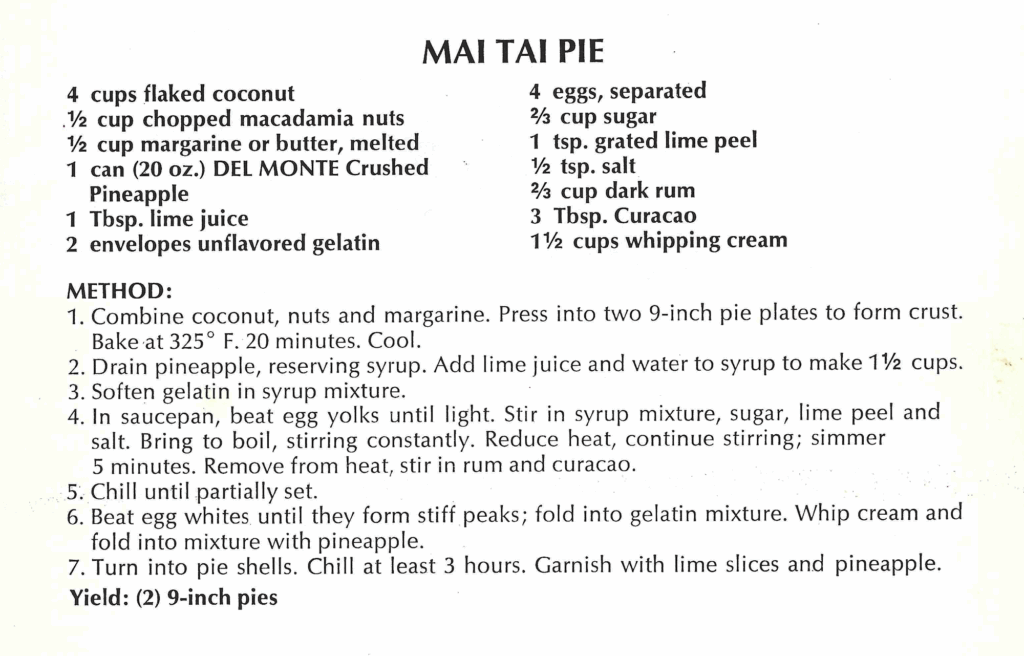
Although the wave of tiki style was waning in the 1970s, Del Monte, vendor of pineapple products among other things, produced the promotional Luau Favorites and Island Recipes (1975) booklet. It’s more Hawaiian than tiki, but among the recipes are a Mai Tai Punch and, more enticingly, a Mai Tai pie. People might say these are summer treats, but we disagree. We think the long bleak winter months deserve a pop of island-inspired flavors.
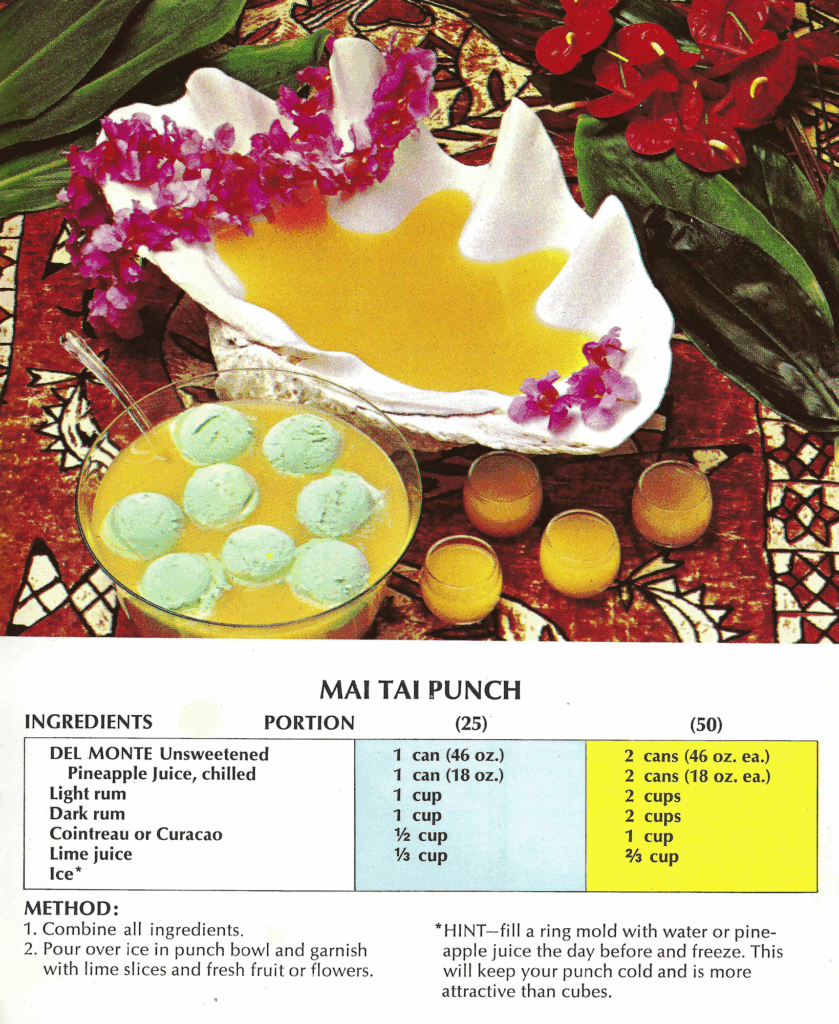
Note that the Mai Tai pie recipe is for two pies, cut in half for one. Or make two and hide one so you can eat it by yourself. Other note, instead regular egg whites, consider using pasteurized or reconstituted egg whites because in the recipe, the egg whites are not cooked.