
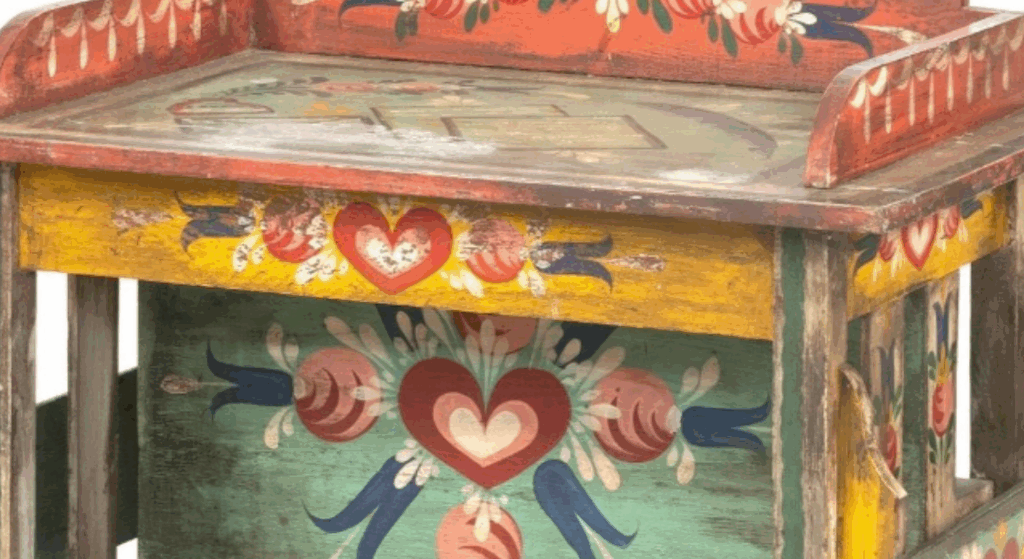
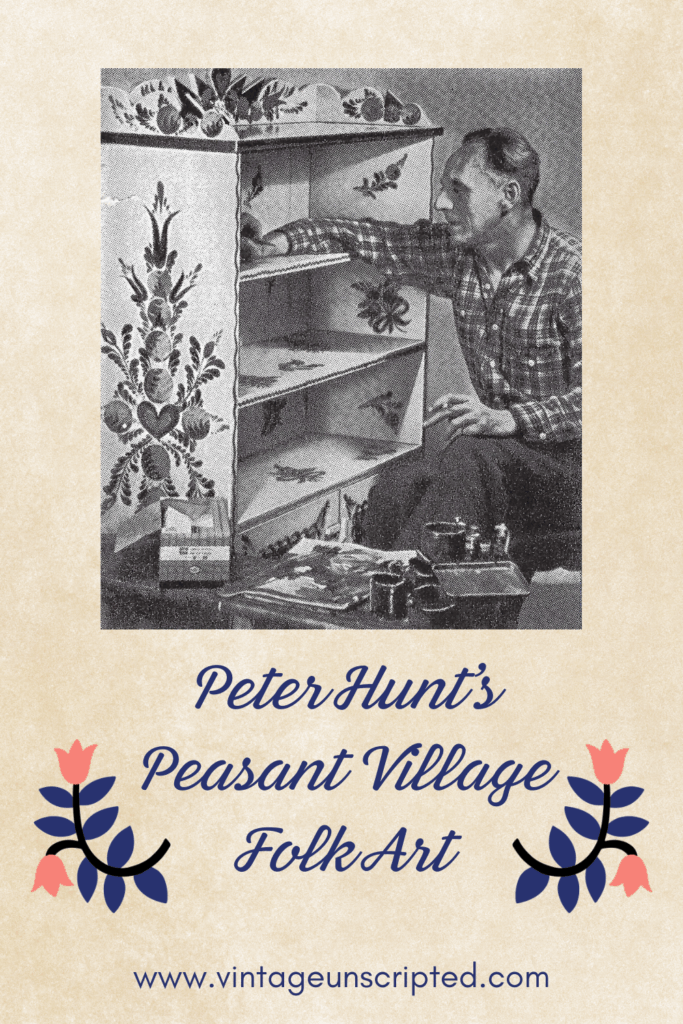
Upcycling furniture has moments. Recent moments are the chalk painting frenzy, and before that the funky colors/sponge painting craze. In the 1930s-1950s, the upcycling world was inspired by folk artist Peter Hunt, a charismatic self taught phenom who boldly refurbished old pieces of furniture into bright, colorful new designs and encouraged others to do the same.
Hunt, born Frederick Lowe Schnitzer in 1896, served in World War I. He moved to Provincetown, MA with his parents in the 1920s and reinvented himself as Peter Hunt, a folk painter and raconteur. Provincetown had evolved from a fishing village into a bohemian colony by the 1920s. Artists, writers and performers rubbed shoulders with Portuguese fisherman. Hunt opened a shop, which quickly expanded to several storefronts and a workshop space where he employed artisans to create his Peasant Village pieces. Called Peter Hunt’s Peasant Village, the shops had prime real estate on Commercial Street.
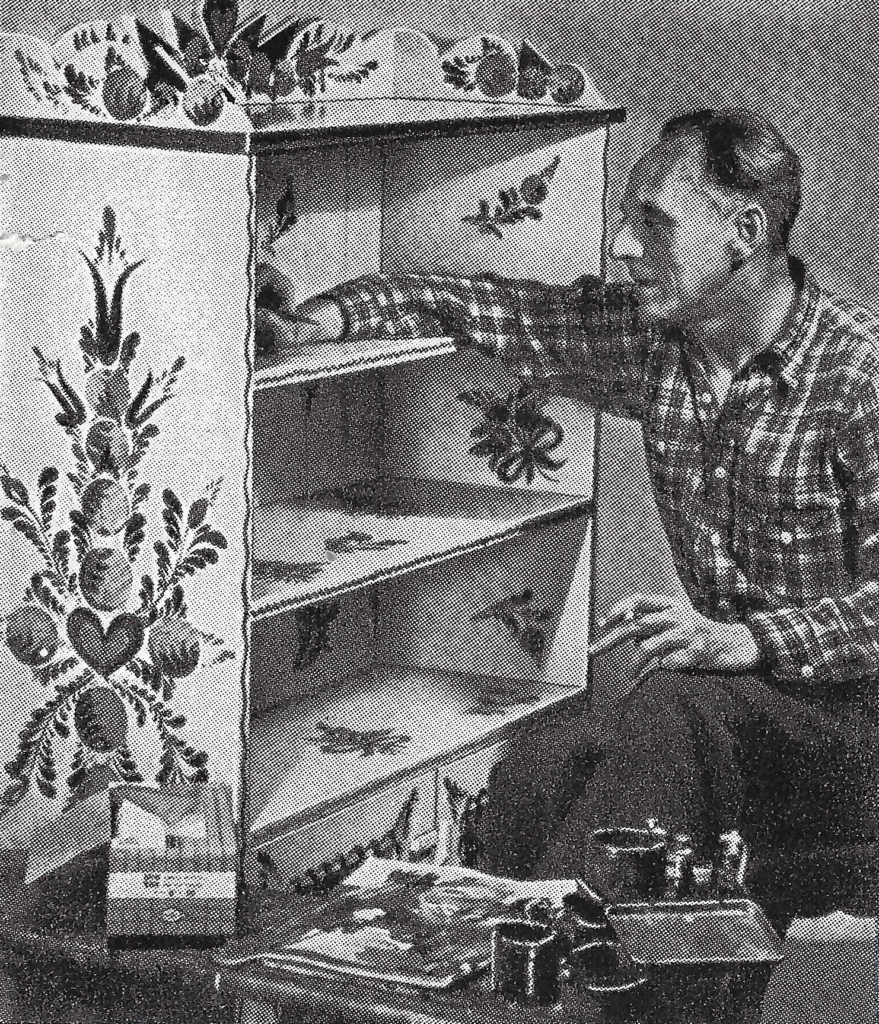
At the peak of his popularity, Hunt’s finished pieces were sold in fine department stores like Macy’s, Gimbel’s and Lord & Taylor, and were featured in popular home dec magazines. His fabulously flamboyant personality charmed socialites, who collected his pieces.
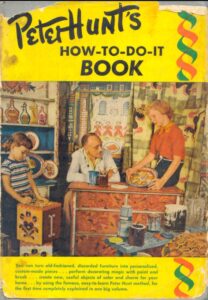 Artistically, Hunt’s mission was to make dull or outdated things charming, drawing inspiration from the folk art of the Pennsylvania Dutch as well as French, Scandinavian and Bavarian folk art, but giving it his own unique spin. Unlike some artists who carefully guard their style, Hunt encouraged everyone to give it a try, publishing Peter Hunt’s How-to-do-it Book in 1952. In a booklet called Transformagic (1955), he said “The important thing is to have fun! Let yourself go; enjoy it.”
Although Hunt’s style started a trend that had a good long run of popularity, by the late 1950s, it was a new era and people were moving on to different looks. Hunt sold his Peasant Village and moved down the arm of Cape Cod to Orleans, opening a gallery in his home called Peacock Alley, with spaces for other artists to sell their wares.
Peter Hunt died of a heart attack in 1967. His coffer was nearly empty and his fame had waned. That seems like a sad ending, but the upside is that his pieces have lived on and are treasured by a new generations of collectors.
Two interesting bits about those in Peter Hunt’s orbit. First, one of Hunt’s Peasant Village salesmen was the father of Alice Brock, owner of Alice’s Restaurant, made famous by Arlo Guthrie. And second, one of the artists who had a shop at Peacock Alley was well-known glass artist Bill Sydenstriker.
How to recognize a Peter Hunt piece
A signature is always the best case scenario. Peter Hunt signed many, but not all of his pieces. Pieces made by apprentices in his workshop will be signed “Peasant Alley.” Here are some other clues:
- bold, bright colors
- folk motifs like hearts, tulips and other flowers, angels, mermaids and roosters
- French phrases
- simple brushwork with no shading
- antique furniture under the paint, if it was made after the 1950s, it’s not his.
- appropriate aging
- sometimes you luck into a paper Peasant Alley label
Examples of Peter Hunt’s work
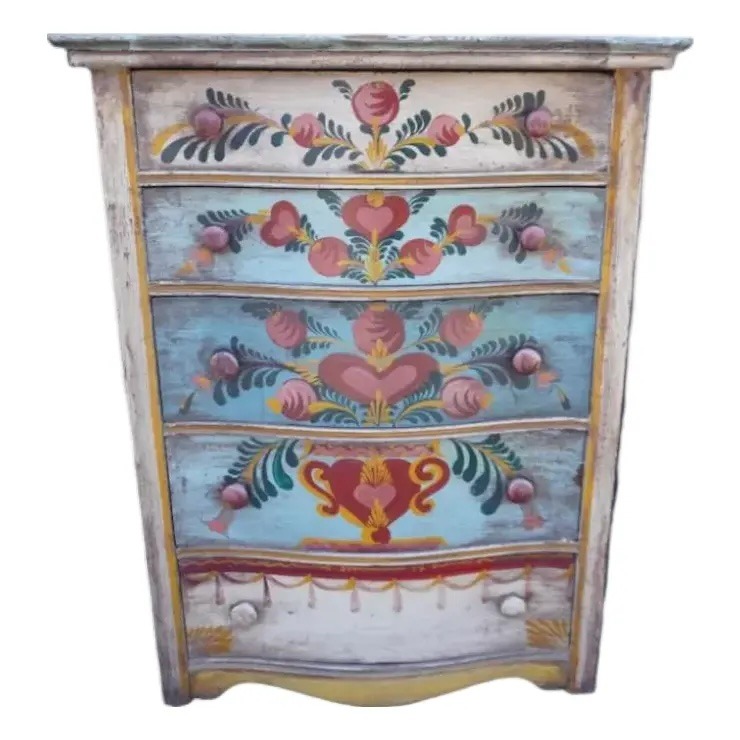
1930s dresser decorated by Peter Hunt, available from Early California Antiques on Chairish, $5040.
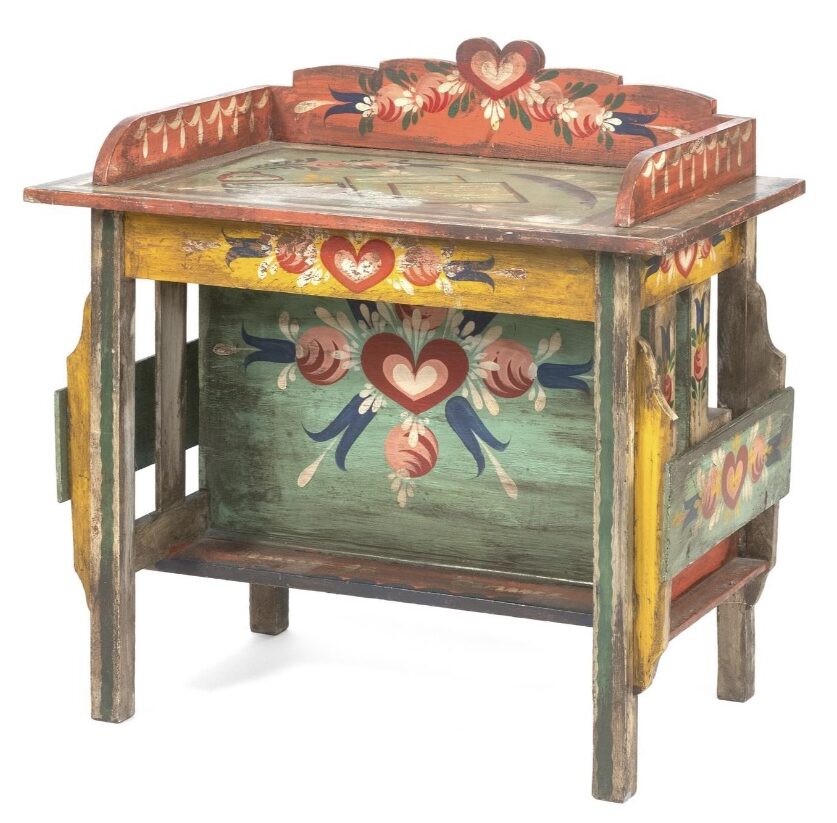
Peter Hunt school desk, sold in 2019 by Eldred’s of West Dennis, MA, $275.
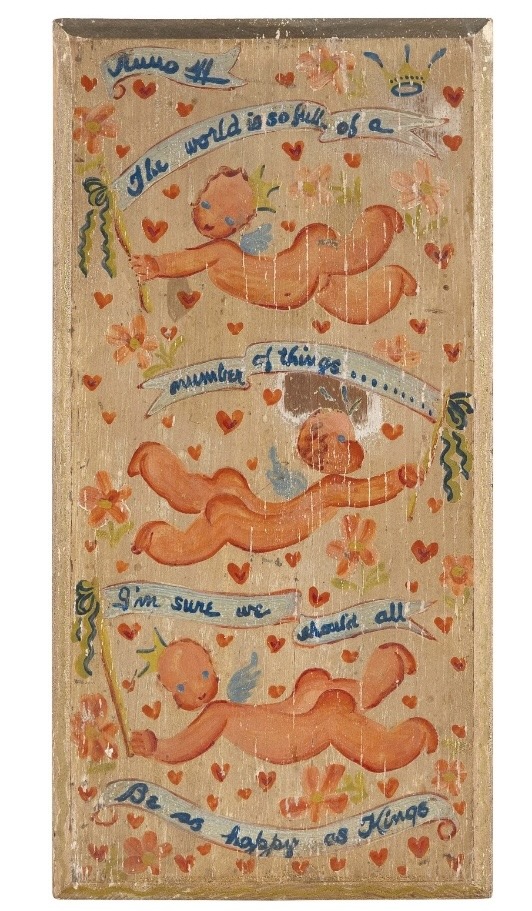
Peter Hunt painted panel, sold in 2025 by Eldred’s of West Dennis, MA, $150.
More reading:
Lynn C. Van Dine’s Peter Hunt website is captured in the Wayback Machine and was helpful in writing this post. There are many more details and lots of examples of his work.



1 comment
Thanks for sharing Peter Hunt’s backstory, Laurie. I am a huge fan of his work.