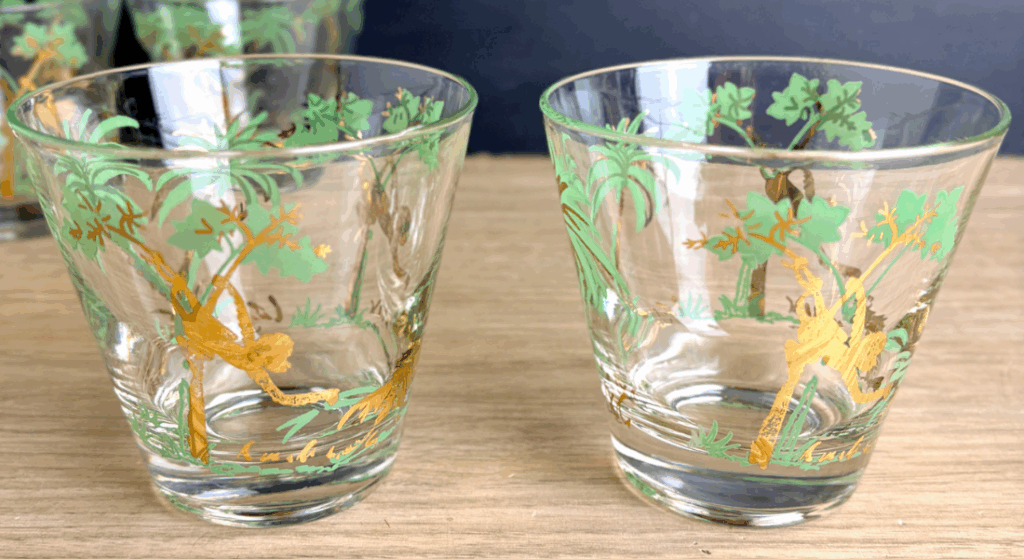
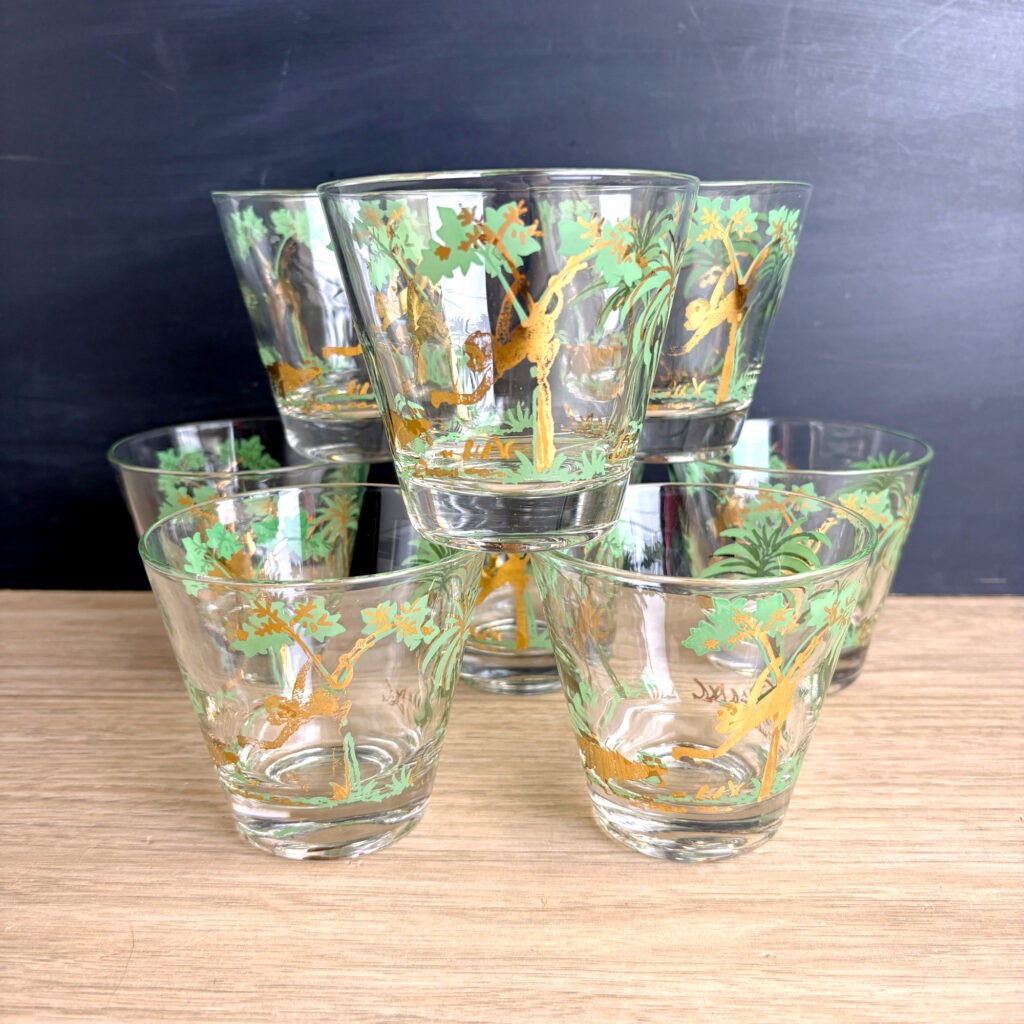
Being a vintage seller for 15 years, one thing I know is that you may think you have good knowledge, but there are many, many, many surprises out there to show you there is always more to learn. I picked up a set of gold foil decorated glassware with monkeys and palm trees and a maker’s mark of William A Meier. Excuse me. Who?
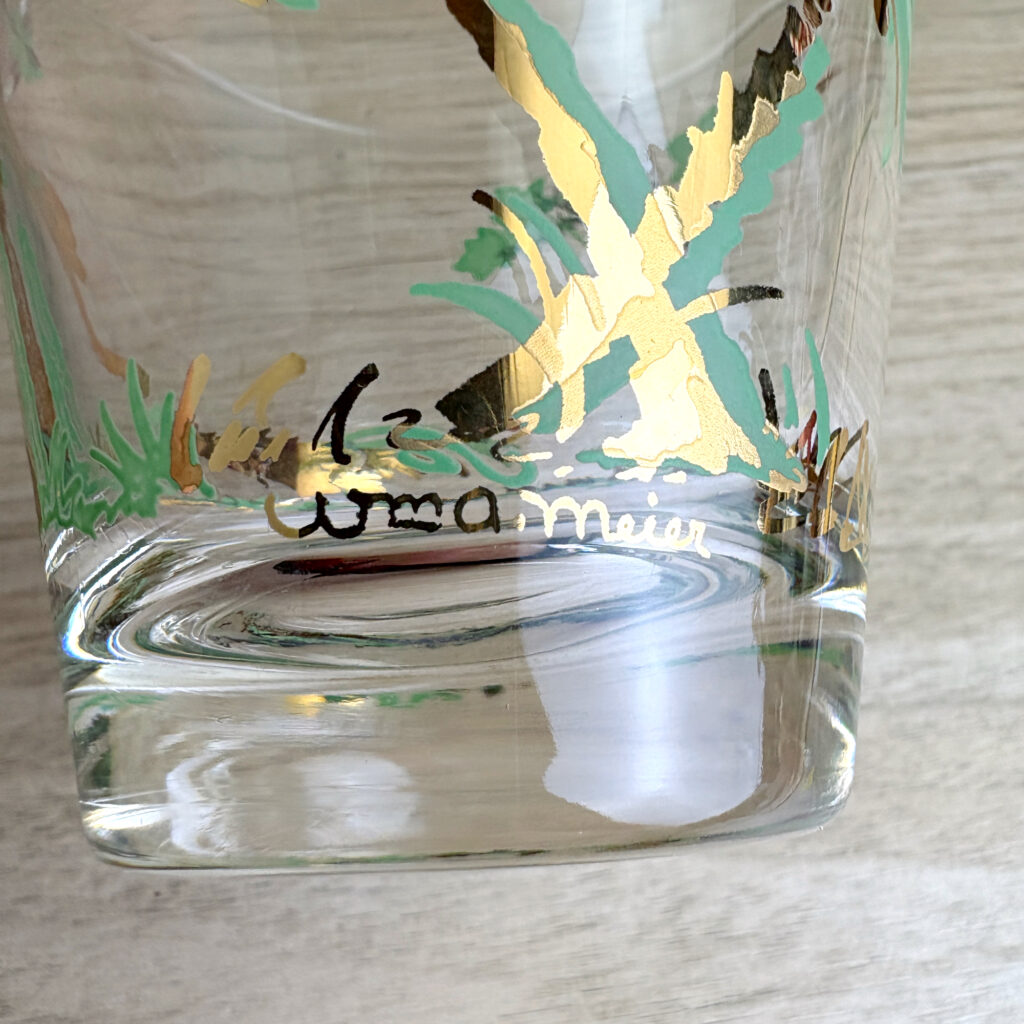
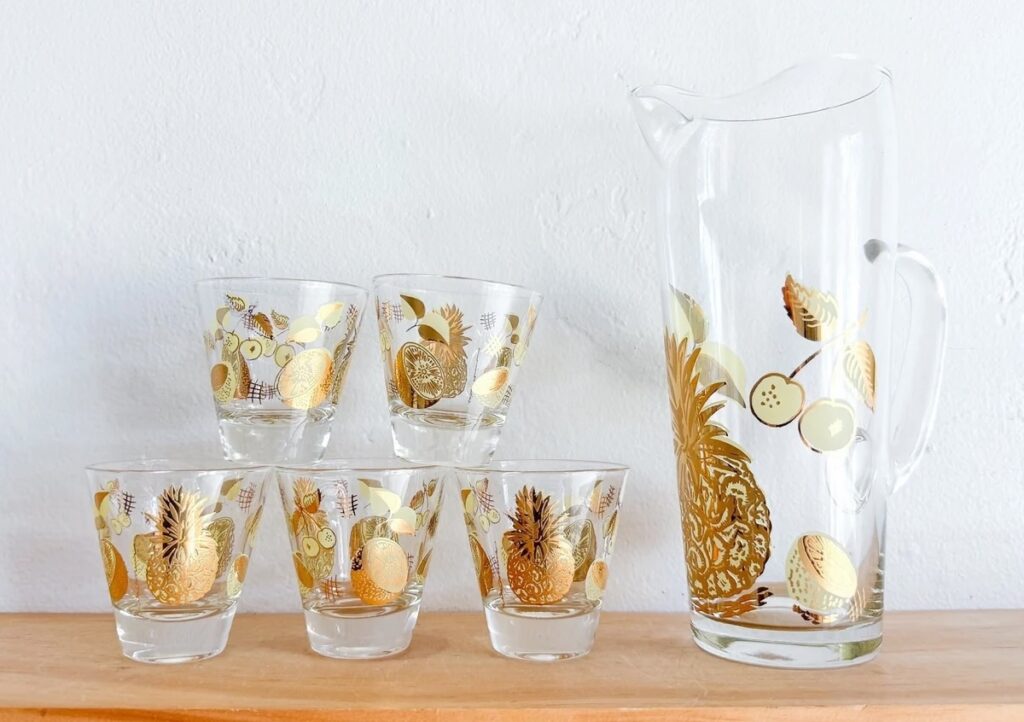
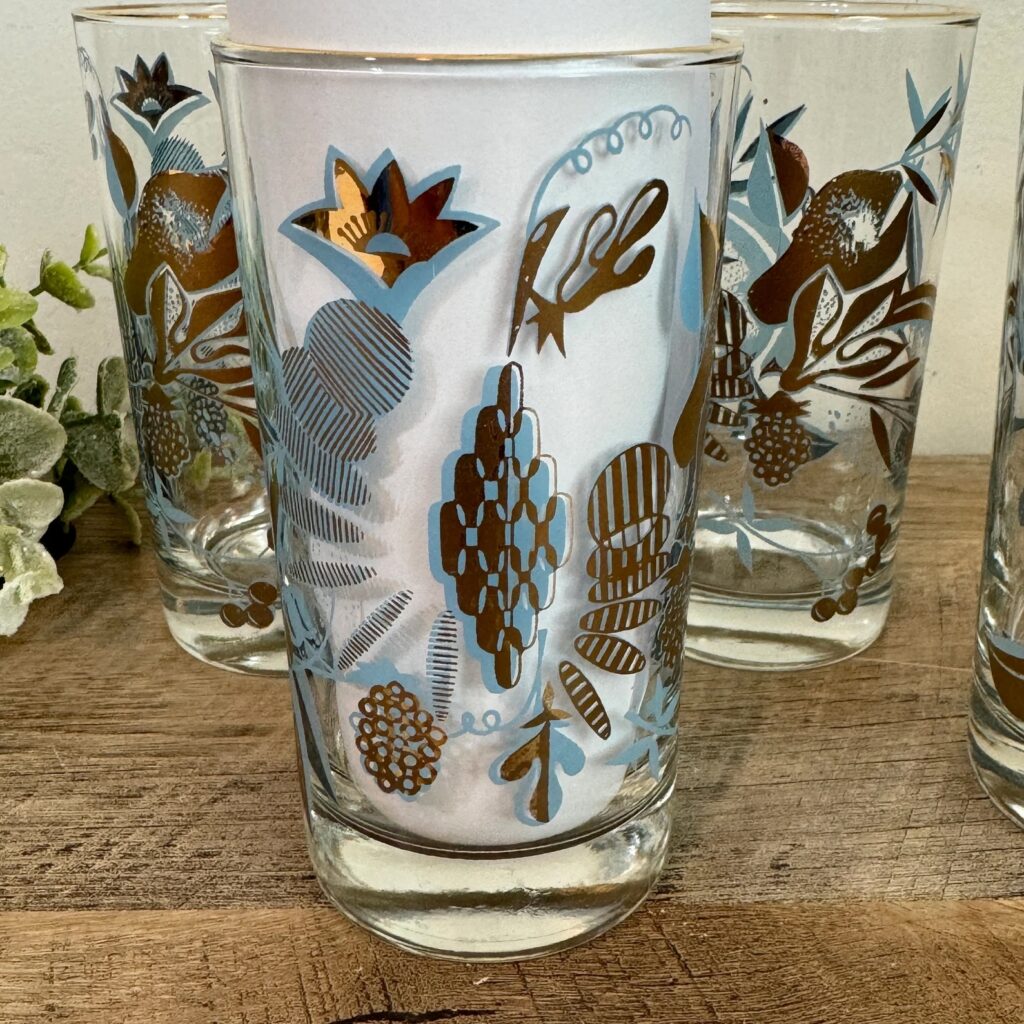
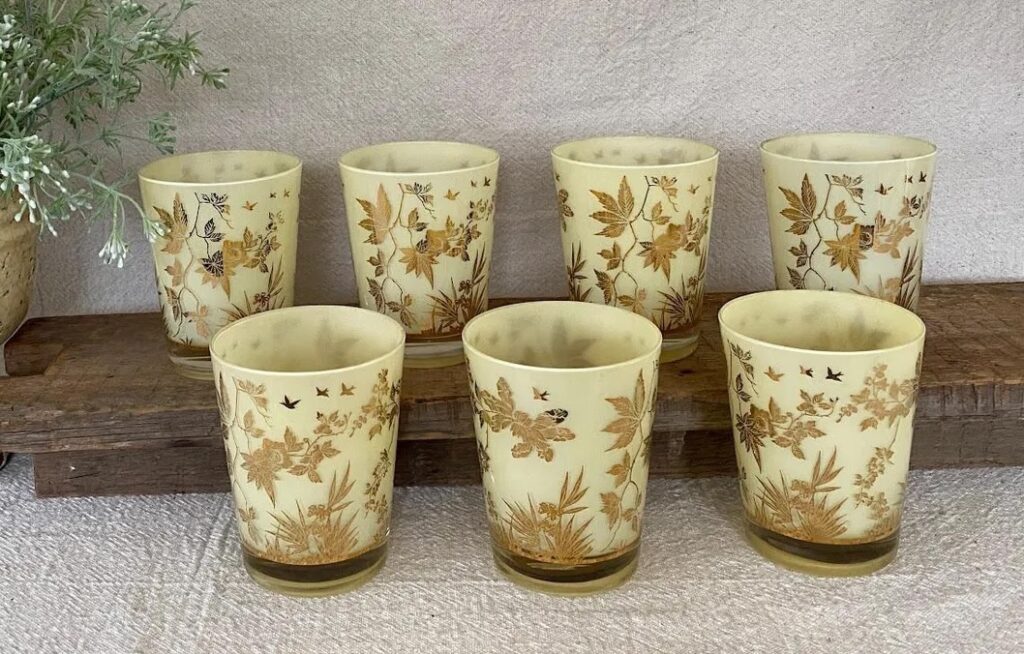
William A Meier was a maker of mid century barware: tumblers, old fashioned glasses, highball glasses, pitchers and more. Decorated in pastels with 22k gold foil, motifs included foliage, animals, starbursts and fruit like most of the other glassware from the same era.
The fancy names in mid century glassware, Culver, Fred Press, Georges Briard and Dorothy Thorpe, were sold in fine department stores like Neiman Marcus, Bloomingdales and Marshall Field’s, as well high end gift boutiques. William A Meier glassware gave buyers who didn’t shop at Bloomies a chance to enjoy the trend of bold gold decorated barware at a moderate price that didn’t empty their wallet. The line was sold primarily at chain department stores like Sears and J.C. Penney as well as gift stores. Chances are because it was a small maker, it was sold by regional distributors, so sales were concentrated in New England and the mid Atlantic.
Meier started his glass company in 1946 in North Rochester, PA. This is not surprising, because the area around Pittsburgh had been an established glass hub since the 1800s. It was an area that had everything you needed to make glass and, most important, a multi generational contingent of immigrant workers from Germany, Czechoslovakia, Belgium and France who were skilled glassworkers. The area continued to be an important glassmaking area until the 1970s, when globalization and automation led to companies closing.
The late 1940s through the 1950s was the peak popularity period for William A Meier. The company continued making glassware into the 60s under the direction of William’s son, Kenneth, but eventually faded into obscurity. It is still collectible and enjoyable, although it lacks the heavy gold encrusting of Culver, the minimalist aesthetic of Dorothy Thorpe and the wit of Georges Briard. It’s also much scarcer, so it’s a fine trophy for a mid century barware enthusiast to add to their cabinet.
Many companies have juicy stories, and William A Meier has one of their own in the form of a cautionary legal tale.
In 1948, William A Meier designed glassware with a continuous decorative rings just under the rim, made using a proprietary flame polishing technique. In the interest of selling the flame polishing service, the company mailed out samples of the loop patterned pieces to other makers, including Anchor Hocking, with the statement that the pattern itself was not to be duplicated. Anchor Hocking engineers visited the Meier factory to see the flame polishing, again under the understanding the pattern belonged to Meier.
Fast forward to a Pittsburgh glass industry show in January, 1949. Anchor Hocking displayed a pattern identical to the Meier loop pattern at a less expensive price, both undercutting and beating the Meier line to market. William A Meier was not amused. In 1950, they sued Anchor Hocking for “deceit and breach of confidential trust.”
When the case appeared before a judge in 1951, things got messy. Anchor Hocking moved to dismiss. The judge said “not so fast,” and allowed fact-gathering to proceed. It was going to be expensive and time consuming for both sides, which is probably why it appears the case was settled out of court since there is no final summary. It is possible that as part of the agreement, Anchor Hocking stopped making the pattern as there are no Anchor Hocking patterns with true loops.
Here’s the cautionary tale part: per the judge, William A. Meier did indeed have an novel pattern, new to the glass business, that COULD have been shielded by a design patent or a copyright, but instead of filing for one of those, Meier relied on secrecy and verbal understandings. Meier could have collected damages from Anchor Hocking for the period before they introduced their own version of the pattern, but once Meier produced and showed the pattern publicly, because the design as not legally protected, it was fair game for anyone.
It would be nice to have a photo of the loopware here. If you have a piece or find a photo, we’d be grateful if you shared it so we could add it here. We came up dry. Meier loopware is as rare as a two horned unicorn.
But we did find some fine examples of William A Meier mid century designs available now on Etsy.